by Scott McLeod | May 19, 2010 | 5 Questions, Blogging, DABA |
[I’m reviving my Blogs That Deserve a Bigger Audience (DABA) feature. If there is a blog that you think should be featured here, drop me a note.]
Today the Crimson Megaphone goes to Andrew Watt. Andrew is a history teacher at a small private boarding school in northeast Connecticut. He also is a level 1 USFA-certified foil coach, a NOLS-trained outdoor educator, and Chair of the Commission on Professional Development for the Connecticut Association of Independent Schools. I’ve been reading Andrew for a long time. His blog definitely deserves a bigger audience.
Blog: http://andrewbwatt.wordpress.com/
Twitter: www.twitter.com/andrewbwatt
Facebook: http://www.facebook.com/profile.php?id=603849193
Here are excerpts from 5 of Andrew’s posts to get you started…
The Mountain & Me
It is then that I realize that the girl is not having difficulty climbing because she’s tired, or slightly on the large side. She is having difficulty because she is acrophobic, and she is now two thousand feet above the surrounding countryside.
It doesn’t matter that there is a solid mountain of New Hampshire shist and quartz underfoot. It doesn’t matter that there is a crowd of people around us at all times. She is small, and afraid, and on top of a mountain.
Oh, and we are alone
…
I taught an acrophobe how to climb a mountain today, and how to come down again. One step at a time. In some ways it’s a wonder that either of us is still alive. In other ways, it’s how we always teach – one step at a time up the mountain, and one step at a time down.
Sometimes the students take the lessons to heart quickly, and sometimes they absorb them slowly. Sometimes they run on ahead and leave us behind so rapidly that we’re still catching our breath. And sometimes? Sometimes you’ve got to be the crutch, all the way up.
And all the way down.
I’m a Vested Interest
as my friend pointed out, those things that I’ll accept and those that I won’t allow make me a vested interest. I’ll fight tooth, nail, and claw to keep certain rights, push back against others, and expect radical change – as long as it does not really inconvenience me, wreck my tenure, or my pension, or damage my seniority.
That makes me a vested interest.
What Teachers Do
There is a strong desire to re-make American education from the top down, and the laws and grand grant programs of the last decade seem uniquely suited to carrying out that vision. The “little people” who stand in the way of that vision are going to be rudely pushed aside for a little while as those forces push for the logical conclusions of the programs.
But the other side of the coin is the real problem. We aren’t about to get some new educational plan out of all of this. There isn’t going to be some new tech-based teaching style and there isn’t going to be a massive shift to a new, progressive creativity-based approach in the classroom, with a lot of innovation in the classroom, and a lot of effort to institute change.
Because a lot of teachers just got scared for their jobs. A lot of teachers just got put on notice that they can’t negotiate, and they can’t argue, and they can’t dawdle or delay or fight back, even though they can’t afford to toe the line.
The Three-Fold Web
It’s not enough to teach kids how to use the web. We also have to teach them how to use books, as well. We have to teach students how navigate between multiple sources of information – some digital, some paper; some secondary, some primary, some tertiary; some books, some magazines, some weblogs. We have to teach them to express themselves in multiple modalities: giving up authorship control on wikis, claiming opinions for themselves on blogs, arguing formally in papers, chatting informally in podcasts, reporting impartially in newspapers, creating beauty in graphical displays; and standing up to present what they know in a way that showcases confidence, intelligence and poise.
And that means that I have to think of each student as enmeshed in a Three-Fold Web.
Setting Targets
one of the points that he makes is that it’s not enough to teach kids to think critically. And it’s not. I’ve been trying to get my kids to think critically for years, but that means observing the process of my own critical thinking – which is harder than licking your own neck.
I also asked Andrew to participate in 5 Questions…
1. Besides your own blog and Dangerously Irrelevant, what are 3 blogs that you’d recommend to a school administrator that’s new to the education blogosphere?
 2. What’s something that recently caught your attention from your personal learning network, RSS reader, Twitter feed, etc.?
I think the big thing that I see is that the teaching profession is starting to be "in-flux" in the same way that the recording industry started being in flux ten years ago, and the newspaper business started to be in flux three years ago. I meet teachers all the time now – both at my school and at conferences and in transit between other things – who are losing their jobs, or having to shift schools because their old school is undergoing re-assignment (magnet school to STEM school, STEM to magnet, public to charter etc). I don’t think schools are going to look like they do now in as little as five years, and the stuff that I see coming out of Clay Shirky, Dangerously Irrelevant, Seth Godin, Weblogg-ed, Moving at the Speed of Creativity, TeachPaperless, and The Tempered Radical suggest that teachers need to start thinking of ourselves as entities that may be teaching in five years, but disaggregated – that means fired – from traditional school environments.
3. What does ’21st century teaching / learning / schooling’ mean to you?
Increasingly, I think there’s a divide between those three things — teaching, learning and schooling. Teaching is what I do in the classroom, which is to try to impart an information-set to a group of students. Learning is what I and my students do together, in a digital environment. And schooling is all the rest of conveying social norms — don’t fight in school, don’t grab a girl’s private bits, this is how you play lacrosse, this is how you set a classroom or conference room in order at the end of the school day, and so on. I do a lot more schooling than I’d really like. I do think that the students who come to me are arriving less-prepared every year. I used to be able to assume some knowledge of ancient Greek myths in my classes, and an understanding of writing basics, and some literary exposure. It’s proving less true, and I do think that 21st century learning has to cater to an audience more influenced by movies and games and television than books and newspapers.
4. What is a special learning experience you had when you were in elementary or secondary school? What made it special and memorable?
My mother recalls that when I was in second grade, she was called to a special meeting. A teacher had given a quiz on the federal government, and many students had done very poorly. There was outrage and anger, because the teacher had given the quiz without providing any information ahead of time. The meeting was an opportunity for the teacher to explain that it was a pre-test, to find out what students already knew. A woman sitting next to my mother leaned over and said, "only one little boy knew all the answers. Your son. Why is that?" And my mother, startled and slightly unnerved, said that her uncle worked in Washington DC, and had hosted me for a long weekend as a visitor and guest, and had taken me to the Smithsonian and the White House and the Capitol. I remember the trip, and the places, but not the quiz, of course. On another occasion, when I was in fifth grade, I was recommended to a special science program, and I and another boy from my class got to spend a weekend at a mountain-top astronomical observatory run by the state department of education. We stayed up all night to watch the stars, learn the constellations and see the planets, and observe the moon through a telescope. In a dark basement room, we got to watch one of the first lasers available to students shine its red light through a cloud of chalk dust. A lot of my best educational memories are along those lines – unusual places and events in locations far distant from home, where experts taught me something new that I might need for the life that was ahead.
5. What impacts do you think ubiquitous wireless broadband Internet access would have on us?
I think that I’m already carrying the Library of Alexandria around in my pocket thanks to an iPhone and an iPad. Even without internet access on it, I carry around about 600 books in Stanza, Kindle software, and iBooks. If I had an SD chip reader that worked with either device, I’d carry around 5000 or so, just to demonstrate the power of this kind of device: an entire school library in the space-equivalent of a 3-ring binder! This kind of always-on firehose of information is seductive to students. I spend far more time policing Appropriate Use issues than I’d like, even in a class where they’re discussed regularly and openly. Yesterday a kid was watching a replay of a baseball game, two others were playing a game, and two more were "wandering vaguely", to use A.A. Milne’s prescient description of web-surfing. This is a class of seven kids! I think lecture-based learning is dead, unless we start including meditation and focus and willpower exercises in grades as low as 1.
Thanks, Andrew, for all that you do!
[Subscribe to all DABA blogs]

by Scott McLeod | May 18, 2010 | 5 Questions, Blogging |
[This is a new feature here at Dangerously Irrelevant, meant to help us get to know some edubloggers a little better. If you’d like to be featured sometime, drop me a note.]
Name: Lucy Gray
Blog: http://elemenous.typepad.com
Twitter: www.twitter.com/elemenous
Facebook: http://facebook.com/lucygray
Besides your own blog and Dangerously Irrelevant, what are 3 blogs that you’d recommend to a school administrator that’s new to the education blogosphere?
1. What’s something that recently caught your attention from your personal learning network, RSS reader, Twitter feed, etc.?
Possible changes to Ning have caught my attention recently on Twitter. It was fascinating watching the reaction unfold over Twitter. And it was enlightening to discover all the alternatives to Ning. One tool I’m interested in learning more about is Bloomfire; Clayton Christensen is on their team interestingly enough. I’m also just hearing about TEDxVolcano and I’m wondering how that turned out. I’m a fan of all things TED in general.
2. What’s something exciting that you’re working on right now?
For my current position I’m working on aligning digital resources to our science curriculum. In my copious spare time, I am working with Steve Hargadon to plan an online virtual conference on global education that will hopefully happen in November!
3. What is a digital technology tool that you can’t live without (and why)?
My iphone…It carries all my content and lets me capture interesting things and moments in my life with its video camera and still camera. Because of the plethora of apps, it’s many digital tools wrapped into one device!
4. What does ’21st century teaching / learning / schooling’ mean to you?
21st Century education means to me that we focus on the preparation of kids to be fully participatory in the world. There is no reason that kids can’t reach beyond geographical boundaries to interact with other, share knowledge and to think critically about real world dilemmas. It means that we are empowering students to take control of their learning to truly reach their collective potential.
5. How do (or would) you respond to someone who says ‘The kids know more about technology than I do. How do I handle this?’
I would reassure him or her that that’s okay, that the universe is not ending, and and would encourage this person to look at kids as a resource for their own learning!

by Scott McLeod | May 17, 2010 | 5 Questions, Blogging, DABA |
[I’m reviving my Blogs That Deserve a Bigger Audience (DABA) feature. If there is a blog that you think should be featured here, drop me a note.]
Today I am awarding the Crimson Megaphone to José Vilson. José is an educator, writer, poet, web designer, and activist. He has one of the most distinctive voices in the education blogosphere. His blog definitely deserves a bigger audience.
Blog: www.thejosevilson.com
Twitter: www.twitter.com/thejlv
Facebook: www.facebook.com/thejosevilson
Here are excerpts from 6 of José’s posts to get you started…
The Education Boogey-Men
the general conversations in education scare me. Deeply.
Some of these conversations make even the most seasoned administrators shake in their boots and question their own thought process, the most veteran and professional teachers more apprehensive about their pedagogy than they already are, and the most brilliant and inquisitive students feel like their whole spaces have no true security. The people we often refer to – the collective “they” – serve more as boogeymen than actual leaders of a people. We can name names like Joel Klein, Michael Bloomberg, Michelle Rhee, Arne Duncan, Barack Obama, Al Sharpton, et. al., but the minute they move, someone will eventually fill that position with more of this anti-people rhetoric. Furthermore, while these ladies and gentlemen attach their legacies to this work, there are hundreds of others behind the scenes who supplement these ideas, even unwittingly.
Frank McCourt and The Whole Teacher Respect Issue
A part of me feels that those of us in social services ought not to delve too deep in the realm of stardom as it detracts from the constituents you’re trying to serve. Yet, a larger part of me says that it’s about time teachers stop being relegated to fairy-tale movies, political ads, and instructional videos. All three of these forms of the teacher image do nothing more than limit the dimensions of the spheres of influences we have.
On The Reason Why You May Only Get One Black Male Teacher Ever In Your Life (If At All)
Many teachers of all races, backgrounds, sexes, and ages have come in the classroom and proven effective facilitators of learning for urban youth, and to a certain extent, that’s true. And if the children is learning (I know what I wrote), then I admit there’s much to be gained there. I love that so many people are concerned about the plight of urban youth that they’re this open to talking about it and making a difference in a field that really needs teachers regardless of background. Plus, I get that there needs to be a diversity of experiences for everyone, as they have to survive in the same world that everyone else does. A small part of me also thinks who better to teach urban youth the tools needed to survive in a predominantly White country than … White people.
But I’d be lying if I told you I wasn’t disturbed by the lack of representation of Black / Latino males as teachers.
The Vilson Manifesto
this is why I teach: not only is this a job for me, but it’s an understanding that I’ll pay forward what I’ve been given. There are teachers in our system who are case studies for the retraction of tenure, but the teachers I’ve had by and large not only made me the man I am, but gave up so much of themselves to be figures of inspiration for me. I did my end, working hard to achieve the heights I did, but when I got out of line, they disciplined me. When I needed the encouragement, I got it and tenfold. I remember their ability to make me feel like everything I had to say was important, and my thoughts mattered, and for someone with the aforementioned history, it means a million.
A Synopsis of the Road Less Wanted
Many of these children don’t really have a disorder, and it’s been proven that if you just talk to some of these kids like human beings, those disorders start going away. And even if they’re not getting mistreated for some disability, they’re getting mistreated in the classroom. Some people who don’t belong near a classroom but see the value in looking like they’re making a difference let their inherent classism and racism shine brightest and thus build mistrust for an education for kids who need it.
Whereupon I Might Encourage Bodily Harm to a Teacher
“He says we’re stupider than dogs.”
Say what?
“He said he can teach a dog quicker than he can teach us.”
My eyes probably went from an off-white glow to a bright-red blaze. Infuriated that any teacher would try to academically dehumanize students who I’ve had for years and known to be fairly astute, I envisioned pounding this imaginary teacher’s face in for kicks. I’m a peace-loving man and I’ve never met this teacher, but when we can’t differentiate between a student’s acts and a student’s humanity, that pushes me over the edge.
 I also asked José to participate in 5 Questions…
1. What’s something that recently caught your attention from your personal learning network, RSS reader, Twitter feed, etc.?
The biggest thing that’s caught my attention is that these students, whether extroverts or pretend extroverts, want desperately to find solutions for their classes and for the system as a whole. They’re looking to share as much as possible about the things they work for them, but without pretense or prejudice. It’s not just political talk; it’s about the pedagogy, and that’s awesome.
2. Besides your own blog and Dangerously Irrelevant, what are 3 blogs that you’d recommend to a school administrator that’s new to the education blogosphere?
3. What’s something exciting that you’re working on right now?
Right now, I’m working on advocating for the increase in racially underrepresented males (i.e. Black / Latino / Asian men) in the teaching profession. I’m also working within my school to synthesize and clarify the role of the math teacher in the next 4-5 years. As part of the Teacher Leaders Network, I’m seeing my work in the lens of local and national teachers.
4. What is a special learning experience you had when you were in elementary or secondary school? What made it special and memorable?
I’ve had plenty of learning experiences that I appreciated. My favorite one was reading "Roll of Thunder, Hear My Cry". As someone who didn’t really understand the racial divisions that existed and still exist, the book and the proceeding discussions planted the seed in me to examine those and fight for equity in this country. Part of that was becoming a teacher. (Though I teach math, and not ELA).
5. How do (or would) you respond to someone who says ‘We’d be moving forward if it weren’t for the standardized tests.’
A part of me feels like we need standardized tests. It’s hard to measure and compare our students as a whole if we don’t have assessments that measure specific items we’d like students to learn by a certain time. I do have to say, however, that our focus on standardized tests has been to the detriment of schools. The lack of diversity in equitable and sustainable models for examining student knowledge has limited the ability for all schools to push their students into this century as thinkers. Students can’t critically think if they’re just taught to manipulate multiple-choice questions and give a "proper" answer for an open-ended question.
Thank you, José, for all that you do!
[Subscribe to all DABA blogs]

by Scott McLeod | May 16, 2010 | 5 Questions, Blogging |
[This is a new feature here at Dangerously Irrelevant, meant to help us get to know some edubloggers a little better. If you’d like to be featured sometime, drop me a note.]
Name: Steve Dembo
Blog: www.teach42.com
Twitter: www.twitter.com/teach42
Facebook: www.facebook.com/teach42
1. What’s something that recently caught your attention from your personal learning network, RSS reader, Twitter feed, etc.?
Lately, I’ve been very focused in on the iPad, and many people in my PLN have shared some interesting insights with respects to it. It has become a tangible representation of so many polarizing issues, from 1:1 initiatives, to digital books (textbooks and otherwise), as well as the role of technology in education. While only a few are doing the exploring, the initial comments create conversations that ripple outwards, increasing in size and momentum as more and more people chime in.
2. Besides your own blog and Dangerously Irrelevant, what are 3 blogs that you’d recommend to a school administrator who’s new to the education blogosphere?
3. What is a digital technology tool that you can’t live without (and why)?
The iPhone. It has truly become my digital hub for an incredibly diverse number of things. I use it to read and respond to emails, both work and personal. I use it to manage my various calendars and to wake me up in the morning while traveling. It entertains me through movies and music, as well as serving as an e-reader in a pinch. I take notes on it, set reminders, and store my passwords there. I use it to log how many calories I consume each day and it connects to my shoes to keep track of how far I run (and have lost 25 pounds thanks to these two). While away from a WiFi network, I use it to provide internet to both my laptop and iPad. It keeps me connected to my instant messenger while away from my computer, and provides me with easy ways to keep up with Facebook and Twitter. It is my news reader, my digital camera, and digital photo album. I have ordered books with it and played music on it. I am playing Scrabble-like games with 15 people right now. It is my mobile reference stations as well as entertainment console. It is a distinct pleasure watching my son practice his letters, numbers, shapes and colors through the games I have provided him. / / Oh yeah. And it makes phone calls too.
4. How do (or would) you respond to someone who says ‘The kids know more about technology than I do. How do I handle this?’
I’d say that’s a wonderful problem to have. The key to remember here is that just because one knows how to use a application, program or piece of hardware, doesn’t mean they know how to do so effectively. When to use and when NOT to use it. What students may have in natural aptitude, they lack in experience. They may be experts at social networking, but don’t know where to draw the line. They may know how to edit video, but not how to use it to tell a compelling story. They may know how to create a Powerpoint, but not communicate their learning effectively. The main thing to keep in mind is that there is much more to an exemplary use of technology… than just the technological aspects of it. / / Educators don’t need to have more technical skills than the students. They need to be able to guide them into effective usage of those skills.
5. How do (or would) you respond to someone who says ‘Students have to learn the basics first. Only then can they work on 21st century skills.’?
In some sense I agree, but only to a point. The issue is when students are being directed to a point that the instruction becomes a shell that students are unable to break out of. For example, if you provide step by step instructions along with a clear description of what exactly you want the students to create, they will likely be able to provide you exactly the results you requested. However, change just one or two variables, and they will have extreme difficulty adapting. Part of 21st century skills is being able to look at problems analytically and determining the best course of action. When failure is encountered, being able to take it in stride, make adjustments and try from a different angle. In many situations, a heavy focus on what is known as ‘basic skills’ can be a detriment to the sort of flexibility students need to succeed in these situations. By focusing on the larger concepts instead of the basic skills, students are better equipped to be able to transfer the same ideas to new problems that they may encounter.
Thanks, Steve, for sharing your thoughts with us!
by Scott McLeod | May 13, 2010 | Blogging |
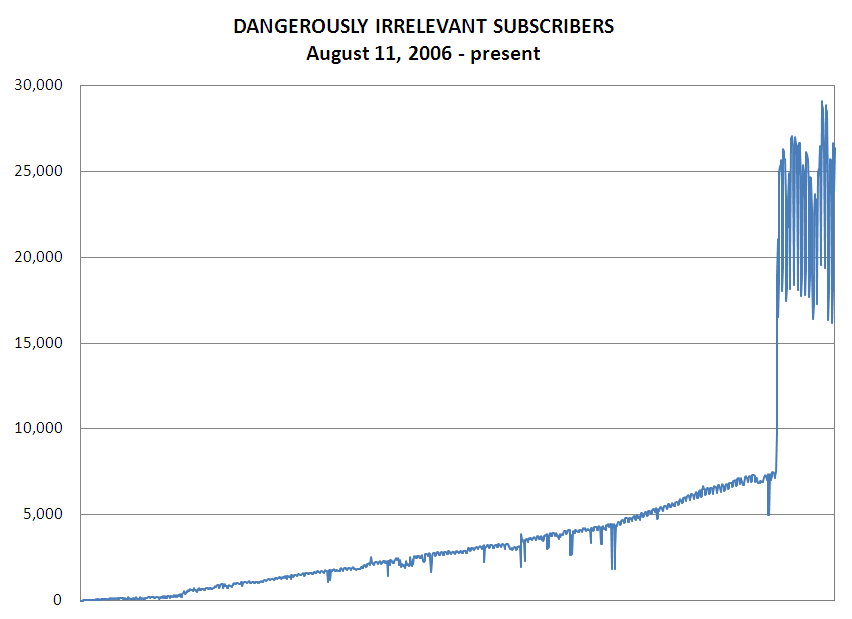
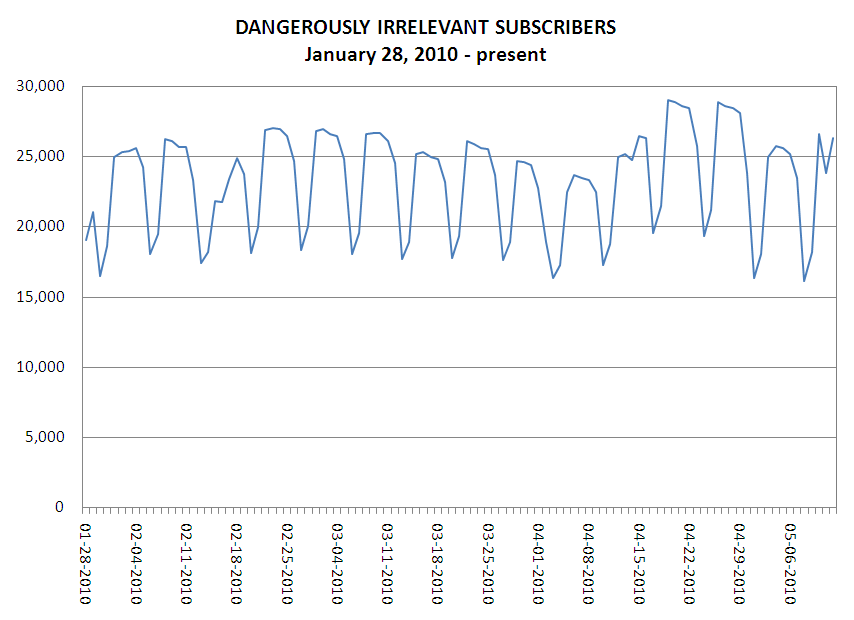
I commented back in January that I was confused about what was happening with Feedburner. I’m not sure that I have any greater clarity now than I did before. Here are two looks at my subscriber numbers. The first chart starts on August 11, 2006, which is the first day I started blogging. The second chart starts on January 28, 2010, which is the first day of the spike in my Feedburner statistics.
If anyone can make sense of these trends, particularly the waviness of the second chart, I’d love to hear your thoughts. What are you seeing with your own blogs?
by Scott McLeod | May 12, 2010 | Blogging, CASTLE, News and Events |
For those of you who haven’t noticed (yes, I’m talking to you, RSS subscribers), Dangerously Irrelevant now has a new look! I finally made the switch from TypePad to WordPress. Let me know what feedback you have about the new design…
I owe a HUGE THANK YOU to the folks at Foliovision. Alec Kinnear and his team were unbelievably fabulous from the very start. They were always responsive, incredibly patient with all of my questions, and did a great job of soothing my fears as I pondered the switch to the new platform (Are my internal links all going to work? What’s going to happen to my Feedburner feed? Am I going to lose all of my RSS subscribers?). The process couldn’t have happened more smoothly and I couldn’t be more happy with their work. They even sent me a shirt as a thank you!
If you’re considering your own move from TypePad, I recommend Foliovision highly; they’re one of the few places that specializes in that service. If you just want a new web site or need search engine optimization (SEO) help, I’m sure they’re great for that too. I still can’t believe they did what they did for the price that they charged me. There’s no way they made money off me. Did I mention they’re in Bratislava, Slovakia. I’ve never met them!
I’ll be rolling out some new features (as well as reviving some old ones) over the next few weeks. Stay tuned (and thanks for being loyal readers)!

by Scott McLeod | Mar 7, 2010 | Blogging, Miscellaneous, News and Events |
 It’s spring training for Major League Baseball and that means it’s time for another season of edublogger fantasy baseball! Last year’s champions, Vinnie Vrotny and Rick Heitmeyer, have their trophies and hopefully will be back to defend their titles (we had enough participants for 2 leagues last year). I shall return as well, hoping to improve on my annual late-season collapse.
Same rules and league settings as the two previous years. A trophy for the winner(s). Friendly banter, potential bragging rights, and loads of baseball fun could be yours!
If you’re interested, complete the BlogBall10 online registration form no later than March 21, 2010. First come, first serve. You must have an active education blog to participate. We’ll make as many leagues as we can fill. Opening Day is April 4!
by Scott McLeod | Mar 3, 2010 | Blogging, Communication, Higher Education, News and Events, Tech Integration, Videos |
Iowa State University held its second annual ComETS symposium a couple of weeks ago. Faculty, professional staff, and a few outside folks gathered together to talk about technology integration and implementation in higher education.
Building a community of practice through blogging
Below is my 10–minute ‘lightning strike’ presentation, Building a Community of Practice Through Blogging. I didn’t have my ‘A game’ that day and wasn’t as energetic a presenter as I usually am. I also spent too much time on the ‘creating a listening station’ portion and not enough time on the ‘participating in the conversation’ portion. That ratio was supposed to be 50–50, not 75–25. Despite all that, I think that the presentation came out pretty well and is a solid introduction to RSS and blogging communities for academics. Here’s a quote from my talk:
Most academics have yet to realize the power of social media. . . .
The reason we go to academic conferences is for the conversations. It’s not for the research presentations because you know how good those are. And it’s not to access the papers because we can get those in other channels. It’s to be around other people and have those conversations in the hall and after the sessions and at dinner and so on that solidify our relationships with people. Well, now we can have those conversations year-round. All we have to do is choose to be part of the conversation.
Extreme presentation makeover
My faculty colleague, John Nash, also gave a lightning strike presentation titled Extreme Presentation Makeover. He took some slides from our rejected UCEA presentation proposal and went to town. [Note to self: always present before John, not after, because he’s a hard act to follow!]. He also has a blog post about his presentation. Here’s a quote from his talk:
The other thing that we generally fail to think about when we give presentations is a call to action. What is it that you want someone to do after you’re done?
All of the symposium videos are available at the ComETS symposium web site and also are being uploaded to the ISU YouTube channel.
Charting our course: Exploring 21st century learning
Our keynote for the symposium was Malcolm Brown from Educause. Here are my notes from his talk:
"Improvement in postsecondary education will require converting teaching from a 'solo sport' to a community-based research activity." – Herbert Simon
Technology predictions v. course charting
The pace and scale of Internet change is unprecedented, so it's very hard to wrap our heads around it.
Every second 1,157 videos are uploaded to YouTube.
2.2 million e-mails sent every second
What Colleges Should Learn from Newspapers' Decline
iTunes has many academic lectures / lessons
So does Academic Earth
I love this line from the Kaplan University video: "?"
Funny thing about paradigm shifts: If we knew what the next paradigm was, we'd already be there.
Where is the student in all of this?
The opportunity is in increased student engagement [Do most profs at research universities really care about increased student engagement? If so, they haven't really showed it to date.]
How we learn, National Academies Press
Discussed the impact of the printing press
The 3 Cs of mobile computing
- Content – delivery, anywhere anytime, ebooks, etextbooks, etc.
- Collaboration – language learning, formative assessment, first-hand data collection, etc.
- Community – student authors, leveraging messaging, enhanced polling, etc.
Angela Maiers: We haven't invited our students to be creators or co-creators of content.
Malcolm just cited quick penetration of clickers as examples of higher ed moving more quickly on the tech front
'Some' is not a rebuttal
Expanding from those that already are technology-inclined to those that need to be
I think that all colleges and universities should have technology communities like ComETS at ISU and at University of Wisconsin-Madison. I said to Jim Twetten, who’s heading the ComETS efforts here:
I like ComETS because it's an opportunity to learn from other ISU educators, both faculty and professional staff, across campus who are doing interesting things with digital technologies. The annual ComETS symposium gives us an opportunity to intersect face-to-face in a variety of different ways. The ongoing ComETS listserv connects us and allows us to share and discuss in between symposia. We're off to a good start. Now the challenge becomes: how do we expand from those that already are technology-inclined to those that need to be? The latter group is much larger than the former…
You can see some backchannel conversations from the symposium by searching for the Twitter hashtag: #comets. Happy reading!
by Scott McLeod | Feb 23, 2010 | Blogging |
Continuing the conversation from yesterday when I asked “What’s WRONG with the edublogosphere?”, today I invite you to share what you think is RIGHT in our not-so-little edublogger world.
What’s right with edublogging?
(or, if you like, What’s right with the edublogosphere?)
Please share your thoughts, either in the comments area or as a post on your own blog (leave us a link in the comments area, though!). As Darren Rowse notes, this is a great opportunity to deconstruct the medium. Share whatever you want as long as it is positive. If you’ve got something negative to say about the edublogosphere, see the post from yesterday.
I’m looking forward to seeing your thoughts!
by Scott McLeod | Feb 22, 2010 | Blogging |
Darren Rowse had a brilliant idea to ask, “What’s wrong with blogging?” I think we should ask this about the edublogosphere as well. So…
What’s wrong with edublogging?
(or, if you like, What’s wrong with the edublogosphere?)
I invite you to share your thoughts, either in the comments area or as a post on your own blog (please leave us a link in the comments area, though!). As Darren notes, this is a great opportunity to deconstruct the medium and get some stuff off your chest that frustrates you about the edublogosphere. Share whatever you want as long as it is NOT positive (as Darren says!). Also, it probably would be more polite if you wrote about general issues rather than go after particular bloggers (if you must do the latter, go easy on me!).
I’m looking forward to seeing your thoughts. Note that tomorrow I’ll ask you what’s RIGHT with the edublogosphere!

 Today the Crimson Megaphone goes to Andrew Watt. Andrew is a history teacher at a small private boarding school in northeast Connecticut. He also is a level 1 USFA-certified foil coach, a NOLS-trained outdoor educator, and Chair of the Commission on Professional Development for the Connecticut Association of Independent Schools. I’ve been reading Andrew for a long time. His blog definitely deserves a bigger audience.
 2. What’s something that recently caught your attention from your personal learning network, RSS reader, Twitter feed, etc.?