It’s the first day of school (again)!
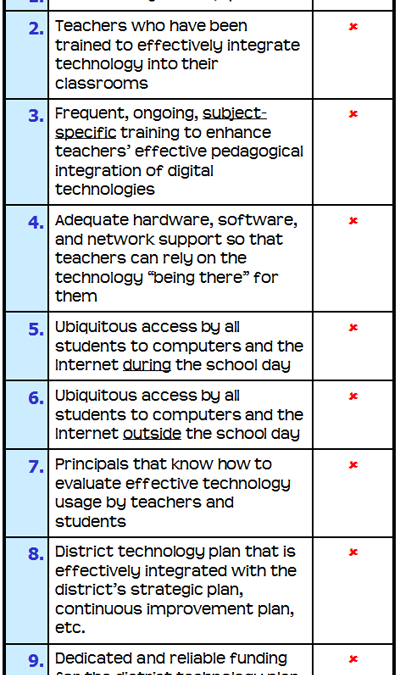
In honor of the first day of school here in Ames, Iowa, here is the checklist I posted last year at this time. Hmmm… I wonder if schools have made any improvements on this list over the past year?


In honor of the first day of school here in Ames, Iowa, here is the checklist I posted last year at this time. Hmmm… I wonder if schools have made any improvements on this list over the past year?
Earlier this month I featured a
report from the Communication Workers of America (CWA) as my
Report of the Week. Although I know that each of you
usually reads every comment on this blog (hah!), Beth Allen of the CWA left
a later comment that I thought was worth bringing to the forefront:
Hello all.
I am very interested in the challenge of articulating the vision as well.
I work with the Communications Workers of America, on the Speed Matters project,
which Scott kindly highlighted as a Report of the Week.We are in the initial stages of gathering real stories about how
universal, affordable broadband can make a real difference. Our research shows
that even people who don’t want broadband for themselves have a vague idea that
it is important for kids and schools and the future of education. We need to
move from the abstract to the specific.We are interested identifying educators who would be interested in
talking about their vision of what they could do if every child had home access
to a computer with a real high speed connection (think FTTH [fiber to the home]
with speeds of 30 mbps or more).We are also interested in getting kids to imagine the future – what would
they do or invent if everyone in the United States had a real high speed
connection. It might be the world’s most awesome video game. It might be a video
phone system so that they could communicate with their grandparents who live far
away.If any of you are interested in participating in one of these projects,
drop me a note at http://www.speedmatters.org/contact.html
Anyone willing to talk with Beth? If so, drop her a note! For what
it’s worth, Beth, here is what I’d talk about:
[cross-posted
at the TechLearning blog]
A few back-of-the-envelope
calculations here (estimating conservatively when in doubt)…
A. Number of students and teachers
50
million public school students
+
3.3
million public school teachers (full-time)
=
53.3
million teachers and students
B. Cost per laptop (a regular laptop, not the OLPC laptop)
$1,993 average district cost per client computer per year [from the three One-to-One CoSN Total
Cost Per Ownership (TCO) Case Studies]
x
1.5 (I’m adding 50% just to
err on the safe side)
=
$2,990 average district cost per client computer
per year (let’s call it $3,000)
C. Total cost to give every student and teacher a laptop
53.3 million teachers and students (see A above)
x
$3,000 average
district cost per client computer per year (see B above)
=
$159.9 billion
(let’s call it $160 billion)
D. Gross domestic product (GDP)
$13 trillion (United States GDP, overall)
x
3.4%
(percentage of United States
GDP spent on K-12 education)
=
$442 billion (amount
in United States spent on K-12 education)
E. Percentage of GDP
$160 billion (see C above)
/
$442 billion (see D above)
=
36% of the overall United States K-12 education expense to
give every teacher and student a regular laptop
$160 billion (see C above)
/
$13 trillion (see D above)
=
1.2% of the overall United States GDP to give every teacher
and student a regular laptop
Obviously this is very rough, but hopefully it’s also thought-provoking. It
is highly possible that my numbers are incorrect somewhere. If you think I left
something out or miscalculated, let me know. Also, of course, opportunities for
savings abound (e.g., open source software, bulk discounts, buying OLPC laptops
instead of regular ones) and those would have to be factored in as well.
So can we afford to give every child (and teacher) in America a laptop? You
tell me…
Internet access in developing countries can be prohibitively expensive and
cumbersome (e.g., thousands of dollars per month for speeds that often are less than dial-up).
Now imagine if someone identified a wealth of high-quality educational materials
on the Internet, downloaded them using web site ‘scraping’
software, and then made them available on an inexpensive hard drive that could
be plugged into an existing server network. All of a sudden, individuals could
access many of the incredible resources on the Web quickly, easily, and cheaply,
without consuming expensive bandwidth. Can you imagine how empowering that would
be?
‘The Internet
in a Box.’ That’s the idea behind the University of Iowa eGranary Digital Library
project, which is making web sites, books, journals, and educational software
available to universities, schools, clinics, and libraries in the developing
world. This is a pretty nifty idea (and I’m not just saying this because I’m a
U. Iowa alum). I encourage
you to check out the eGranary fact
sheet, content
catalog, list of
subscribers, and other
materials.
I wonder how this could intersect with the One Laptop per Child initiative. Also, wouldn’t it be a great school project to raise money to buy these for some institutions in other countries?
I just ran across this Alan November post on the ‘laptop lashback.’ Here’s a great quote:
Teachers have not changed the way they teach. We are using $2,000 pencils.
Also, check out Comment 3…
A couple of weeks ago I posted about U.S. Secretary of Education Margaret Spellings’ ed tech woes. Apparently now she wants to hear from YOU. Please give her your thoughts and opinions. Who knows? Maybe someone will actually listen (and, if you believe that, I got a bridge to sell you…).
A couple of additional thoughts:
I previously posted about wireless technologies in less developed nations. Kofi Annan supported this view nearly 4 years ago! One cool indigenous Wi-Fi innovation, is the Cambodian motoman. Here, motorcycle drivers equipped with with Wi-Fi contraptions, drive past schools and health centers to download and retrieve email.
"As they pass each school and one health centre, they transmit the messages they have downloaded and retrieve any outgoing mail queued in the school or health centre computer, also equipped with a similar book-sized transmission box. They then go on to the next school. At the end of the day they return to the hub to transmit all the collected e-mail to the Internet for any point on the globe."
Less developed nations are indeed making strides to leapfrog old technologies. This leapfrog effect can be seen in education, health care, information, energy, economies, and more. Thomas Friedman wrote how globalization has essentially created a ‘flat’ world. The globalized processes Friedman refers to have really made possible the leapfrog effect.
The question remains, how will these nations tap into digital possibilities and genuinely leapfrog industrialized nations?
Wired magazine ran an interesting story in their April 2007 edition about an entrepreneur in the Ivory Coast who bought a cell phone, rigged up a ‘telephone booth’ and earned $200 the first month charging community members 80 cents per minute. The same man bought a PlayStation and charged 10-20 cents to play a game earning him $20 in the first three days!
I mention this story because with ICT in international development, there is much promise and a lot of the best solutions are indeed indigenous (Thanks John). A main role for ICT4D planners and policy makers is localizing technology to the needs of the community. This is evident from my experiences in Cambodia where outside experts were not in touch with the needs of the teachers yet some teachers simply found applicable ways to use the skills that were outside of the scope of the training.
ICT has promise in the less developed world. However experts from more developed countries have the onus to not just plop ICTs into a nations without thinking about localization and sustainability. After all, development is not about giving fish, it is about teaching others to fish for themselves!
The Networked Readiness Index measures how prepared countries are to tap into the power of ICTs by focusing on the readiness of the environment and stakeholders as well as measuring the usage of stakeholders. You can read parts of the 2006-2007 Global Information Technology Report here.
The top ten nations are:
The bottom ten nations are (position 113-122):
Take note that the U.S. is seventh while European nations dominate the top ten. Eight out of 10 of the bottom entries actually lost positions and fell in their rankings while six of the top ten entries gained ground and improved their NRI.
The nations that gained 10 or more position are Dominican Republic, Costa Rica, Croatia, Guatemala, Ecuador, and Guyana. The nations that lost 10 or more positions are Cyprus, Pakistan, Jordan, Botswana, South Africa, Egypt, Kazakhstan, Armenia, Uganda, Cameroon, Mozambique, and Zimbabwe.
Since nations in Europe are dominating this list with regard to the NRI, some nations in South America are making great strides upward, and some African nations are falling further behind, what does this mean for educational development?
I give you this background data because I am often asked about the future of ICT4D and the ability of less developed nations to really embrace ICTs. In general the pressing issues for the near future of ICT4D as I see it are:

Minnesota is used to being at the top. Our accolades include being one of the best states in the country in which to raise a family, being at the top on child and adult health measures, and being one of the highest states in terms of adult educational attainment. The state consistently is at the top when it comes to academic achievement on national and international tests as well. But when it comes to K-12 technology we’re not doing so well.
Last year Education Week gave Minnesota a D when it came to K-12 technology policy and practice. This year its annual Technology Counts issue bumps Minnesota up to a C but notes that the state is still below the national average. Here are some of the relevant tables from the Minnesota report (click on each for a larger image):


You can see from the charts below that we lag the nation as a whole when it comes to closing the digital divide (click on each for a larger image). On average, our poor and/or minority students have less access to instructional computers than do similar students in other states.


How did your state do? Visit Education Week to find out.
multimedia textbooks: A strategic investment
multimedia textbooks: Follow-up