Video – 21st century education in New Brunswick, Canada
A new video from New Brunswick, in the Did You Know? (Shift Happens) style. Well worth a watch!

A new video from New Brunswick, in the Did You Know? (Shift Happens) style. Well worth a watch!

Okay, I think I’ve got this figured out, at least for now…
I use five primary tools to post content and resources to the Web:
I’m now using TwitterFeed to feed everything from Dangerously Irrelevant, Mind Dump, Delicious, and Google Reader to Twitter and Facebook. Everything that goes through Twitter also is sent automatically to LinkedIn and Google Buzz. So if you’re following me on Twitter, Facebook, LinkedIn, and/or Google Buzz, you should see everything that I’m sharing out. And, of course, many of you have put Dangerously Irrelevant and/or Mind Dump in your RSS readers (thank you!).
 I could use Evernote for sharing publicly but instead I use it to archive things that need to be more private than Mind Dump (such as meeting notes, my highlights from Kindle books, and the HTML coding for my web sites). I also use other social media sites such as Flickr, YouTube, and Vimeo but I share their content through my five main channels above.
The Shareaholic extension for Google Chrome makes all of this much easier. It also allows me to post items to Digg, Yahoo Buzz, StumbleUpon, Reddit, Mixx, and other aggregation / sharing sites as desired.
The feeds for Dangerously Irrelevant, Mind Dump, Delicious, and Google Reader all have been run through Feedburner so I can monitor RSS subscribers. I set up TwitterFeed to run everything through bit.ly so I can track how often items get retweeted. I also am using Google Analytics.
For those of you who are interested, here are the URLs and RSS/email feeds for my five main channels:
And here are some of my other sites, including the folders that I share from Google Reader (so you can read what I do!):
I think I’ve got all this set up so that there’s no duplication in any one place. For a while there, for example, I was posting the same resource more than once in Facebook. If you notice any future duplication, please let me know.
Is there anything I’m missing, forgetting, or also should be doing?
Happy reading!
[hat tip to Jose Vilson, who’s apparently in the same mindset I am these days]
[This is a guest post from Carl Anderson. If you’re interested in being a guest blogger, drop me a note. Happy reading!]
By now it is an old story but still a pressing contemporary issue. Industries that have traditionally relied on a top-down hierarchy of power distribution are folding. We see it today most readily in the newspaper industry but it is painfully obvious that other industries, especially those who deal in information currency, are under siege as well. It is clear that the schools are a part of this list.
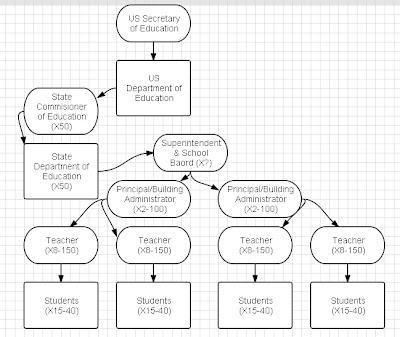
Traditionally, or for as long as anyone alive today can remember, most school systems have operated under a very clear top-down hierarchy. The Department of Education passes down edicts to states. State Departments of Education (headed by a commissioner) then pass funding & accreditation requirements and curriculum standards down to school districts. School districts are headed by superintendents operating with an authority given to them by school boards delegating responsibilities to principals and other building administrators. These administrators then delegate responsibilities to teachers and other school employees who then deliver the state mandated standards-driven curriculum to students. I realize this is a very simplistic picture of our school systems and there are great differences in the nuances between schools but for the most part this is the type of system most of us operate under.

This system was very efficient for many years and was necessary for a long time. However, when we hear criticisms of schools operating under an industrial model of education looking more like factories it is not just what goes on in the classroom that causes this comparison but also how they are structured. This structure looks like almost any corporate business hierarchy with the CEO and shareholders at the top and the workers and consumers at the bottom. Just as the corporate structure is designed to make as much profit for those at the top this system best ensures that the needs of those near the top of the pyramid are met. Today, in education, this hierarchy is most concerned with administering RTTT and NCLB measures like curriculum standards. Hence, the overly high concern with high stakes testing and “teach to the test” messages many of our teachers end up hearing. Who does this system serve? With whom lies agency in learning?

There is a new structure of learning emerging that is gaining momentum, one which appears to have no regard for edicts issued via a top-down hierarchy. Web 2.0 & social media technologies have given teachers and students agency in their own learning through the creation of what has been collectively referred to as “personal learning networks” (PLNs). Through PLNs learners choose their own learning agendas and self-select who they listen to and what curriculum (if any) they follow. Through the use of popular technologies like Twitter, YouTube, Blogs, and Facebook informal learning is quickly becoming a viable option. Teachers no longer have to look to their school system for support, they can find it through the networks they have created. This same kind of network structure and powerful informal learning is also what has made this latest phenomenon of unschooling actually seem like a viable option for some. The more our networks grow the more they challenge the authority of the traditional top-down hierarchy.

In this talk Dr. Pattanaik discusses how the fundamental belief structures between east and west cultures clash. He illustrates this with a simple story about Alexander the Great meeting a gymnosophist, “When they met, the gymnosophist asked what Alexander the Great was doing. To which he replied, ‘I am conquering the world. What are you doing?’ ‘I am experiencing nothingness,’ replied the gymnosophist.” Neither could see the point in the others endeavor because the denominator for Alexander’s life was One and the denominator for the gymnosophist’s life was Many. This fundamental element of belief informed everything about how both individuals interpreted these actions. The traditional hierarchy that has dominated our school systems has a denominator of one while PLNs, student-centered learning environments, and movements like unschooling operate with a denominator of many. If our industry is going to survive we need to find a way for both equations to find a common denominator. We have to look for ways to invert this hierarchy.
Currently there are just ten TPP public schools in operation in the United States and so far they all appear to be doing well. This model of school organization holds a lot of potential addressing the problems and issues facing schools and education including the inevitable irrelevance of our traditional school hierarchy. Ted Kolderie from Education|Evolving will be Steve Hargadon’s guest on his Future of Education series this Thursday, July 8, 2010 to discuss Teacher Professional Partnerships. For more information on TPPs I urge you to attend this free online discussion in Elluminate or at least listen to the recording afterwords.
Carl Anderson is an art and technology teacher, technology integration specialist, and adjunct instructor for Hamline University’s School of Education. He writes the Techno Constructivist blog and is @anderscj on Twitter.

Here are a few resources to help you navigate the ISTE conference:
Want to keep up with the absolute latest breaking news and information?
There are numerous information channels for the conference. What important ones did I miss?

For its upcoming conference, ISTE has put forth its “backchannel code of conduct.” In short, it reads:
There are more details, but that’s the short summary. Sounds pretty good to me.
What do you think? Is there anything that you’d add to the list? Is it a good idea for ISTE to have a code of conduct for the backchannel?

I head to Denver tomorrow, eager and excited for the ISTE conference. I’ve got a plan this year; there are some things I want to learn and some conversations I want to have…
Things for which I’m scheduled
Things I hope will happen (if you can help with any of these, please come say hi!)
Other thoughts
I’m deliberately leaving much of the conference open. I want to reserve space for spur-of-the-moment conversations and serendipitous interactions. If you want to chat – even if we’ve never met before – please come introduce yourself!
Trying to reach me at the conference? Try @mcleod on Twitter or call/text me at 707–722–7853. I’ll also be hanging out a lot in the Bloggers’ Café.
What’s your plan for the ISTE conference? Hope to see you there!

On the Internet, we write ourselves into existence.
That’s a wonderful thing. It allows us to reach audiences that we otherwise wouldn’t reach. It allows us to try on personas – and perhaps to reinvent ourselves – in ways that may be difficult in our everyday, face-to-face interactions.
But it also can be misleading.
Several recent incidents have caused me to revise some of my pre-existing beliefs about a few fairly prominent education bloggers. I now think and feel differently about them than I did just a few months ago, simply because I now have more information and thus a more complete picture of who they are.
I’ve been thinking about this as I get ready to head to the ISTE conference later this week. I won’t necessarily be wary as I interact with my edublogger peers, but I may be just a little less willing to accept things as they appear on their face. Not much, just a tiny bit. Most of the time people are as they appear – face-to-face or online – and I’d rather be a naive, trusting optimist than a negative, surly skeptic. But we have to recognize that we all also have secrets, ones that may remain uncovered because of geographic and/or interactional distance.
That edublogger who’s active in Twitter every evening and has a bunch of followers? He seems cool but maybe he beats his kids.
That edublogger with 20,000 subscribers and a heart of gold online? She seems great but maybe she’s cheating on her spouse. Or a cutter.
That charming, effervescently cheery and witty edublogger that everyone loves to hang out with at the conference? He seems wonderful but maybe he’s embezzling funds. Or a kleptomaniac. Or a drunk driver.
As you head to the ISTE conference later this week, or simply interact with folks online, I leave you with the thought:
Can you ever really know that edublogger beside you?
Update: I’m not as pessimistic as this may read. I’m just thinking out loud here…
Image credit: In order to exist online we must write ourselves into being