by Scott McLeod | Sep 8, 2008 | 21st Century Skills, CASTLE, Miscellaneous, Planning and Funding, Tech Integration |
I was a little stunned to see that I was the lead-in for this article in The Washington Diplomat:
I think I came across a little harsher than I am in real life, but that’s okay. Happy reading!
by Scott McLeod | Aug 27, 2008 | Leadership and Vision, Management and Operations, Planning and Funding, Professional Development, Tech Integration |
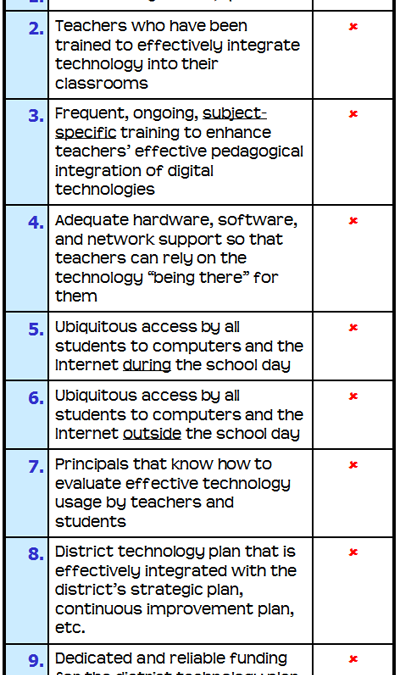
So far 85 people have completed the online survey version of the Beginning of the Year Technology Checklist. Initial results are very interesting…
If you haven’t yet completed the survey and would like to do so, it will remain open through this Friday.
by Scott McLeod | Aug 21, 2008 | Leadership and Vision, Management and Operations, Planning and Funding, Professional Development, Tech Integration |
It’s the first day of school here in Ames, Iowa. The past two years at this time, I’ve posted the following checklist, wondering if schools have made any improvement since the previous fall. This year I changed the checkboxes to a scale of 1 (low) to 5 (high) and thought I’d try something a little different…

You have two ways to participate…
- Download this checklist in Excel. Enter the name of your school organization and fill in your ratings (editable areas are in yellow). Click on the Chart tab at the bottom, then print. Disseminate broadly!
- Participate in the 2-minute online survey. Fill in your ratings and click on the Submit button. I’ll publish everyone’s aggregated results in a future post! (deadline: Friday, August 29, 2008)
Feel free to use and distribute the Excel file and/or the survey link as desired. If you would like to conduct this online survey within your school organization, contact me about hosting a version just for you (at no cost). Hope you made some progress since last year!
by Scott McLeod | Jul 1, 2008 | Law, Policy, and Ethics, News and Events, Planning and Funding |
Here are the rest of my notes from ISTE’s annual digital equity summit at NECC…
Discussions
- Wyatt Sledge, Forth Worth (TX) ISD, told me that the district just hired a dedicated technology trainer for its administrators. Awesome!
Expert panel
Lara Sujo de Montes, New Mexico State University
- Digital divide v. digital equity
- Divide = lack of access to equipment
- Inequity = lack of access to benefits of learning and using that equipment
- Digital inequity reproduces existing social and socieconomic inequities
- The Internet is 2/3 in English but only 10% of world population speaks English
- Developing countries: rural, unemployed, uneducated farmers or unskilled wage laborers, subsisting on $1 or $2 per day, ethnolinguistic minorities
- Request distance learning courses for high school students, develop online materials yourself (even for a traditional course), install Moodle
David Thornburg, Thornburg Center
- Digital equity and space exploration as a STEM curriculum
- Half of workers at Lockheed Martin and Northrop Grumman will retire in the next decade; 15% of Boeing engineers are eligible to retire right now; we don’t have enough new people to replace them
- We need to go beyond teaching about STEM and help students see themselves in those jobs
- There is a lot of beauty and joy in STEM
- In prison they let you out early for good behavior. Schools don’t do that.
- I’m tired of corporations thinking of children as wallets with bodies.
Ashanti Jefferson, Chicago Public Schools
- Described some of the work CPS is doing with its kids
Al Byers, National Science Teachers Association
- NSTA Learning Center: significant gains in the learning of science teachers who participate in its online learning modules
- Teachers must have a voice in their own professional development if we want to see positive results
- If you include elementary and middle school teaches (who teach science but don’t think of themselves as science teachers), there are 2.1 million science teachers in the USA
Discussion
- Thornburg: Students in affluent schools use technology in creative, innovative ways. Students in disadvantaged schools use computers for decontextualized drill-and-kill exercises.
![NECC 2008 – SETDA PD Roundtable]()
by Scott McLeod | Jul 1, 2008 | Higher Education, Law, Policy, and Ethics, Leadership and Vision, Miscellaneous, News and Events, Planning and Funding, Pre-Service Preparation, Professional Development, Tech Integration |
 Here are my notes from Tuesday’s Professional Development Roundtable sponsored by the State Educational Technology Directors Association (SETDA). This was an EXCELLENT conversation.
Effective professional development for educators
- Peer-to-peer training is particularly effective for teachers and administrators. Training also should be job-embedded. The focus should be the project or task, not the technology.
- Alabama has found that the graduates of their Gates grant initiative constitute the bulk of the innovative school- and district-level technology leaders in the state.
- Dr. Mary Ann Wolf, Executive Director of SETDA, asked me to talk about CASTLE! Administrators need dedicated funding, training, and TIME to learn.
- Coaching models for professional development (PD) work extremely well.
- New York City has a comprehensive PD model that includes principals, teachers, etc. Principals want to see best practices and what’s working in other schools. In contrast, teachers want people to come to their classroom, to discuss ‘what works here.’ Having an in-school professional developer works really well for teachers. It’s important to have both the in-class and the off-campus components.
- A lot of people don’t really know what high-quality PD looks like.
- Brenda Williams, West Virginia Department of Education: If you get professional development right, student learning will improve.
- Steve Andrews, Intel: The politics of cost is incredible. EDC has found that If you can get one PD coach per building, the results and progress are amazing.
- Project-based administrator training needs to involve the team, not just individuals. The principals need their assistant principals, teacher leaders, etc.
- We need to get teachers into other classroom via learning walks, observations, lesson study, etc.
- Principals need to have an actionable theory of change.
- There are a number of strong PD models in existence. SETDA is going to try to collect and then disseminate some of these models.
Barriers to effective, scalable professional development
- Lack of adequate, large-scale Internet access in training facilities. The West Virginia Department of Education forced state hotels to step up or risk losing all of its workshops!
- IT people still aren’t talking to curriculum people, assessment people, etc.
- There is a fairly large number of obstructionist teachers.
- Time, perceptions of endurance, perceptions of efficiency. Teachers wonder if it’s worth investing in a technology because it is changing so fast. Teachers have seen a number of technologies come and go [and they have resisted all of them!].
- Lack of exposure to effective models for technology-related PD.
- Many teachers view technology as a classroom distraction rather than as a meaningful learning tool.
- We don’t bring IT people into the process soon enough. They need more lead time and more involvement.
- Statewide programs have trouble ensuring consistency and implementation fidelity.
- Intentionality is important. Technology training that’s driven by subject learning goals (e.g., we need to get our math scores up) is more successful. Dedicated time and focused assessment also are necessary.
- Leadership turnover and program sustainability are issues.
- Leaders need help translating models of effective PD and time reallocation to their local implementation context.
- Content area people need to be involved in the tech training. Instruction first.
- Tom Carroll, NCTAF: Are we applying the right treatment to the right teachers? One technology PD model does not fit the learning needs of all teachers (just like students).
- Students need to be the ultimate focus of teacher PD efforts. It’s not about the tools, it’s about how it benefits the students. Having students demonstrate and discuss can be a powerful motivator to teachers. Clayton Christenson: The disruptive innovation in education is not charter schools or online schools. It’s student-centered learning.
- New teachers are effective users of personal technologies and are comfortable with instructional technologies. However, they have few models of good technology integration in their schools and they also probably had instructional technology courses in their pre-service program that were separate from their content methods courses.
- Preservice teachers do not come out of college as instructional designers.
- Steve Andrews, Intel: One of the most incredible opportunities of our lifetimes is before us.
- We need to use pride, greed, hope, love, and guilt to get teachers moving.
- Schools’ poor use of technology is having negative impacts on the retention of young teachers.
Policy and practice recommendations
- Specific guidelines of 1 instructional coach per 1,000 students.
- Concrete strategies for changing how we do business (at all levels), maybe differentiated by setting, size, and locale.
- Strategies for informing and engaging parents / community members.
- A comprehensive K-20 vision and agenda – state level and/or national level – that drives forward movement.
- Mandatory interactions between K-12 and higher education. [NCATE requires that colleges work with schools?]
- We need to pay more attention to our leaders!
- Colleges of education are not going to accept any responsibility (for technology training, outreach, service, PD) until legislatures, departments of education, and/or accrediting agencies make them do so. [U. Minnesota performance review: ‘Dr. McLeod’s work with schools is exemplary but inappropriate.’]
- We need to follow up statements of ‘It’s so expensive to do this’ with the reply ‘What is the cost of not doing this?’ We need to think more in terms of investment (not cost) and return on investment.
- We have to figure out what to take off educators’ plates (the idea of prioritized abandonment).
- Most high-functioning companies spend about 4% of their budgets on employee training. We come nowhere close to this in K-12 education.
- We need to remember the interconnectedness of the success of the whole. We don’t want others to cherry pick components of what should be a comprehensive approach to systemic school reform.

by Scott McLeod | Feb 28, 2008 | International, Leadership and Vision, News and Events, Planning and Funding, Professional Development, Tech Integration |
ASB Unplugged is a 1:1
laptop conference for international schools, hosted by the American School of Bombay and the Laptop Institute. These are notes
from a session I attended on technology-related change at the secondary
level…
- Andrew Hoover, middle school principal
- Devin Pratt, high school principal
- Dianna Pratt, middle/high school tech coordinator

[the educators in this room are from more countries than you probably can
place on a map!]
- Change is not linear
- Expect both bursts and delays
- Complacency and resistance come from…
- Being busy
- Maybe being risk adverse
- Perceived (and actual) threats to professional identity
- DyKnow software really takes advantage
of the tablet PCs’ functionality, making it worth the tablets’ extra cost
- Key implementation stages (from John Kotter)
- Establish a sense of urgency
- Generate cognitive dissonance!
- Create a guiding coalition
- The leadership team has to be on board
- Develop a vision and strategy
- Communicate the change vision
- Repetition of message, vision, goals, etc. is key
- Lead by example
- Empower educators for broad-based action
- Lots of just-in-time professional development
- Ongoing instrucational support
- Reliable technology and infrastructure
- Small, frequent, purposeful meetings
- Generate short-term wins
- Teacher-sponsored demos and highlights, tied into concept of enduring
understandings
- Repetition of this gradually overcomes the resisters
- Teachers are asked to use DyKnow just once and have the lesson observed to
get feedback
- There is a curriculum to foster a sense of responsibility among
students
- Students carry around eggs first; if an egg breaks, the student has to go
through a process before she gets another one
- Later students graduate to laptops but have to leave them at school
- Finally students get the laptops 24–7
- Consolidate gains and produce further changes
- “You don’t know how comfortable you are until you start moving on”
- Keep stressing ‘here’s where we were 2 years ago and look how much progress
we’ve made’
- Andrew is using a blog to keep staff, students, and parents informed of
progress
- Work on facilitating dispersed leadership
- Anchor new approaches in the culture of the school
- Recognize how culture already has changed and build upon it
- Foster a climate of continuous improvement (kaizen)
Scott’s trip to Mumbai: pics at Flickr, movies at
YouTube.
by Scott McLeod | Feb 11, 2008 | Leadership and Vision, Planning and Funding, Professional Development, Tech Integration |
My colleague and good friend, Dr. Jon Becker, has a new blog, Educational Insanity, that’s worth checking out. Here are some excerpts from a recent post on technology planning:
There have been many great sports coaches who were successful based on a “system” they installed. . . . I think educational leaders/policymakers are guilty of installing systems without regard to the personnel. . . . In other words, the “systems” have been installed and the leaders are then forced to try to fit the personnel into the system. . . . Make the system fit the team, not vice versa.
FYI, Jon’s post references the allegedly nightmarish technology implementation at T.C. Williams High School in Alexandria, VA, which is the school that my two sisters attended (before the tech makeover / building remodel!) and also is the basis for the movie, Remember the Titans.
Happy reading!
by Scott McLeod | Jan 31, 2008 | Leadership and Vision, Management and Operations, Planning and Funding |
Over the past few years, I mentioned several times to Keith Krueger, CEO of the Consortium for School Networking
(CoSN), that CoSN was a great organization for larger districts that had CTOs or CIOs that
supervised large staffs but that technology coordinators in smaller districts
didn’t really have an organization that represented their interests. Keith
rightfully replied that many of CoSN’s resources (which are superb in my
opinion) also were relevant and applicable to smaller districts’ needs. I
concurred but still wished that there was an organization that better
represented these folks. As I
noted way back in August 2006 when my readership was about 12 people, there
really isn’t a national association that represents the majority of people in
these positions like there is for principals, teachers, counselors, school
business officials, etc.
Although my desire for an organization that comprehensively represents
technology coordinators has yet to be fulfilled, in November 2007 CoSN unveiled its Small School
District Technology Leadership Wiki. I can’t take any credit for this, of course, but I’m delighted. The wiki is chock full of information
for technology leaders in smaller districts and, of course, can be edited and
expanded by others. I encourage you to check out this
fantastic resource and to contribute and make it even better. Thanks,
CoSN!
P.S. Join Keith and me later today for an online
chat about PK-12 technology leadership.
by Scott McLeod | Jan 25, 2008 | Planning and Funding |
Schools that are interested in promoting innovation, science, technology,
engineering, and math are eligible to apply for one of Motorola’s Innovation
Generation Grants. Recipients can receive up to $100,000 and you can see what was funded last
year. The deadline for applications
is March 1. Good luck!
![NECC 2008 – SETDA PD Roundtable]()
by Scott McLeod | Nov 17, 2007 | Law, Policy, and Ethics, Leadership and Vision, News and Events, Planning and Funding, Pre-Service Preparation, Professional Development, Research and Evaluation, Tech Integration |
Friday was the first day of sessions at the UCEA convention. CASTLE sponsored a panel discussion on national K-12 educational technology policy, moderated by Drs. Sara Dexter (U. Virginia) and Matt Militello (U. Massachusetts-Amherst).
 Listen to the podcast! (73.9 Mb, 81 minutes)
Panelists
- Hilary Goldman, Director of Government Affairs, ISTE
- Dr. Mary Ann Wolf, Executive Director, SETDA
- Doug Levin, Senior Director of Education Policy, Cable in the Classroom
Some main themes
- In the mid– to late 1990s, there were LOTS of national funding initiatives aimed at K-12 ed tech – all were replaced by EETT, which is much smaller and more limited – today, EETT has declined from over $700 million to $272 million – in the past, the Bush administration has even attempted to zero out the EETT budget – Congress has saved the program but at increasingly lower levels
- There is a perception that the job is done
- Teachers have not been trained how to use technology to improve student learning outcomes
- Educators are moving slow – lots of missed opportunities – extremely incremental change in a revolutionary environment
- TPCK model – preservice teachers should not take separate ed tech classes – should be integrated with content-specific methods courses
- We are finally starting to get research that is helpful for policy purposes – for example, the eMints program in Missouri and other states
- The amount of education that people need is astounding – state and federal policymakers, education associations, the public – they make major assumptions about what is happening that just aren’t true
- Example: because nearly all schools are wired, people truly think that means that all kids have access to the Internet – far from being true – only buildings and teacher computers are wired – every student is NOT wired and connected
- Example: lots of money has been poured into student information systems – as a result, people think that teachers are getting data that informs their day-to-day instructional practice – again, this is far from true – in most districts, the data that are in these systems are not that granular
- You have to use sexy vocabulary – the terms of art – that capture policymakers’ attention – right now it is global competitiveness
- High school reform and other change efforts – technology is not specifically articulated as a component – it thus gets lost or left out
- Ed tech policy is still fairly immature – we’re in our tweens
- Groups like NEA, AFT, NSBA, AASA, NASSP, and NAESP are not knowledgeable about technology – they advocate for Title I, IDEA – they don’t advocate for ed tech
- The Partnership for 21st Century Skills is trying to change the conversation rather than trying to figure out how to fit ed tech into existing paradigms / models / laws – this is a real herky-jerky process
- There is not, and has not been, a systemic long-term research agenda, funded by policymakers, to answer key research questions about K-12 educational technology
- What kind of research is needed to further the cause of K-12 educational technology?
- Most education academics are naive about how policy gets made – don’t really understand the policy process – much educational research is not pertinent or helpful to policy conversations and the questions that are being asked by policymakers – we have to remember that ed tech is only one voice of many
- ETAN – www.edtechactionnetwork.org – you don’t have to get to DC – can plug in your e-mail and zip code and get resources and information – just 12 letters can make a difference – meeting in local offices back home also make an impact – asking questions at local town halls sponsored by legislators
- We were blessed in the 1990s with the folks that were in the U.S. Department of Education (US DOE) – there are lots of places where this can break down – there are not strong advocates there today – one place to focus advocacy efforts is the US DOE, not just legislators
- Why has school leadership been left out of the ed tech policy conversation and policy efforts? – historically, efforts were focused on affecting the classroom, not on changing the system – promising levers appear to be 21st century skills, data-driven decision-making, and cybersafety
- We could draft Title II legislation around professional development for administrators regarding technology leadership

[left to right: Sara Dexter, Matt Militello, Hilary Goldman, Mary Ann Wolf, Doug Levin]

 Here are my notes from Tuesday’s Professional Development Roundtable sponsored by the State Educational Technology Directors Association (SETDA). This was an EXCELLENT conversation.

