Those of you who read me regularly may recall my April 24 post that highlighted some parent complaints about the new elementary school schedule that was proposed by my school district’s elementary principals. That post focused on the leadership issue of stakeholder communication…
Well, over 2 weeks later, the principals’ formal response is out (see below). As I expected they might, they give a number of good explanations for the scheduling changes. Although the memo is dated April 30, today is the day it was sent home by our school.
The communication issue is still very much present, though. At its heart, this is a conversation between three groups – school administrators, teachers, and parents/community members – and it’s being waged via paper letters and flyers, with responses several days or weeks apart. As long as it proceeds in this manner, how can this possibly be a successful, respectful conversation?
And, yes, even more trees gave their lives to the cause…
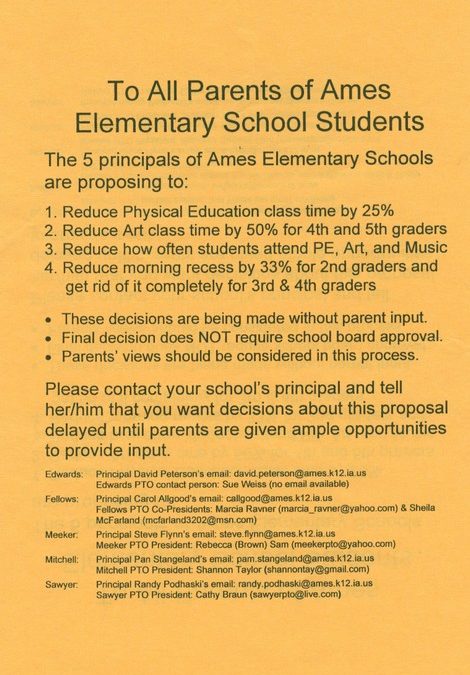
The elementary principals here are collectively rearranging their schools’ schedules to create a unified literacy block every morning and greater opportunity for teachers to have common planning time. In order to do this, Art and Physical Education time will take a hit, as will some elementary teachers’ ability to focus on one particular subject area (i.e., just math) rather than having to teach all of the subjects. I think that the new schedules also will allow for a greater possibility of doing flexibile ability grouping within subject areas.
Many parents and teachers are unhappy about the changes. I’ve heard from several of them and this was under my windshield wiper last night when I left our school’s Science Night:
There are both pros and cons to the changes. My kids’ elementary school has a phenomenal art teacher and we’re not too keen on our kids seeing her less often. And, of course, regular physical activity is important too, particularly given the growing problem of childhood obesity. On the other hand, I’ve seen firsthand in many schools the benefits of having common planning periods, a greater emphasis on unified literacy instruction, flexible ability grouping, and so on. In a community like ours, where the family demographics are such that most districts would die to have the standardized test results and college attendance rates that we do, there also is a strong element of ‘the current system is working fine so why change it?’
The interesting issue for me is the communication problem that’s highlighted here. The plan was presented a week or two ago and the uproar is now starting to reach critical levels. If the principals had done a better job of communicating their intentions and involving teachers and parents in the planning, could this emotional upheaval have been avoided? Without admittedly knowing any of the particulars, I’m guessing that there probably was a way to avoid some of this.
On another note, paper flyers on windshields? Um, the Internet, anyone? Maybe even e-mail? Another tree gives its life to the cause…
The Washington Post recently published a really interesting article on the ability of well-connected parents to influence the decisions of their local school districts (hat tip to The Science Goddess). The term ‘well-connected’ refers to parents’ abilities to use online tools to communicate and mobilize (rather than to their connections to people with power).
The article highlights several different online communities of parents and has some great quotes:
We are not our moms, who were just involved in the PTA. . . . To expect us to show up and just make photos or write checks does not sit well with this generation.
and
It used to be that the superintendent and the School Board made decisions and said, ‘This is how it’s going to be,’ and the community would accept that.
and
Many school systems ‘are still responding to 21st-century parents with 20th-century approaches.’
Below are a few examples of parents pushing back on their local school systems. Parent tools include blogs, online petitions, and even administration countdown timers! I’ve linked to individual posts but you can click on the headers to see the blogs in their entirety.
Be sure to also read about the New York City Department of Education ‘truth squad,’ whose job it is to ‘scour a group of 24 education Web logs, e-mail Listservs and Web sites in a hunt for factual errors and misinformation.’
Dean Shareski, Will Richardson, and Alec Couros, among others, have blogged about the importance of trying to manage one’s ‘digital footprint’ or digital identity. However, John Palfrey and Urs Gasser, in their excellent book, Born Digital, note that “Social identities are much richer, more varied, and more persistent – AND FAR LESS UNDER OUR CONTROL – than ever before” (p. 34; emphasis added). In other words, now that everyone can have a voice, we have a lot less control over what gets said about us than before, and what does get said is more visible and findable than ever.
Online communication technologies have greatly amplified the abilities of parents to voice their opinions and mobilize for desired change. Activist parents now have a bevy of new tools and strategies to help facilitate their agendas and they are not afraid to use them. School organizations are going to have to get used to this new state of affairs in which parent activism and criticism are more public, permanent, and far-reaching. I’m pretty sure that most school leaders haven’t really thought about this…
What are your thoughts on this? If you’ve got an example of a parent group in your area leveraging online social tools to advocate for change in its local schools, please share!
Let’s say that you were interested in creating the world’s best PTA / PTO blog as a tool to help build greater community for your kids’ elementary school. What would you include in it?
You can see what I’ve come up with so far at the Fellows PTO Blog. I’m just getting started. In addition to fun and/or helpful online resources for students and parents, over the next few months I’m going to:
solicit student stories or artwork,
publicize upcoming school events,
interview principals and the teaching staff,
highlight great books (and hopefully have students submit book reviews), and
possibly host a few fun contests for kids and families.
If you have other suggestions for blog activities, web sites I should be checking out, or great PTA / PTO blog examples, please leave them in the comments area or send me a note. Thanks!
Last year a middle school librarian in New Jersey received a lot of media attention for her anti-Wikipedia campaign:
Linda O'Connor regards Wikipedia the same way former first lady Nancy Reagan campaigned against drugs. . . . She put up a sign saying "Just Say No to Wikipedia" over the computers in the school library. . . . Wikipedia is blocked on all computers in the Warren Hills Regional School District.
At the time I said that I was highly skeptical about this librarian's stance. On any given day, approximately 1 in 10 Internet users visits Wikipedia. This fact alone should indicate that there's something going on worth paying attention to, something that warrants a more nuanced approach than simply prohibiting access. If it was terrible, it wouldn’t maintain its audience. Folks who take the time to understand Wikipedia learn very quickly that it's actually an amazing site. It's already 8 times larger than the Encyclopedia Brittanica, is growing incredibly quickly, and has been created entirely by volunteers. Peer-reviewed studies published in our top scientific journals have shown that it is as accurate as the Brittanica too, particularly those articles that reside in its mainstream core (rather than at the fringes).
If all of this is true, then why are so many educators, librarians, and media specialists upset about Wikipedia? I think the concerns stem from several different sources. One is their beliefs about accuracy. We tend to assume that print materials such as the Brittanica and school textbooks are error-free when in actuality they contain numerous mistakes. Even when identified, these mistakes usually linger until the next edition is printed and purchased (unlike Wikipedia which corrects known mistakes almost instantly). Second, the idea that volunteers can create something as valuable as that created by experts strikes us as ludicrous. But in this case it happens to be true. Sure, at any given second, some vandal or incompetent may have inserted something inaccurate into a particular article. But over time (and often unbelievably quickly), Wikipedia is remarkably self-healing, unlike the paper materials on our bookshelves. Wikipedia also is a counter to outdated information. How many of the reference books in libraries and school media centers contain incomplete or inaccurate information simply because they're old? Wikipedia doesn't have that problem.
Our students deserve better training about how to navigate our new, complex, online information landscape. They don't learn about information literacy, bias, media literacy, assessment of online validity, and other critical online skills by being denied access to that information. They don't learn how to cite and use online resources appropriately if they can't use those resources and learn from their mistakes because the materials are banned.
If you take half an hour to show administrators these things, their mindset changes. I like to have school leaders visit some Wikipedia pages with me. I start by showing them the asphalt article. After we look at the article itself, I show them the history tab (and take them all the way back to the first few revisions) and then the discussion tab. We talk about what we see and what their perceptions are regarding accuracy, quality, and neutrality. Then I put them into groups to check out more controversial articles like Sarah Palin, Islam, Vladimir Putin, or Pluto. They examine the articles for bias and inaccuracy and spend some time in the history and discussion areas.
The administrators inevitably walk away with a deeper understanding of Wikipedia and a greater appreciation for the safeguards that have evolved to protect against abuse and inaccuracy. Many of them also begin to see the site as an excellent lens for teaching students about how, as a society, we construct knowledge, negotiate meaning, and develop collective understanding. Some even begin to think about how their students might be able to serve as Wikipedia contributors. In the end, that richer understanding may be more valuable than the content of the articles themselves.
How are you using Wikipedia to teach information literacy and critical thinking?
I delivered a presentation today at ITEC 2008 on (in)effective presentations. I thought some of you might be interested in the before and after slides I displayed to show my own growth in this area. I’m getting better!
Does anyone know of some superintendents who are podcasting? If so, would you drop a URL and/or some contact info in the comments area for this post? Doug Johnson and I are looking for some examples that we can show other superintendents…
The authors of Blown to Bits, an absolutely superb book on life ‘after the digital explosion,’ note that
There is a difference … between ‘public’ and ‘readily accessible.’
Public records such as real estate transfers, birth records, and business transactions often contain sensitive personal information, including Social Security numbers, birth dates, mother’s health information, credit card numbers, voter registration, fingerprints, professional occupations, and the like. While these data technically always have been available to the public, the difficulty of sifting through the paper records made large-scale aggregation and use nearly impossible.
What happens when those public records get digitized, however? What happens when public databases become easily accessible? What happens when paper records are turned into searchable text via optical character recognition and/or tagging? Or, as the authors, note, what happens when all of this public information gets merged with commercial marketing databases?
As the IowaLandRecords.org controversy here in Iowa shows, we need to do some tough thinking on this topic. Just how ‘public’ do we want our public records to be?
Many of us don’t think much about the back of our business cards. I think they’re an opportunity. Here’s what it says on the back of my card:
… and they all crossed their fingers, hoping … despite little to no investment in their leaders … despite making conscious, intentional decisions to keep it out … that somehow their students and staff would be prepared for the digital, global world that surrounded them …
The End?
I’ll probably word this a little differently next time, but I think this gets my message across that we need to better invest in our leaders and that we need to recognize that schools must be critically engaged in the preparation of digital citizens / workers. I always hand out my card with the back facing up so that the recipient at least sees that there’s something there.
What’s on the back of your business card? What could / should be?
I often get asked by administrators for some recommended reading. Here are some of my favorite books on delivering effective presentations. If the Amazon widget doesn’t load in a few seconds, here’s a static picture of the list.
[Transparency disclosure: If you buy a book using this list, CASTLE gets 4% of the proceeds. Your cost doesn’t go up any. Amazon just pays us a little for the referral through its Associates Program.]



 The Washington Post


