But why should youth not be allowed to participate in public life? Do paternalistic, age-specific technology barriers really protect or benefit teens?
One of the most crucial aspects of coming of age is learning how to navigate public life. The teenage years are precisely when people transition from being a child to being an adult. There is no magic serum that teens can drink on their 18th birthday to immediately mature and understand the world around them. Instead, adolescents must be exposed to – and allowed to participate in – public life while surrounded by adults who can help them navigate complex situations with grace. They must learn to be a part of society, and to do so, they must be allowed to participate.
…
Rather than trying to protect teens from all fears and risks that we can imagine, let’s instead imagine ways of integrating them constructively into public life. The key to doing so is not to create technologies that reinforce limitations but to provide teens and parents with the mechanisms and information needed to make healthy decisions. Some young people may be ready to start navigating broad audiences at 13; others are not ready until they are much older. But it should not be up to technology companies to determine when teens are old enough to have their voices heard publicly. Parents should be allowed to work with their children to help them navigate public spaces as they see fit. And all of us should be working hard to inform our younger citizens about the responsibilities and challenges of being a part of public life.
it didn’t surprise me to hear the spokesperson for the monitoring app claim that 70 percent of kids had been cyberbullied. Though not all are guilty of this, it’s not uncommon to hear such exaggerations from companies (and some agencies and non-profits) in the Internet safety space.
While any case of cyberbullying is bad, the fact is that the statistics are nowhere near as dire. The numbers vary a lot. The National Center for Educational Statistics reports that 6 percent of students in grades 6-12 experienced cyberbullying. The Centers for Disease Control found in 2011 that 16.2 percent of students had been bullied via email, chat rooms, instant messaging, websites or texting — compared to 20.1 percent who had been bullied on school property (traditional bullying) — during the 12 months prior to the survey. The Cyberbullying Research Center reports that “on average, about 24 percent of the students who have been a part of our last six studies have said they have been the victim of cyberbullying at some point in their lifetime.”
Dan Olweus, who the editor of the European Journal of Development Psychology referred to as the “father of bullying research” wrote a 2012 article for that journal where he said that “claims about cyberbullying made in the media and elsewhere are greatly exaggerated and have little empirical scientific support.” Based on a three-year survey of more than 440,000 U.S. children (between 3rd and 12th grade), 4.5 percent of kids had been cyberbullied compared to 17.6 percent from that same sample who had experienced traditional bullying. An even more interesting statistic from that study is that only 2.8 percent of kids had bullied others.
A big thanks to everyone at TEDxDesMoines for a fantastic event, particularly the video editors who somehow turned our videos around in less than 24 hours. Amazing!
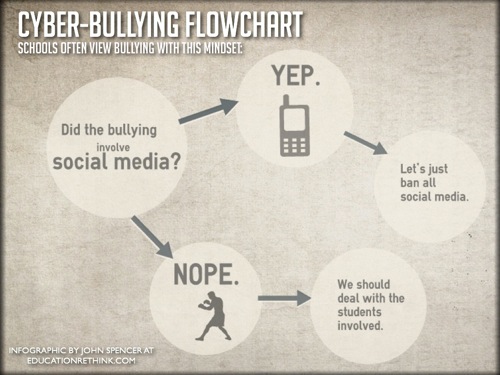
Schools should also monitor cyberbehavior by students. There are good software tools that monitor cyberactivity in real time and flag threats based on keyword libraries that are specific to threatening, bullying, suicidal, or violent language. Every school should have this kind of sophisticated monitoring to capture such behavior.
No, this is not the answer to cyberbullying. America is not a police state. Whether educators like it or not, students have Constitutionally-protected speech and privacy rights. Every individual in the United States, no matter how young, has essential human rights and liberties that are rooted in self-autonomy, privacy, and freedom from invasive searching, tracking, and monitoring by the government.
I’m not a conspiracy theorist and I don’t walk around with a tin foil hat, but the idea of public schools actively monitoring the online speech and behaviors of youth with the intent of catching them doing something bad sends chills up my spine. This is just another classic example of fear run amok…
Check out this video regarding “today’s biggest risk online.” [“Scary, like terrifying.“]
Are you as terrified as these people are? Photo geo-tagging and other location-based services have been prevalent for awhile now. [You can find “her favorite fast food shop” and “the specific part of the park where she plays!“] Have you heard about a horrifying uptake in incidences of predation by online strangers as a result? Me neither. [“The location of her kids’ bedroom was available to anyone online!“]
What do you think? Yet another incidence of slimy fearmongering (particularly when the reporter visits the mom’s house at 2:27)? Or a valuable warning that all parents should heed [“Experts say you can still be perfectly safe just by turning off GPS setting on pics you plan to post online.“]?
Let me know what you think (and what you might add to the resource lists). I’m always on the search for student and/or employee AUPs that focus more on empowered use rather than hammering on safety/security concerns. We need more AUPs that emphasize YES! instead of NO!
Imagine for a second if we taught our teenagers to drive a car in the same manner we attempt to teach them about social media.
Driving lessons would be taught by adults (teachers or parents) with little or no experience of driving. Sure they may know of certain brands of cars or be aware of some of their capabilities. They may know it is illegal to speed or drive without a seatbelt, but in reality they have spent little time behind the wheel.
Driving lessons would only focus on what not to do. An average driving lesson would entail students being preached to about the dangers of speeding, drinking and driving, or not wearing a seatbelt. There may be a little advise on how to keep you and your car safe – e.g., regular service checks, installing an alarm, and NEVER allowing a stranger to get into your car would all constitute sound advice.
Driving lessons would NEVER take place in an actual car. In fact cars would be banned in the majority of driving schools. So students would be able to take notes, draw pictures, or even present a PowerPoint on how to drive, but they would only be able to put these lessons into practice once they were out of sight of an adult.
A blast from the past: a PSA produced in 1995 by 5th graders in Helena, Montana. Seventeen years later – because of insufficient quantities of computing devices, draconian filtering and blocking systems, differential student usage and access, inadequate bandwidth, adult fears, and many other issues – many of our students are STILL asking how they can get on the Internet at their school…
Normally this is where I’d say ‘Happy viewing!’ but it’s sort of depressing to think about my second sentence above.