[I am teaching a Leadership for Deeper Learning elective for one of our doctoral cohorts this summer and thought that I would share what is happening each week.]
We were missing a few members of the doctoral cohort in Class 01, so our second class was the first time this summer that we were all together. It was great to see everyone in the same room again!
We kicked off Class 02 by beaming in Chad Mabery as a guest speaker. Chad is the Assistant Superintendent of Instructional Services for the Laguna Beach (California) Unified School District. He shared with us LBUSD’s journey toward deeper learning, along with many of the strategies that the district is employing to change what learning and teaching looks like there. My students asked Chad some fantastic questions and we all wished that we had more time with him.
After a short discussion about my approach to this new class and our summer assignments, we engaged in a couple of quick activities. First, I described the Hegelian dialectic, just to emphasize that we should try to hold opposing thoughts in our heads and that reality is likely somewhere in the intersection of those. Second, I discussed the concept of a theory of action. Everything we do in schools is based on some theory of action: If we [do this], then [that thing will happen] because [reasons]. A theory of action is a belief statement about how things work, and often there are competing theories of action. For example, a theory of action in many schools is:
If we [create double math blocks each day], then [students’ math learning will increase] because [more math time equals more math learning].
Some competing theories of action might be:
If we [create double math blocks each day], then [students’ math learning will NOT increase] because [we are not also changing how we teach math, we are only subjecting students to even more of what they already don’t like].
If we [create double math blocks each day], then [students’ math learning will NOT increase] because [by cutting a recess, students will have even more trouble self-regulating and staying focused].
I paired up my students and asked them to articulate at least one theory of action that they thought was occurring at Dewey High, which was profiled in the chapter of In Search of Deeper Learning that they had read for this evening. They also articulated a theory of action that they thought was occurring in LBUSD and at Crosstown High in Memphis, based on their conversation with Chad and the film that they watched last week. They then articulated at least two competing theories of action, and we shared those with each other.
The rest of our time was spent unpacking our readings and other pre-activities for the evening (see below). I ask each student to publicly post on a Padlet ‘2 or 3 fantastic leadership-focused discussion questions’ before each week’s class. We use that collection of questions to inform our small group discussions. For example, some of the questions that my students posted for this week included:
“Bringing symmetry to life means that leaders who seek collaborative, inquiry-rich learning environments for students must build collaborative, inquiry-rich environments for adults” (Fine & Fullan, 2026). To what extent was this provided for the staff at Crosstown High? At Dewey High? How did they benefit? What would your leadership moves be if you were leading those schools?
One thing that I noticed across Dewey High (using physics for the portable darkroom), Crosstown High (using geography for the Twister game re: the refugees’ journey) and Hook River Middle School (using algebraic formulas to determine acreage) was that allowing choice drove the desire to want to learn the skill. So the question I have is how can this be successful in every classroom? Once again, if teachers are not taught how to facilitate and foster this style of student-led instruction too many students slip through the cracks and will not achieve mastery of the skills.
Mehta & Fine (2019): There seems to be a large fear of failure holding back our schools. Deep learning requires experimentation and uncertainty and the risk of failure (as their many examples suggest). In a system whose purpose is to educate our children, how much risk is acceptable and who gets to decide when the potential benefits outweigh the potential costs? Also taking an equity lens, how can we ensure that the risks are not disproportionally beared by historically marginalized underrepresented students?
Structural incongruities are expected in public education because the “policies, schedules, or evaluation systems are out of step with a learning-centered culture” (Fine et al., 2026) When District and School Unified Improvement Plans (DUIP and SUIP) are rooted in state testing, how can school leaders cultivate symmetry? Is it realistic to create a deeper learning environment within the confines of our current reality of public education?
Why is math so hard? In thinking about integrating content and covering standards with deeper learning practices (and as highlighted by Dewey High’s separate math classes), why is mastering math standards seemingly the most difficult subject? It leads me to think about how we ‘organize’ and silo math currently, and I wonder what a completely different K12 scope and sequence for math might look like. Does every student need to get into ‘advanced’ math classes? Why is calculus more important or rigorous than statistics, when the latter is much more likely to show up in day to day life? Does geometry have to come after algebra 1? Why? Does math need to be subsectioned into these topics at all?
Across the readings on symmetry (Fine, Rincón-Gallardo, Fullan), there is a strong emphasis on aligning leadership behavior with the learning culture being promoted in schools. However, in many systems there appears to be a gap between “rigorous” or equity-centered practice models and what actually happens in day-to-day implementation. Could this gap suggest that even well-designed models are often reduced to symbolic or performative practices (tokenism) when they move into real organizational contexts? If so, is the issue the model itself, or the conditions under which it is implemented? What would it take for a model of practice to remain intact once it enters a complex school system?
What is a theory of action that you’re working with in your current setting? Discuss what competing priorities may be hidden in a “competing theory of action” that could limit the desired outcome.
As you can imagine, our conversations are quite robust!
Our readings / viewings for Class 02 are listed below. The theme for the evening was Theories of Action. End-of-class evaluations for the second week were very positive.
I am teaching a Leadership for Deeper Learning elective for one of our doctoral cohorts this summer and thought that I would share what is happening each week. It is my first time designing and teaching this course, and we only have eight weeks. I have had a blast pulling this course together!
Before the class started, I gave my students two pre-assignments. Last November, I encouraged them to purchase and start reading In Search of Deeper Learning by Jal Mehta and Sarah Fine. We are working through all 400-ish pages this summer, and I hoped that they might try and get ahead of that heavy reading load, particularly since we have such a compressed semester in June and July. Some students have, others haven’t. Including other readings, we will be averaging about 75-80 pages each week.
The second pre-assignment was to add five slides to a collective online slide deck. This spring, before the school year ended, I asked each student in the cohort to take five photos of P-12 students engaged in deeper learning, describe what is happening in the photograph, and include the grade level and subject area. PhotoVoice is a participatory photography strategy that allows community members to observe their inhabited spaces, document lived experiences, analyze issues of interest, and raise critical consciousness. We used my list of nine key elements for definitional purposes, and the student who works for an airline, not a school organization, included some fascinating photos of adult learning. We will be using these photos for a class session later in the summer.
I am including cinematic lenses in this course, and the main event for our first class was an in-class screening of The First Class, the documentary from XQ of the first group of students to attend and graduate from Crosstown High in Memphis, Tennessee. I have included the movie trailer below, and I believe that you can see the entire film online by signing up on the documentary website. I created a film screening poster, printed movie tickets, and brought popcorn, movie popcorn buckets, and theater candy to class. We had some time to debrief the documentary afterward, even though the movie took up two-thirds of our class time. My students loved the film, and it was a great springboard into our summer class discussions!
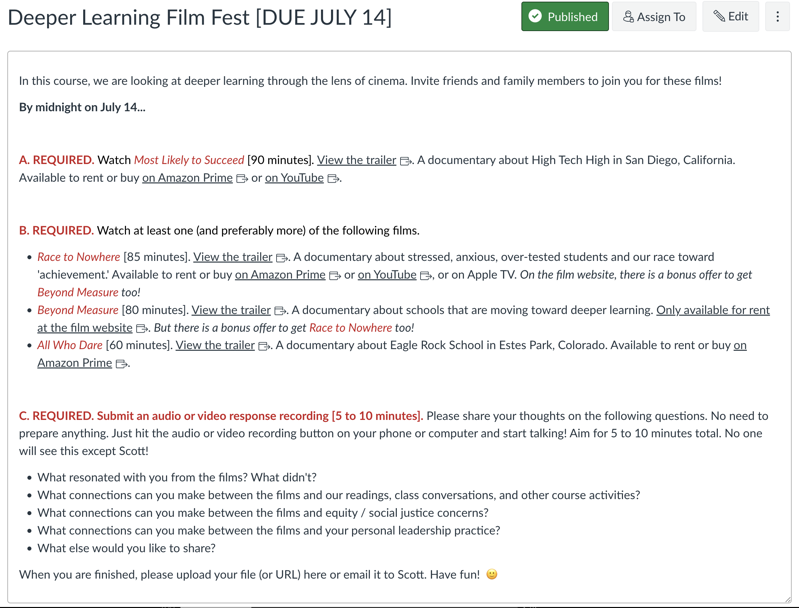
One of our course assignments is our Deeper Learning Film Fest. In addition to The First Class, each student will watch Most Likely to Succeed and at least one of the following: Race to Nowhere, Beyond Measure, and/or All Who Dare. Students then will submit an audio or video response in July, reflecting on what they saw in the films and responding to some prompts that I gave them. Additionally, I am including one or more shorter videos each week that show deeper learning (or the opposite) in action in schools across the country.
End-of-class evaluations for the first week were overwhelmingly positive. I feel like we are off to a good start and am looking forward to a fun summer talking about deeper learning!
Our readings / viewings for Class 01 are listed below. The theme for the evening was Cracks in the Foundation.
Master core academic content.Students develop and draw from a baseline understanding of knowledge in an academic discipline and are able to transfer knowledge to other situations.
Think critically and solve complex problems.Students apply tools and techniques gleaned from core subjects to formulate and solve problems. These tools include data analysis, statistical reasoning, and scientific inquiry as well as creativity, nonlinear thinking, and persistence.
Work collaboratively.Students cooperate to identify and create solutions to academic, social, vocational, and personal challenges.
Communicate effectively.Students clearly organize their data, findings, and thoughts.
Learn how to learn.Students monitor and direct their own learning.
Develop academic mindsets.Students develop positive attitudes and beliefs about themselves as learners that increase their academic perseverance and prompt them to engage in productive academic behaviors. Students are committed to seeing work through to completion, meeting their goals, and doing quality work, and thus search for solutions to overcome obstacles.
This culture [in American schools] has been defeating people who try to change it for decades. . . . If you ask people to do high level work in classrooms in the current culture, they will do low-level work and call it high-level work.
Schools have a long history of announcing that we are now doing that new thing! and yet… school still feels mostly the same, particularly in core courses. We simply absorb the innovation like an amoeba, weakened into whatever form can be easily ingested without much concern, and then move on with little or no disruption to current internal practice. As I look over the Hewlett list, I can see many schools saying, “Yeah, we already do that.” Put another way, as we said in Leadership for Deeper Learning (2021):
the standardized model of education has deep roots and sharp claws, which help it fend off its challengers. . . . [t]hrough both active opposition to change and sheer historical inertia. (pp. 1-2)
emerges at the intersection of three virtues: mastery, identity, and creativity. . . . students [have] opportunities to develop knowledge and skill (mastery), they [come] to see their core selves as vitally connected to what they [are] learning and doing (identity), and they [have] opportunities to enact their learning by producing something rather than simply receiving knowledge (creativity). (p. 6)
I like their definition a lot better! Jal and Sarah recognize that mastery goes beyond just academic content, lean hard into student identity and ownership, and stress that making something is more impactful than simply reading, listening, and regurgitating.
One of the best definitions of powerful learning that I’ve ever encountered comes from Seymour Sarason, who said simply that “productive learning . . . engenders and reinforces wanting to learn more” (p. x). Many of our current instructional practices leave students wanting more, but not in that way!
In my own interactions with schools and educators, I have been trying to articulate deeper learning in terms of what we probably will observe when we visit:
hands-on, active, holistic experiential learning by students;
high levels of student agency, voice, choice, and ownership;
deep, robust student creativity, critical thinking, and collaboration;
student acquisition of ‘durable skills’ beyond low-level factual and procedural content;
students who are engaged in authentic, interdisciplinary, real-world work and problem-solving;
students who are making positive impacts in local or global contexts;
place-based, community-engaged partnerships;
extensive utilization of performance assessment models; and/or
creative and empowering student use of digital tools, learning technologies, and online platforms.
Each of these elements could be dissected in more detail but, if you ever get to visit a present-day ‘deeper learning school,’ you likely will see many / most of these. I am sure that this list is incomplete, but it is my current go-to operational definition. You will see a strong emphasis in my definition on students doing things that feel meaningful and relevant and actually matter. What would you add or change? How are you defining ‘deeper learning?’
I kicked off a new principal licensure cohort this week. It’s always fun to meet a fresh group of graduate students for the first time. They bring new energy and perspectives, new experiences and expertise, and new questions and concerns. I am going to really enjoy getting to know these folks over the next four semesters.
For my principal cohorts, the topic of our first class is always What is the job of schools these days? We are going to spend a year and a half talking about how to effectively lead today’s schools. Whenever I can, I also try to insert some discussion about how we should be building and leading tomorrow’s schools. Our very first evening together is meant to insert some uncertainty about current practices, and to spark some robust thinking about what our students, graduates, families, and communities really need from our schools versus what we’re actually doing and providing on a day-to-day basis.
One of the questions that I asked on Tuesday night was What percentage of incoming Colorado 9th graders will graduate high school on time and then also complete a 4-year college degree within six more years? In other words, what percentage of today’s 9th graders in our state will have a 4-year college degree in hand ten years later? Guesses from my students varied. The correct answer is about 26%.
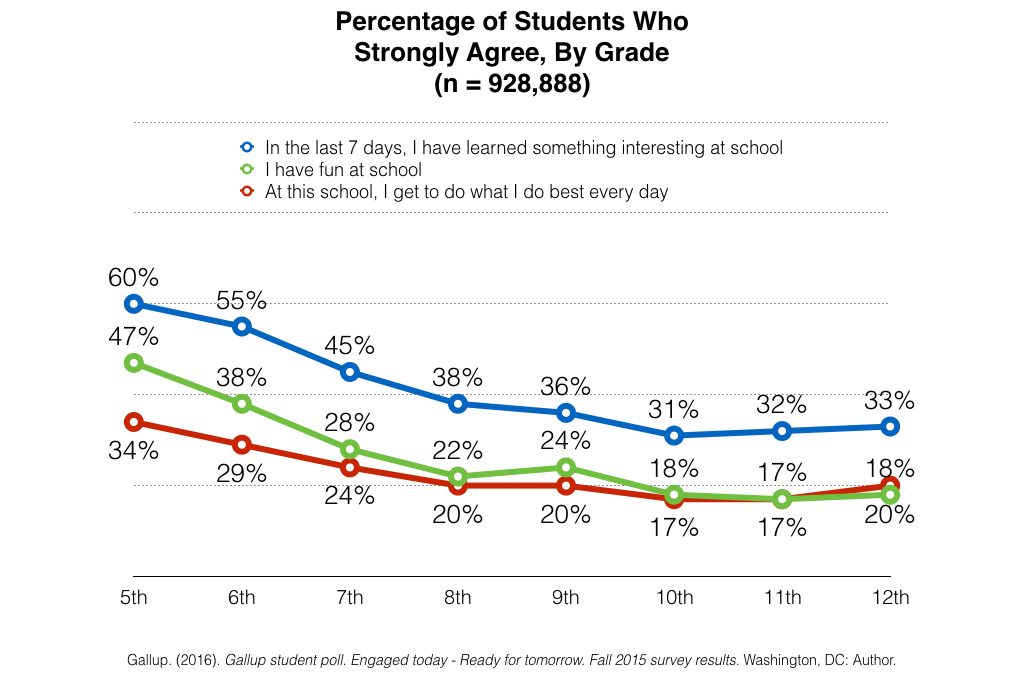
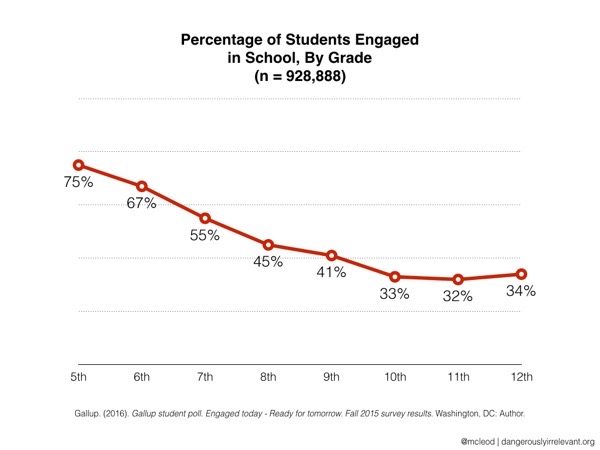
We also talked about the national data showing that most high school students are extremely disengaged from their classroom learning experiences. These data are confirmed anecdotally by observations regarding student apathy and boredom in our own local high schools. Even if students are compliant, they’re mostly going through the motions and hoping that whatever comes next is more interesting. I asked my graduate students – all P-12 educators – if they thought that their high schools were designed for the needs and interests of the aforementioned 26% or the remaining 74% of the student body. Said a different way, are the structures and processes of high schools primarily oriented toward the top quarter? Who thrives and has a strong sense of success, belonging, and self-efficacy in our high schools?
My students all pretty much agreed that the design, practice, instruction, grading systems, student recognitions, and other processes of their high schools were aimed primarily at the 26%, with lots of hope that the remaining students would be more like the top quarter. We also noted that, when push comes to shove, the high-capital families of high-achieving students typically prevail whenever there is a discussion regarding ‘what is best for students.’
I closed our conversation with the observation that if we design our high school learning experiences around the 26% rather than the 74%, we shouldn’t be surprised when our student engagement data look like this:
Episode 005 of the new CASTLE Conversations podcast is now available on most major podcasting platforms. I had a super fun discussion with John Spencer, who helps educators and schools think about all sorts of cool stuff, including technology integration, AI, design thinking, and project-based learning.
[I realized that I am way behind on posting recent podcast episodes, so I am catching up!]
Recently I had the opportunity to appear on the Education Matters podcast with Jason Buccheri. Jason was an awesome host and we talked for a long time about deeper learning, models of organizational change, reclaiming joy in school, empowering students through technology, and … surprise, AI! … among other topics. Also, Jason has superb production skills if you ever need podcasting assistance or training. I hope that the episode is useful to you.



![AI in the classroom: Building digital citizenship from the inside out [NAESP]](http://dangerouslyirrelevant.org/wp-content/uploads/2025/11/NAESP-Podcast-1080x675.jpeg)

![Project-based learning in early childhood [NAESP]](http://dangerouslyirrelevant.org/wp-content/uploads/2025/06/NAESP-Logo-Square-1080x675.jpg)