
I kicked off a new principal licensure cohort this week. It’s always fun to meet a fresh group of graduate students for the first time. They bring new energy and perspectives, new experiences and expertise, and new questions and concerns. I am going to really enjoy getting to know these folks over the next four semesters.
For my principal cohorts, the topic of our first class is always What is the job of schools these days? We are going to spend a year and a half talking about how to effectively lead today’s schools. Whenever I can, I also try to insert some discussion about how we should be building and leading tomorrow’s schools. Our very first evening together is meant to insert some uncertainty about current practices, and to spark some robust thinking about what our students, graduates, families, and communities really need from our schools versus what we’re actually doing and providing on a day-to-day basis.
One of the questions that I asked on Tuesday night was What percentage of incoming Colorado 9th graders will graduate high school on time and then also complete a 4-year college degree within six more years? In other words, what percentage of today’s 9th graders in our state will have a 4-year college degree in hand ten years later? Guesses from my students varied. The correct answer is about 26%.
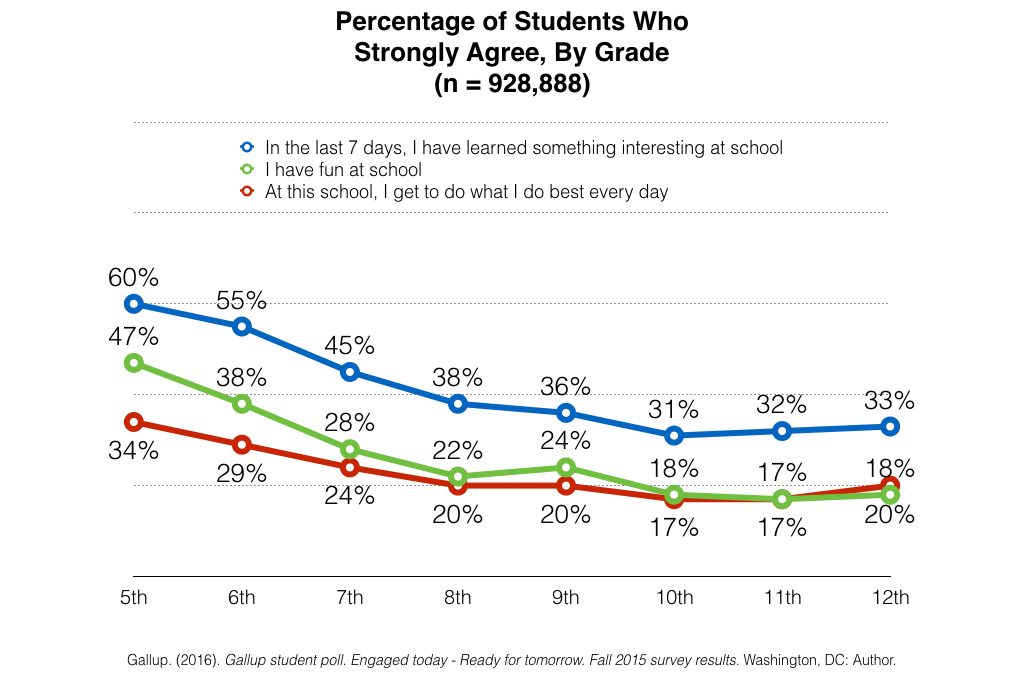
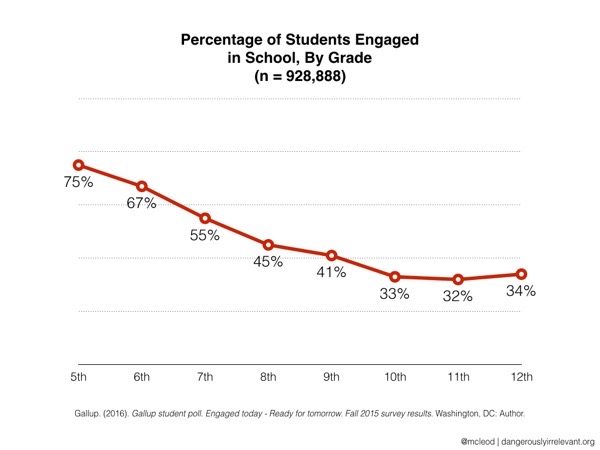
We also talked about the national data showing that most high school students are extremely disengaged from their classroom learning experiences. These data are confirmed anecdotally by observations regarding student apathy and boredom in our own local high schools. Even if students are compliant, they’re mostly going through the motions and hoping that whatever comes next is more interesting. I asked my graduate students – all P-12 educators – if they thought that their high schools were designed for the needs and interests of the aforementioned 26% or the remaining 74% of the student body. Said a different way, are the structures and processes of high schools primarily oriented toward the top quarter? Who thrives and has a strong sense of success, belonging, and self-efficacy in our high schools?
My students all pretty much agreed that the design, practice, instruction, grading systems, student recognitions, and other processes of their high schools were aimed primarily at the 26%, with lots of hope that the remaining students would be more like the top quarter. We also noted that, when push comes to shove, the high-capital families of high-achieving students typically prevail whenever there is a discussion regarding ‘what is best for students.’
I closed our conversation with the observation that if we design our high school learning experiences around the 26% rather than the 74%, we shouldn’t be surprised when our student engagement data look like this:
Your thoughts?


Optional Textbook Scott: https://www.amazon.com/Real-Learning-Accomplishment-Schools-that-ebook/dp/B0FR6P9DDM/ change back from your $3 bill