by Scott McLeod | Jun 15, 2011 | 21st Century Skills, Higher Education, Leadership and Vision, Our Changing World, Pre-Service Preparation, Slides, Workforce and Economy |
Well, I finally wrote the article I always wanted to write: a letter to my 3,000+ faculty peers in Educational Leadership preparation programs all across the country about how our collective inattention to technology-related issues is an embarrassing indictment of our lack of relevance:
Regular readers of this blog will recognize some of the language that I used in my broadside against my own profession. Here are a few quotes to whet your appetite:
We also are witnessing the early adolescence of a vastly different global economy. For instance, the rapid growth of the Internet and other communication technologies has accelerated the offshoring of jobs from the developed world. Complex corporate global supply chains locate manufacturing work wherever costs are lowest, expertise is highest, or necessary talent resides. Geographic or product niche monopolies disappear in the face of Internet search engines. Micro-, small-batch, and on-demand manufacturing techniques facilitate customized, personalized production. Whatever manufacturing work remains in developed countries is high skill, is high tech, and, more often than not, requires greater education than a secondary diploma. The low-skill industrial system that was the backbone of the developed world’s economies in the previous century is increasingly a bygone memory.
Like manual work that is non-location-dependent, knowledge work also is frequently done cheaper elsewhere. Service jobs are increasingly fungible, able to be located anywhere in the world that has an Internet connection. Ongoing workflow and final products are exchanged at the speed of light via e-mail, instant messaging, and other corporate networking tools. The same technologies that facilitate interconnected global conversations also facilitate interconnected global commerce. As was done in previous decades for manufacturing work, the next two decades will see many complex service jobs broken up into component parts. Once these tasks are disaggregated, they will be done by lower-skilled workers who can do these discrete components of the overall work, facilitated by software. In other words, many high-paying service jobs will turn into globalized piece work. Since the service professions represent over three-fifths of America’s economy, the impacts of this are going to be quite significant.
AND
If every other information-oriented societal sector is finding that transformative reinvention is the cost of survival in our current climate, schools and universities shouldn’t expect that they somehow will be immune from the same changes that are radically altering their institutional peers. We shouldn’t pretend that these revolutions aren’t going to affect us too, in compelling and often as yet unknown ways. And, yet, for some reason we do.
As long-existing barriers to learning, communicating, and collaborating disappear – and as what it means to be a productive learner, citizen, and employee shifts dramatically – it’s worth asking how we as educational leadership faculty and programs are responding. Are we doing what we should? To date the evidence is pretty clear that most of us are not.
AND
Can we as educational leadership faculty do better? Given the scale and scope of the transformations occurring around us – and their power and potential for student learning – we MUST do better. It’s embarrassing to consider how little we’ve done to stay relevant. A learning revolution has occurred and – given the attention we’ve paid it – it’s as if many of us didn’t care.
AND
We know, simply from projecting current trends forward, that in the future our learning will be even more digital, more mobile, and more multimedia than it is now. It will be more networked and more interconnected and often will occur online, lessening dependence on local humans. It frequently will be more informal and definitely will be more self-directed, individualized, and personalized. It will be more computer-based and more software-mediated and thus less reliant on live humans. It will be more open and more accessible and may occur in simulation or video game-like environments. And so on. We’re not going to retrench or go backward on any of these paths. We thus need school leaders who can begin envisioning the implications of these environmental characteristics for learning, teaching, and schooling. We need administrators who can design and operationalize our learning environments to reflect these new affordances. We need leaders who are brave enough to create the new paradigm instead of simply tweaking the status quo and who have the knowledge and ability to create schools that are relevant to the needs of students, families, and society.
Like teachers, administrators, and media specialists, educational leadership faculty have a voluntarily-assumed (and paid) responsibility to be relevant to the needs of children and education today and to prepare administrators as best we are able for tomorrow. Our professional priorities must be aimed at preparing our graduates for the world as it is and will be. Otherwise, what are we here for? In other words, who’s going to prepare these school leaders if we don’t?
Please share this widely
Want to help further my cause of fostering technology-savvy school leaders? Share the Summer 2011 issue of the UCEA Review with any Educational Leadership faculty members that you know. I also think the article is good reading for most practicing administrators; in 4 short pages it sums up much of what I think principals and superintendents should be thinking about right now regarding 21st century schooling. Other great reads in the issue include Matt Militello’s article on technology integration challenges (p. 15), Jon Becker’s article on open access (p. 17), and the interview with John Nash (p. 12), one of my CASTLE co-directors.
All thoughts, reactions, and suggestions regarding my article are most welcome. The ironies of publishing my piece in a print / PDF medium are not lost on me, but sometimes you have to put your writing where your intended audience can find it.
Happy reading!

by Scott McLeod | Apr 29, 2011 | 21st Century Skills, Leadership and Vision, Learning and Teaching, Our Changing World, Tech Integration |
You’re about to hand laptops over to their 12– and 13–year-old children. What do you tell your school’s parents? Here are some excerpts from what , ICT Director for the Diocesan School for Girls in Auckland, New Zealand, told his…
—-
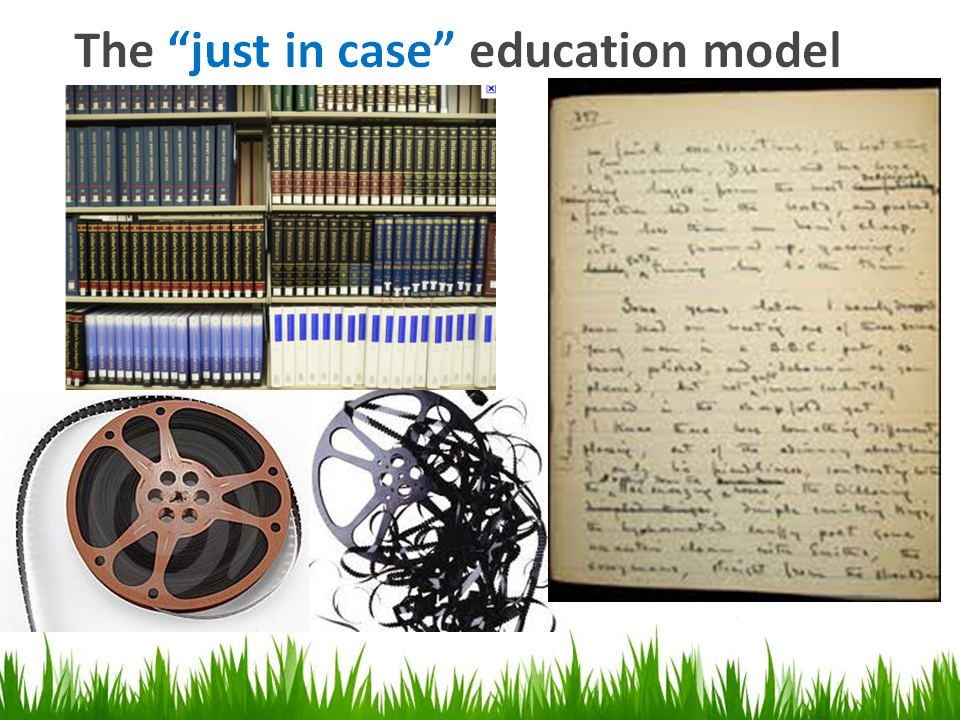
“Most of us went through school and, by and large, succeeded. When we had education done to us, we experienced what I call the “just in case model” of education. We learned things just in case they might be useful. Just in case they might be on the test. Just in case we might look for a job in that area. Just in case you might study physics later on.
And a key reason that education developed this model was that the predominant mode of teaching, and hence learning, relied on the predominant technology of the day: paper. . . .
The system kind of worked for a couple of reasons:
- Not much had changed in the information landscape over the 20th century in terms of what was written down and accessible to students.
- It was too expensive and lengthy to rewrite textbooks all the time.
Right up until 1986, all of the information that mankind had collated since the dawn of time – all 2.64 billion gigabytes of it – only 0.02 billion gigabytes was digital. So over 99% of the information we had to work with was analog - written down.
What we have witnessed in the past 10 years is unprecedented growth in information – all of it digital. From our 2.6 billion gigabytes in 1986, we now have well over 400 billion gigabytes of collective human information – and growing at a rate of 5 billion gigabytes every 3 days according to Google. The big difference now is that – since 2001 when traditional paper-based information and digital information gained parity – digital data now accounts for well in excess of 95% of all information. The info landscape reversal looks like this…

If you were charged with designing a new model for education – and you came to the conclusion that you could ignore 95% of available information and operate without the “tool of the time” – would your system be given the go ahead?
By the way – this is also the reason why everyone – not just students – should be online and connected. To not be is shutting off 95% of what’s happening.
But we need do more than just equip ourselves – our model needs to change from “just in case” to “just in time.”
You see, with such dramatic changes in information, we can no longer rely on outmoded means of working. We’ve seen what happens to organisations that don’t adapt to the digital world – CD stores and book store chains are recent examples in New Zealand.
The same for education. No longer does it make sense to focus on content just in case it might be useful. . . .
What has become important is the “just in time” model. A model which sees essential habits and attitudes of learning being the focus. A model which sees the ability to think about our own thinking as a focus.
And expect to see traditionally-held beliefs challenged. Here is a model of the human brain showing the areas that are being engaged as the same person (an experienced Web surfer) reads a book and, at a separate time, is browsing the Web.

Let’s debunk a myth or two: Writing will be affected. Well, looks like that may be correct.
Point England School has had its kids blogging for a couple of years. One of the outcomes is that its students’ achievement in writing and reading have increased dramatically over this time. They don’t write earth shattering stuff all of the time – take Silas’ story, for example. But someone made a comment that wasn’t from his class … or school … or country. How cool is that for a young writer?

In early 2009 we ran a trial program with Year 9 students. It ran for four weeks and they studied the Horizon Report, a report focussing on emerging technologies in education. Their project finished in April 2009. We now find that the web site they created is accessed by around 50 to 60 people per day from the U.S., Canada, the U.K. Australia, Russia, Ireland… Obviously the work they did has some value for a lot of people in other parts of the world.
My 13–year-old son: “Can I have a guitar?” Great, another fad. What about some lessons? “No thanks. I’ll learn online.” So he goes to YouTube and does just that – for hours. He played lead guitar at his school’s end-of-year function last year.
Me? I don’t read much and certainly don’t write much. And yet my blog is read in 30 countries and – because of the usefulness of RSS – I now get what I am interested in reading delivered to my phone, iPad, and computer every minute. I read far more than I did because I can…
. . . .
You may know that New Zealand has a digital strategy. It’s tucked away on the Ministry of Economic Development’s web site. It says this: “New Zealand will be a leader in the use of information and technology to realize its economic, social, environmental and cultural goals, to the benefit of all of its people.”
How many other countries have a digital strategy? And how many of them are putting education at the front end?

Peru, Afghanistan, Madagascar, Paraguay: just some of the countries involved in the One Laptop Per Child campaign aimed at trying to bring kids in developing countries on some kind of level playing field with kids in other countries.
In New Zealand, for education the government sees up to 100Mb bandwidth in 97% of schools by 2015. Too little, too late?
. . . .
What we need to do is to build the skills and attitudes with your daughters so that they can take advantage of the huge opportunities that await.
You need to give your daughters the opportunity to succeed in this ever-changing world. At the moment that means a laptop computer now is basically a table stake.”
—-
Nicely done, Rob, nicely done. Those of you with laptop and other learning technology initiatives, how have you framed the conversation with your parents?

by Scott McLeod | Mar 14, 2011 | 21st Century Skills, Leadership and Vision, Learning and Teaching, Tech Integration |
Let’s dream for a minute. What if we lived in a world in which students and educators…
- had access to all of the information in their textbooks – and an incredible wealth of primary documents – for free?
- had access to free, robust, and often multimedia and interactive learning resources (texts, images, audio, video, games, simulations) to supplement and deepen what was being learned in school?
- photo © 2010 [F]oxymoron | more info (via: Wylio)could easily learn from and with students and teachers in other states or countries?
- could easily and quickly connect with authors, artists, scientists, business professionals, entrepreneurs, craftsmen, professors, and other experts?
- could more authentically replicate and/or actually do real-world work through the use of the same tools and resources used by scientists, engineers, designers, accountants, and a multitude of other professionals and artisans?
- could easily share their own knowledge, skills, and expertise with people all over the world?
- could easily and quickly find or form communities of interest around topics for which they were passionate?
- could be active (and valued) contributors to the world’s information commons, both individually and collaboratively with others?
- essentially had the ability to learn about whatever they wanted, whenever and wherever they wanted, and to contribute to this learning environment for the benefit of others?
Wouldn’t the possibilities for learning and teaching in this kind of world be both amazing and nearly limitless? If this world existed, wouldn’t we as educators and parents and policymakers do everything we could to help students and schools take full advantage of these learning affordances? If we actually had access to this world, wouldn’t we be chomping at the bit to get these resources into the hands of kids and teachers?
Oh, wait a minute… Apparently not.
What if a learning revolution occurred and many of us didn’t care?
by Scott McLeod | Oct 22, 2010 | 21st Century Skills, Leadership and Vision, Learning and Teaching, Our Changing World |
[cross-posted at The Huffington Post]
I’ve watched this TED talk by Sugata Mitra several times now. And every time I watch it, my brain keeps asking the same question:
In the world’s richest country - indeed, in all ‘Westernized’ societies - what are our (pitiful?) excuses, again, for not putting computers in the hands of our children every day at school and giving them greater agency over their own learning?
[I love the Indian child’s quote: ‘Apart from the fact that improper replication of the DNA molecule causes genetic disease, we’ve understood nothing else.’]

by Scott McLeod | Sep 29, 2010 | 21st Century Skills, Leadership and Vision, Learning and Teaching, Our Changing World, Pre-Service Preparation, Tech Integration |
Steve Dembo said:
I don’t see it as teachers spurning technology, or choosing not to take advantage of those new ideas and tools. I think most teachers don’t even realize that there’s a decision to be made. It’s not a matter of choosing the red pill or the blue pill… if you don’t know that there are even two pills available as options.
… A teacher that has never heard of Blabberize or Glogster or Prezi, has never been introduced to the new world of online applications that are available to them. They likely don’t follow blogs or listen to podcasts. They have probably never been to an EdTech conference or seen a TED talk. In short, they’re just ordinary, average educators who aren’t aware that there’s a whole other world that they have easy access to… if they just ‘take the blue pill’.
… I’m all for conversations about ‘big’ change. And yes, I agree, it’s not the technology, it’s the pedagogy. However, I also think that you need at least a minimal base to build from before you can have those conversations. And the vast majority of the educators in this country do NOT have that base yet.
Every day that I present for educators, I have a greater appreciate for how distorted the view is as seen through the eyes of a typical EduBlogger. In fact, the majority of the voices in the EdTech Community are so far ahead of the curve that it doesn’t even seem like their on the same road anymore. Most educators have never listened to a podcast, much less created one. They’ve never edited a wiki, much less started one of their own. So how on earth could they be expected to have a rational conversation about the impact new technologies are having on the skill sets our students need? Simply put, they can’t. The majority of the voices many of us listen to on a regular basis… actually represent just a tiny fraction of the educators out there. We’re the minority, the outsiders, the ones who talk using strange terms involving words with far too many missing vowels.
Darren Draper said:
the large majority of teachers that I know are very caring individuals that believe firmly in life-long learning. Most love teaching because making a difference in the lives of our youth can be the most rewarding profession on the planet. Most love kids, love community, and want to share. It’s not that they don’t want to try new things, it’s not that they’re lazy, and it’s not that they’re incapable. Rather, it’s that their priorities don’t always line up with those of other progressive educators in and out of the blogosphere. I’m not saying it’s right, but I am trying to describe the reality that so many in the blogosphere seem to misunderstand.
Darren also said:
Those content to lurk but still hesitant (or unable, for whatever reason) to contribute.
The fact of the matter is that there exist a very large number of effective educators that are simply not able to contribute in any significantly recurrent amount to online discussion. All told, it’s not that they’re incapable of participating and it’s not that they’re unwilling. Rather, this group maintains perceived silence online because their professional priorities prohibit them from spending the time or energy required to provide plausible contribution.
To which I say, NO, WE CAN’T LET EDUCATORS OFF THE HOOK. Whether they’re teachers or administrators or librarians or education professors, they have a voluntarily-assumed, paid responsibility to be relevant to the needs of children and education TODAY and to prepare graduates as best they are able for TOMORROW. ‘Professional priorities’ must be aimed at preparing students for the world as it is and will be. Otherwise, what are educators there for?
You can’t ‘firmly believe in life-long learning’ and simultaneously not be clued in to the largest transformation in learning that ever has occurred in human history. Those two don’t co-exist. Being a ‘life-long learner’ is not ignoring what’s going on around you; you don’t get to claim the title of ‘effective educator’ if you do this.
Look, it’s not like those of us who now ‘get it’ were born with this knowledge. We weren’t like this at the beginning. At some point in our personal histories we were the same as these educators that for some reason now get to be labeled as ‘unable’ to do this. Unable to do this? Poppycock. At no time in the personal computer / Internet era has this technology and social media stuff been easier to initiate. It’s not like back when you needed to know computer coding. Want to use a wiki? Click Edit; type; click Save. Want to leave a comment on a blog? Click on Comments; type in your name, e-mail, school web site, and comment; click on Save. There isn’t an educator alive who ‘can’t do that.’ They engage in similarly-easy activity every time they search or order something online.
The reason many of us now ‘get it’ is because we realized that the world is changing, we recognized our responsibility to our students and schools, and we dived in and learned as we went along. Changing inertia into momentum, not waiting for someone to hand us the answer, taking responsibility ourselves rather than blaming others for our own inactivity – that’s what life-long learners do. That’s what effective educators do. That’s what we owe our children.
If you’re a teacher / administrator / librarian / education professor that somehow ‘doesn’t even realize [yet] that there’s a decision to be made,’ should you even be working in a school or university? Don’t our children and our school systems need and deserve someone who’s in a different place than you are? It’s one thing to still be a learner; heck, we’re all learners with this technology stuff. It’s another to opt out or not even recognize the choice. If we look at what our kids need, shouldn’t we replace you with someone else?
It’s not about us. It’s not about our personal or professional priorities and preferences, our discomfort levels, or any of that other stuff that has to do with us. It’s about our students: our children and our youth who deserve at the end of their schooling experience to be prepared for the world in which they’re going to live and work and think and play and be. That’s the obligation of each and every one of us. No educator gets to disown this.
We can’t let educators off the hook. Not a single one. So keep that fishhook firmly wedged in their mouths. Keep tugging them along on the line. Keep scooping them up in our nets. Feed them tasty tidbits if need be. Do whatever it takes to make this happen. But insist on them doing the same.

Image credits: My fish hook; Slide – Should teachers get to choose?

by Scott McLeod | Sep 27, 2010 | 21st Century Skills, Assessment, Guest Bloggers |
Last week was another phenomenal week of guest blogging here at Dangerously Irrelevant. I had invited guests to reflect on how to reconcile standards- and data-driven accountability with so-called ‘21st century skills.’ Some of the best posts of the week were when my guests all but ignored the assignment!
Here are all of the posts from last week:
- An Apple (Inc.) in 21st century classrooms
- How to teach for jobs that don’t exist
- Ignore the test
- Teach wisely, teach well
- Can we just skip the whole “data-driven” part if the technology is free?
- Collaboration: The lost skill?
- The death of subjective values
- 26 centuries of skills
- Writing – The elephant in the class room
- Reclaiming the language
- To whom are we accountable?
- It’s all about building culture
- Can states assess creativity?
- Sharing reconciliation with the people formerly known as the audience
Thank you Shawn, Aaron, Jason, Karen, Kyle, Tony, Carl, Dave, Joe, Dan, Matt, Tyler, Richard, and Andrew for an incredible week of writing, thinking, and reflecting. I am humbled by the thoughtfulness (and excellence) of your work and your willingness to share your perspectives with me and my readers.
Happy reading, everyone. I strongly encourage you to click through at each post and see my guests’ other writing. Also, feel free to forward this wrap-up post on to your local school administrators and/or university educational leadership professors; there’s lots of good stuff here for them and/or their students!

by richardkassissieh | Sep 26, 2010 | 21st Century Skills, Assessment, Guest Bloggers, Learning and Teaching |
by Richard Kassissieh
 A student gazes at a mystery solution. Its contents are unknown. The student reaches into her toolkit, a set of known solutions, and one by one, combines them with a small portion of the mystery solution. One test changes the color to bright yellow. Another produces a milky, solid substance. Gradually, the student pieces together the clues that allow her to identify the unknown solution.
This qualitative analysis laboratory required the student to recall properties of different solutions, understand reaction processes, and synthesize the results of different experimental tests while under pressure. To practice, the student had worked together with classmates to identify a series of mystery solutions and shared their findings with their classmates.
Did this performance assessment play out in the classroom of an innovative, 21st-century educator? No, the qualitative analysis laboratory has been part of British national chemistry examinations for decades.
It is tempting to rail against high-stakes state tests in the United States. They emphasize basic skills and fact recall, pressuring school districts to strip programs to the basics and eliminate or reduce “non-core” subjects such as art and history. For example, many school districts “double dose” language arts and mathematics classes in order to improve students’ performances on state tests (see this EdWeek article).
Are large-scale, standardized assessments bound to forever measure a narrow range of skills and knowledge?
Summative work has to insist on standards of uniformity and reliability in collection and recording of data, which are not needed in formative work, and which inhibit the freedom and attention to individual needs that formative work requires.
External tests which are economical are bound to only take a short time. Therefore, their reliability and validity are bound to be severely constrained: they can only use a limited range of methods and must be limited in respect to their sampling of relevant domains.
Paul Black, Testing: Friend or Foe?
On a brighter note, some national assessments include hands-on performance assessments. Not only do we have the IGCSE national examination described above, but the U.S. Advanced Placement examinations test higher-order thinking skills through essays in many subjects and the submission of a portfolio of work in art.
The International Baccalaureate program, originally from Switzerland and growing in popularity in the U.S., includes summative assessments that measure creative problem solving, analysis and presentation of information, and argumentation (IB Diploma Programme Assessment Philosophy).
The Partnership for 21st Century Skills reports on work in progress in several states to develop “demonstrations of 21st century skills graded based on a common rubric” (p21.org).
The U.S. college admission process represents another effort to assess higher-order thinking skills fairly across a broad pool of candidates. Most selective colleges use multiple measures to evaluate students: essays, standardized test scores, lists of accomplishments, interviews, the reputation of one’s high school, and letters of recommendation.
It may well be possible to develop standardized assessments that measure 21st century skills. Cost is the main obstacle. How much would it cost to systematically test problem-solving, collaboration, and presentation skills across all U.S. schools?
Though we may see inconsistencies between standardized assessments and 21st century skills, we can advocate for an increased role of performance assessment and the assessment of higher-order thinking skills in these high-stakes tests.
Richard Kassissieh is director of information technology at Catlin Gabel School (Portland, Oregon, U.S.A.) You may find him at http://kassblog.com and @kassissieh.
Photo credit: judybaxter on Flickr

by Joe Bower | Sep 24, 2010 | 21st Century Skills, Assessment, Guest Bloggers, Learning and Teaching |

Have you ever taken part in a conversation about progressive education or school reform and left the dialogue wondering if you were even talking about the same topic? Often I’m left wondering how this can happen. How can two people talk about the same topic with very similar vocabulary, and yet be having two separate conversations at once?
It would be convenient if we could simply differentiate the discussion via politics; however, it would also be inaccurate. There’s a reason why Rep. John Kline (R-MN) recently remarked with chilling accuracy that the Obama-Duncan education game plan is “straight from the traditional Republican playbook.” The larger point to be taken here is that it doesn’t matter whether you are speaking with a liberal, a conservative, a Democrat, a Republican, reading the Washington Post or Newsweek – when it comes to education, most of them are indistinguishable from Fox News.
So how do we differentiate between the authentic and the rhetoric? In his article The Case Against ‘Tougher Standards’, Alfie Kohn states, “Today, it is almost impossible to distinguish Democrats from Republicans on this set of issues — only those with some understanding of how children learn from those who haven’t a clue.” So who has a clue?
To sort out who does and who doesn’t, I think we need to understand how one Washington DC activist put it, “It’s gotten to the point where I’m almost embarrassed to be associated with the word ‘reform'”. There is nothing inherently wrong with school reform – but there is something amiss with the way the word has come to be defined. Words like achievement, data, 21st century skills and accountability have been bastardized by those who haven’t a clue about real learning.
A real discussion about 21st Century education would require us to understand how wrong we got it in the 20th Century. Some might say that there is a war going on in schools between behaviourism and constructivism and the kids are losing while others have written “One cannot understand the history of education in the United States during the twentieth century unless one realizes that Edward K. Thorndike won and John Dewey lost.”
If we really want to have an authentic discussion about 21st Century education and data-driven accountability then we better reclaim the language.
ACCOUNTABILITY: in it’s current context, accountability is simply a code word meaning more control for people outside the classroom over those who are inside the classroom. Ever wonder why we can’t get school reform right? I won’t profess to have the definitive answer, but I have a feeling it has something to do with the fact that education is being run by people who have no practical experience or professional training in how children learn. What’s worse is that these clueless dictators have the audacity to enforce their ignorance through manipulative legislation, and when those who know better speak up, they are beat down by the accountability club.
So how do we reclaim the word accountability? We need to redefine it. John Spencer, a teacher from Arizona, says “accountability should mean that when you wander off too far, there is a group of people calling you back and saying, ‘Look, you belong here. You are important to us.'” For those who claim we need accountability in its current form, I encourage them to look to Finland who don’t even have a word in their language for accountability, so they use responsibility – the difference being much more than simple semantics.
DATA: Number crunching, data mongers see children as data-in-waiting. Their bodies are simply transportation devices for their number two pencils. And yet, one test isn’t even enough for these spreadsheet junkies, so they feed their mania for reducing everything to numbers by having tests that prepare kids to take a benchmark test before they take the test. Sadly, the worst teachers don’t teach to the test any more, they test to the test. The problem here is that if their goals are simply higher test scores (raise achievement) then their methods are not going to be worth much. In other words, even if we achieved all the test scores the policy makers could ever want, we would end up providing the kids with nothing they really need. Things go very, very wrong when a teacher knows more about how to raise a kid’s test score than how to raise a kid.
If we want to reclaim data, and we do need to, we need to stress that real learning is found in children not data. The best teachers never need tests to gather information about children’s learning nor do they need grades to share that information with others. They know that there is no substitute for what a teacher can see with their own eyes when observing and interacting with students while they are learning, and any attempt to reduce something as magnificently messy as real learning will only ever conceal more than it will reveal. I might go so far as to say that the best educators in the 21st Century understand that “measurable outcomes may be the least significant results of learning” except that this has been true in every century. Anyone using data must understand that what we see largely depends on what we look for and there’s a huge difference between valuing what we measure and measuring what we value – but again, this is true regardless of the date on the calendar.
21st CENTURY SKILLS: Unfortunately, most people who speak about 21st Century Skills actually think that something changed because the date on the calendar advanced. They also (mis)assume that we are in some competitive race for the finish line – except there’s no competition and there’s no finish line. Education reform built on the foundation of competition is a house of cards just waiting to be toppled over.
If we really care about getting school reform right in the 21st Century, then we have to go back to two men from the previous century who have framed how we think of truly progressive education – John Dewey and Jean Piaget.
Dewey’s message focused on democracy as a way of life, not just a form of government, and that “thinking is something that emerges from our shared experiences and activities.” Piaget taught us that “even very young children play an active role in making sense of things, ‘constructing’ reality rather than just acquiring knowledge.
If we take the work of Dewey and Piaget seriously, we have to acknowledge that the best kind of education we can provide our children has nothing to do with the date on the calendar and more to do with understanding how children learn.
In the end, I have one question about the 21st Century: will the politicians and policy makers figure out what Dewey and Piaget figured out in the 20th Century, and will they listen to the modern day education experts such as Linda Darling-Hammond, Deborah Meier, Alfie Kohn, Yong Zhao and Constance Kamii before we get to the 22nd?
——
Joe Bower teaches in Red Deer, Alberta, Canada and is the author of for the love of learning.

by danmcguire | Sep 24, 2010 | 21st Century Skills, Assessment, Guest Bloggers, Learning and Teaching |
In the 35 years since I got my first job teaching writing, a few new tools that make writing easier have been invented. I used a retractable fountain pen, one of the green marble ones, when I was in 3rd grade to write those ‘important papers’ – really messy. I thought mechanical pencils were cool -I think the ones I used worked better than the cheap ones floating around my class these days. Copiers were a big improvement over mimeographs; computers are way better than IBM Selectrics which were way better than Remington ‘portables.’
For the last three years, the 21st Century tool, Moodle, has enabled me to make writing fun for 8 and 9 year olds, the ones who start welling up with tears when you tell them that all of the words they just managed to get on a piece of paper with a pencil should be reordered or changed. A word processor and the Moodle software make editing, all that adding and subtracting of words, peer comments, and teacher comments easier and doable for the young minds and fingers that are still wrestling with this puzzle called written language. (I share Donald Murray’s notion that writers never really quit wrestling with language.)
Moodle was designed in the early days of this century as a distance learning tool. It’s rapidly becoming an invaluable tool for teaching in all kinds of classrooms. There are over a million teachers in over 200 countries using it, so far. Last spring on Earth Day, my class was paperless for the day. We took a learning walk and explored the history and science rich neighborhood near our school. I posted this and and a few other photos when we got back from our walk. In less than an hour my students had posted over a hundred comments on the pictures. (With a click or two, I can show them to you, too.)
Moodle also enables me to post pictures from our sessions with the U of Mn Teaching Smart scientists that then serve as prompts for my students to go deeper into their understanding of the activities they do with the scientists by writing and sharing their writing with each other and me.
 U of Mn biologist, Brandon Breen, showed the students how to identify scavengers.
Some of those scientists who can’t get away from their labs at the University use Moodle to act as online tutors for my 3rd and 4th graders in their science writing- a real win-win-win. It’s real time authentic assessment, and it’s engaging students with their wider learning community, connecting them with real doctors of science who know about insects and worms and skulls and rocks and butterflies, the kind of things that excite 8 and 9 year old kids.
Already this year, my students have taken to using our new Google Apps like ducks to water. Google docs adds some nice new capabilities for formatting, printing and sharing that weren’t as easily available with Moodle. Google Apps and Moodle work very nicely together.
The ‘standards’ based curriculum being prescribed by the data-driven accountability that put my school on AYP hardly mentions computers or 21st Century communication tools of any kind (and I don’t think that’s atypical of most curricula in K-12.) The guest speaker at our summer elementary science professional development session spent a whole day talking about how important writing is to scientific inquiry, but never said a word about the tools that almost every scientist uses these days to record and write up their data and reports – computers. The irony is that these new writing and reading standards based curricula that ignore computers like the Taliban ignores razors are based on the process theory of writing fathered by Donald Murray who noted way back in 1985 how computers significantly improved the writing process (his observations are listed down the page in this post.) Murray said in his last days, “Click the computer on and I am 17 again, wanting to write and not knowing if I can.”[1]
Our students need instruction and practice using the tools that the world is now using and will be using in the future for writing of all kinds. 21st Century tools like Moodle, Google docs, and e-Portfolios can replace data-driven accountability with knowledge and skill driven accountability. The National Education Technology Plan 2010 does a good job laying out the way to get where we need to go; we just need to start working the plan.
Dan McGuire is the 1976 recipient of the Archer B. Gilfillan Prize for Poetry. He lives with his wife and children in Minneapolis in the vortex of the Hiawatha, Minnehaha, Nokomis, and Keywadin neighborhoods. He’s on Twitter as @sabier

by davecormier | Sep 23, 2010 | 21st Century Skills, Guest Bloggers, Learning and Teaching |
In the past several years I’ve been very fond of saying that moving into the 21 century has very much been a return to our roots. We are finding words like ‘tribe’ and ‘community’ ringing through the din of post-war individualism and we are turning to each other with words of trust and collaboration. Some of us are starting to see the established (and, pre-internet, necessary) forms of identifying reliability, competence, insight and creativity as outdated and difficult to work with. We are looking to the whole identity of a person, to the ways in which they have built the work and network they have as method of vetting the people we wish to work and innovate with. We are less interested in degrees, in ‘certificates’, as, for many of us in technology or education, these degrees do not actually mean very much. These are not new things… they are very old things… very old words, coming back to us.
26 centuries ago, a now very famous philosopher was bemoaning the advent of writing. Socrates was very much afraid that people would use the text of a written book to simply recall things that were said… that there would be no need for them to understand and engage with the work itself. He very much worried about the ideas that were printed in a collection of pages, that once written down they would not be able to defend themselves, that the ideas would become stagnant and unmoving. He wasn’t wrong, I don’t think, to be worried about these things, as texts have very much become things that are static, that can be stagnant, and they’ve become things that we in education expect people to simply be able to ‘recall’ and not to understand.

St. Michel de Montaigne
5 centuries ago, a quite excellent philosopher was sitting in his reading room at what is a quite incredible Chateau. He was a very odd philosopher in some ways, as he saw working on books as a conversation with the authors themselves, and, indeed, as a long term conversation with himself. He would leave three or four paragraph reviews on each of his books, giving himself or a future reader of the book a sense of what they had to expect from this book should they ever pick it up. He was also fond of the personal essay. He would write of himself, of ethics and morals, of the things that were important to him in an open, easy style, that focused on the audience as much as the ideas. He was, in many, many ways… a blogger
80 years ago, a senate resolution was considered on the banning of dial telephones from every senators office. They claimed that this new fangled technology contributed not one whit to the efficiency or ease of use of the telephone, that it simply complicated matters, and they wanted to return to the manual phone. They complained that in order to efficiently use a dial telephone one had to be constantly concerned about the light being in the right position, and, iniquity of all iniquities, if one did not turn the dial the entire way around, one was connected to the wrong person. It was an impossible situation. And one, I might add, that was only solved by the installation of two entirely different sets of telephone systems running side by side inside the same building. One manual, run by operators, the other automated through the use of dials.
Three simple examples of people being a bit outside of their time. Our poor friend socrates was watching the dialectic, open discussion as the pathway to enlightenement and the refining of the intellect slowly drain away. Montaigne was out there, blogging to us, from 500 years away. And 100 powerful men were afraid to change, nervous of new ideas, and complaining that they didn’t work, rather than make the little adjustments they needed to make in order to live in a world that was changing around them. We are playing out one of the many sine waves of history. Control centralizes, and it moves apart. We need to lock many people up in one location to build a pyramid, then spread them out to ride horses through Gaul. We brought them back together again to work in the factories and are now coming to terms with spreading them out again.
One thing that certainly hasn’t changed is that the old guard is still slow to adopt. They are still comfortable in the ways that brought them to power, and many see any change of the status quo as an implicit threat to the power that they worked hard to get to. And we ourselves have mostly lost track of what we are trying to do when we educate people. Socrates, he was sure I think. We wanted people to understand justice, love, honour. He thought that if you forced people to question their ideas enough, you would come to see the truth. For Montaigne, he saw the sharing of himself, of his thoughts, of his humility of spirit as the best gift he could hand off to his fellow man[sic]. So often, though, education is just about maintaining what we had before.
If we are to teach 21st century skills, what are they for? Are they for the world we feel we know they need to live in, as with Socrates? Are we moving forward with Montaigne’s humility? Or are we simply going to try and make them the things that we understand… the three Rs of remembering and testing?
dave cormier is a lover of cast iron pots, a believer in the power of communities and a inveterate blogger and educational theorist.