by Scott McLeod | Sep 23, 2010 | 21st Century Skills, Law, Policy, and Ethics, Learning and Teaching, Tech Integration |
North Scott High School in Eldridge, Iowa is allowing students to use their cell phones for practice tests. Teachers are using PollEverywhere to assess students’ knowledge and see what course material needs additional attention.
It would be even better if all schools, including North Scott, allowed students to use their cell phones for any assignment or assessment. A world’s worth of information is now at our fingertips, anytime and anywhere. If we permitted students to instantly look up any low-level factual recall knowledge – like we adults do daily in the real world – wouldn’t this force schools to employ better, more complex assessments that got at higher levels of understanding? I think it might!
Kudos to North Scott High for starting the journey of figuring out how to integrate into classroom instruction and assessment the powerful mobile computers that their students carry with them every day. Now, is it ready for the next step? Is your school?
Image credit: Business baby
by carlanderson | Sep 23, 2010 | 21st Century Skills, Assessment, Guest Bloggers, Learning and Teaching |
This summer I have been conducting an experiment. Rather, I have been engaged in a personal project. I call it Twitter Book Club. Twitter Book Club is rather simple, it has one member–me. The goal of Twitter Book Club was three-fold: 1. To see if social construction can be simulated in a solitary activity; 2. to place into the Twitter stream voices of others who would not otherwise post their words in that space on their own; and 3. To provide personal motivation to read, or re-read through slow digestion of text, books that I had not read but feel I should have, books that I read a long time ago and feel a need to revisit, and books I read or were exposed to in graduate school but had not taken time for slow digestion. The day following each chapter I archive the tweeted quotes and their resulting conversations on my blog and add my own personal reflections and commentary.
The result of this project has been profound for me. Nearly every night when I sit down to read I end up engaged in conversations with others on the topics brought up in the book(s). These conversations sometimes continue on throughout the next day. I also have noticed a lot of related talk on other people’s blogs and in the nature of the conversations among educators I have been following. I don’t know if this is due to Twitter Book Club or if Twitter Book Club has placed me on alert to these topics and themes and thus I am more apt to find them. Either way it has benefited my own personal learning. I have also found that through the conversations I have had with others around these books I have brought upon myself an obligation to continue night after night. This obligation becomes a powerful motivation to keep reading and keep the Tweets coming.
Additionally, the books I have read for Twitter Book Club have given me the words to express many things that I have long felt but lacked the language to articulate. This is especially true for issues related to the nature of learning, standards, accountability, equity, and oppression. The books which, I feel, have contributed the most to my clarification of thought on this matter are John Dewey’s Experience & Education, Ivan Illich’s Deschooling Society, Seymour Papert’s The Children’s Machine, and Paulo Freire’s Pedagogy of the Oppressed.

I Am An Art Teacher in Exile.
Before I explain the thinking that these four authors helped me to clarify I believe it is important to briefly relate to you my own story. I began my teaching career in the year 2000 as an art teacher. Time and time again, despite repeatedly receiving high marks and awards for my performance I found myself in the position of looking for a new job. With one exception where I chose to leave to move closer to family every art position I ever held was eliminated. In the course of seven years I held five different art teacher positions in five different school districts. When I left these jobs I was the last to fill them and no one would be hired to take my place. I would take this personally were it not for other art teachers in these and neighboring districts also loosing their jobs or forced to work for reduced FTEs. Naturally, I began to wonder why this is happening when it seems the arts embody so many of our culturally shared values. No one will openly tell you that the arts are not important yet what is happening in our schools in this past decade seem to contradict this value.
Especially difficult for me was the loss of an art teaching position at an alternative school serving “at-risk” students who did not find success in the traditional school system. When a student at a school is not finding that environment suits their educational needs schools will do what they can to place them in another setting. Often this ends up being alternative schools. Our school was special. It was small, only nine teachers and three educational assistants. We had a part-time principal but her time had to be split in such a way between her other jobs that she was not able to handle many of the daily operations of our school. She entrusted the day to day operations and decision making to the teachers. We grew to be a tightly-knit family of nontraditional educators. We shared a common workspace by choice and regarded instructional spaces in the school to be shared resources. We were responsive to the unique needs of the students we had and over the course of a year developed a program that tended to collect and keep the kinds of kids who typically get passed around the system. We found our work worthwhile and felt like were were making a real difference for the students we served.
Our program grew fast and by the end of the year our superintendent told us he needed to bring on a full-time administrator to help us run the school. Within a year most of the authentic organizational structures our team had built were disassembled. Our shared spaces were subdivided and assigned to us as “our own” spaces, our common workspace was broken up and we were officed in our own classrooms. Bringing on this administrator meant that we had a projected budget deficit. We were told that we would have to further increase our enrollment or we would be forced to make cuts. Of course, those cuts would not involve the newly hired full-time principal, they would be program cuts. Additionally, we were all asked to make the case for how our programs added value and should be kept. Of course, this pitted us against each other and led our family into a state of dysfunction. The end result was that kids left. Some dropped out and others transferred schools. In fact, our enrollment dropped so drastically that nearly half the staff was forced to be let go in the end, including myself.
So, having been burned so many times trying to support my family as an art teacher I decided to make a career change. Now, as an art teacher in exile, I serve schools a technology integration specialist. In that role I have witnessed both the loss of fine arts FTEs in schools continue and the continued passing around of the children left behind by our current education system. Why is that? The answer to that question is what Freire, Illich, Dewey, and Papert clarified for me.
Objective Versus Subjective Assessment
“The appeal [of back to basics education] may be temporarily successful in a period when general insecurity, emotional and intellectual as well as economic, is rife. For under these conditions the desire to lean on fixed authority is active. Nevertheless, it is so out of touch with all the conditions of modern life that I believe it is folly to seek salvation in this direction.” John Dewey (1938)
Dewey wrote this statement in 1938 (or at least it was published in that year). In that time the world was well into the Great Depression and as far as general insecurity goes, the general public likely looked a lot like the general public today. Dewey characterizes traditional education, of which standards, subject matter, and textbook curriculum are all paraphernalia, as an education of the past. In changing times, in times of instability and insecurity, it is natural for many people to want to hold on to the past and a good way to do that is with scripted standardized curriculum.
The problem is, standards require a world view that is fixed and objective, a world view that can be measured and assessed objectively. It is hard, if not impossible, to create standards based on subjective reality. For this reason, state standards in content areas with stronger subjectively added value and areas that are best assessed via subjective means are pushed aside for they pose a problem. How do you objectively assess the value of a painting, song, dance, poem, or play without killing that which we find value in it? Paulo Freire (1970) tells us that this kind of denial of subjectivity is naive and simplistic. He takes it one step further by saying,
“The separation of objectivity from subjectivity, the denial of the latter when analyzing reality or acting upon it, is objectivism.” Paulo Freire (1970)
This is exactly what is happening in education today. By denying the value in subjectivity and placing all value on what are perceived as objectively defined standards and assessments we have objectified the subjects we teach.
The Objectification of Subjects
“The notion that some subjects and methods and that acquaintance with certain facts and truths possess educational value in and of themselves is the reason why traditional education reduced the material of education so largely to a diet of predigested materials.” John Dewey (1938)
We are living in a time of heightened accountability. The world is changing and people want to know who to hold accountable when things fail. This is easier done objectively than subjectively so when we need to know if our kids are learning what they should be learning in school we give them standardized tests to objectively measure their progress. Of course this is easier to do for subjects like math, science, and reading than it is for the fine arts, social studies, or anything else that requires subjective reasoning. A Scantron machine cannot tell you if your painting is good or how beautifully you played a melody. When students fail to meet adequate yearly progress on these objectively measured assessments schools prescriptively move resources to those areas that are being measured. An addition in one place requires a subtraction in another. Therefore, the subjects that offer subjective value are cut.
In an attempt to justify their existence and fit them within the framework of standardized curriculum all school subjects are necessarily objectified. This objectification kills the subject, a point Seymour Papert (1993) addresses, “The learning of a dead subject requires a technical act of carving the knowledge into teachable bites so that they can be fed to the students one at a time by a teacher, and this leads straight into the traditional paraphernalia of curriculum, hierarchy, and control.” The standards movement also narrows the curriculum immensely and in its comprehensive inclusion of benchmarks that need to be taught eliminates an infinite number of types of learning to occur or subjects to be examined.
“The extreme conservative side is to follow what is already in the school curriculum: There is already more there than children seem to be able to learn; reformers will do better to improve teaching what is there than aggravating the situation by quixotically proposing new subjects. But on my reckoning, the fraction of human knowledge that is in the curriculum is well under a millionth and diminishing fast. I simply cannot escape the question: Why that millionth in particular?” Seymour Papert (1993)
“The planning of new educational systems…must not start with the question, ‘What should someone learn,’ but the question, ‘What kind of things and people might learners want to be in contact with in order to learn?'” Ivan Illich (1970)
“The capability of banking education to minimize or annul the students’ creative power and to stimulate their credulity serves the interests of the oppressors, who care neither to have the world revealed nor to see it transformed.” Paulo Freire (1970)
The Objectification of People
“Plato once defined a slave as the person who executes the purposes of another, and, as has just been said, a person is also a slave who is enslaved to his own blind desires.” John Dewey (1938)
By eliminating subjectivity from our assessment of student and teacher performance on standardized assessments we thus objectify the people we measure. I believe this is what lies at the heart of the teacher accountability debate. It is where John Merrow and Grant Wiggins get it wrong on this post and why the LA Times article listing “ineffective” teachers based solely on objective measures is wrong. According to Freire this kind of action constitutes an objectification of teachers and their students. He also says that objectification is an act of oppression and violence.
As I read Paulo Freire I can’t help but put his words in the context of the current debate regarding standards, P21, and teacher accountability. It seems as though P21 folks and curriculum standards folks are pitted against each other in this debate in a polarizing way. If the standards movement and high stakes testing represent the pedagogical strong arm of the dominant class then the P21 movement is a counter movement that threatens the cultural heritage embedded in the standards-based structure. However, P21 looks as though it has set itself up to be equally oppressive, it has all the trappings of the standards movement including a “core curriculum,” strictly segmented subject areas, predefined skills, etc. 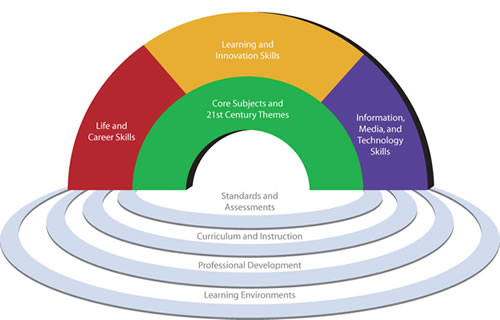
“[The oppressed] are at one and the same time themselves and the oppressor whose consciousness they have internalized.” Paulo Freire (1970)
This is a profound thought for me and a key point for Freire’s book. That the oppressed are simultaneously oppressed and their own oppressors is a fascinating concept and, I think, a difficult realization for many. The truth is we have internalized this struggle between subjective values and objective assessment. It is why many arts advocates fail in their efforts to save programs from being dissolved and their funding reallocated. In this case we are our own worst enemies. Our own fear of liberation prevents us from renouncing this internal oppressor. So, under this oppressive system we are forced to live with a decrease in the capacity for inquiry and the elimination of subjectively measured subjects, subjects which best help students develop critical thinking skills and creative capacity.
Critical Thinking
Subjective assessment involves critique. It is in the areas of study that require personal and group critique in their assessment where the ability to think critically is developed. To critique a painting, a piece of music, a dance, or poem requires one to observe, analyze, interpret, and evaluate in ways that require higher order thinking. A math equation requires these steps too but only in an objective capacity. The type of knowledge our standardized tests measure in this capacity is rather shallow. It is only in the study of subjectively measured learning that this capacity can be deepened.
This critical capacity is not self-serving though, it carries through to the solving of problems in all areas of life. I am a better technology integration specialist because I have spent a lot of time in the creative arts. Because of my creative capacity I am able to see solutions to problems other “technologists” cannot. The reduction of the sorts of programs in schools that allowed me to develop this capacity means that fewer people will be given the same opportunity to develop this capacity in themselves for the future. Thus, we will end up with a deficit in critical capacity. I will let Paulo Freire finish this line of thought for me in these four quotes
- “they react instinctively against any experiment in education which stimulates the critical faculties”
- “dialogue cannot exist unless the dialoguers engage in critical thinking”
- “Without dialogue there is no communication, & without communication there can be no true education.”
- “In their political activity, the dominant elites utilize the banking concept to encourage passivity in the oppressed, corresponding with the latter’s ‘submerged’ state of consciousness, & take advantage of that passivity to ‘fill’ that consciousness with slogans which create even more fear of freedom.”
Alienation & Lost Histories
“Schools by their very structure resist the concentration of privilege on those otherwise disadvantaged.” Ivan Illich (1970)
Through extended loss and reduction of the fine arts from our schools we are alienating not only those subjects but the people who most closely value them. If we continue to allow the arts to be repressed in the name of standards and accountability over time their history and tradition will be lost.
I know for a fact that many of the students at the alternative school I worked at stayed with us and stayed in school because of my art program. I know many of these students were deemed undesirable by the system. Yet, though they may not perform well on a standardized test they were particularly gifted at drawing, painting, sculpture, poetry, creative writing, dance, music, etc. When my position was eliminated from our school these were the first kids to go. I still hear about many of my former students who left our school when we were divided and crushed. Many of them dropped back out of school. Every once in a while I see in the paper that one of them has been arrested or has been sentenced to time in prison. I worry about the ones most who I have not heard from or about. Did they find another school? How many more times did they get passed around the system? So much for leaving no child behind.
“People who have been schooled down to size let unmeasured experience slip out of their hands.” Ivan Illich (1970)
Carl Anderson is an art and technology teacher, technology integration specialist, and adjunct instructor for Hamline University’s School of Education. He writes the Techno Constructivist blog and is @anderscj on Twitter.

by kylepace | Sep 22, 2010 | 21st Century Skills, Assessment, Guest Bloggers, Learning and Teaching |

First I’d like to say thanks to Scott McLeod for the opportunity to write a post for Dangerously Irrelevant. The topic of student collaboration is one that has been bouncing around in my head for quite some time. I want to disclaim at the forefront that I want this to be a conversation. I want to learn from you. I want you to make me think. This is not the end-all be-all about collaboration. I want to talk about the necessity of this 21st century skill and how I think it dwindles as a necessary skill as students move away from elementary school.
My daughter is almost 6 years old. She just started Kindergarten. Recently she was at a playground with her brother and numerous other kids. As I watched her play, I noticed how comfortable she was going up to kids she’d never met, introducing herself, and engaging these kids in conversation which led to a new playtime opportunity. She was probably doing whatever she could to not have to play with her younger brother for a while. 🙂
If you have young children it’s really an amazing thing to watch. She just went right up to these other kids, and started in like she had known them already. Right away I thought about collaboration. Even if it’s in the most simplest form, she is collaborating. It doesn’t matter if it’s in her kindergarten classroom or on the playground. She wants to have a productive play/learning time. That is her goal. It would seem, that she is eager to collaborate for this to happen. I feel like I’ve been a positive guide for her to be this way; but it wasn’t decreed like, “You shall speak to all of your peers and engage them!” I am blown away by her comfort level. Even when I’m in a classroom of younger students (I’m thinking Kindergarten through 2nd grade), I am always intrigued at their collaboration skills (as basic as they may be) to achieve a common goal.
All of this thinking on collaboration and 21st century skills led me to ask this via Twitter, “What field of expertise DOESN’T require some form of collaboration to succeed?” I didn’t get one serious response. My friend Andy Marcinek, however, gets the award for funniest response. “A mime.” Seriously though, how can we say that students don’t need the skill of effective collaboration? I want to hear your thoughts on this.
I have seen tweets and blog posts recently about frustration that teachers are having getting their students to collaborate. These were mainly secondary teachers and library media specialists. It was even an #EdChat topic a few weeks ago: “How do we engage students who find participatory learning uncomfortable?” What do you find most difficult when getting students to collaborate? Criticism from their peers? A bad experience with a previous teacher? It seems like there’s so many factors that can come into play.
How are we fostering this skill beyond kindergarten? What have you found that really is motivating for students to collaborate? What gives them true ownership of their learning? There’s awesome digital tools that aid in collaboration, but those tools don’t MAKE the collaboration. It’s a skill that still has to be fine tuned. It’s a skill we should all be modeling effectively if we want our students to do it effectively. If you’re looking for some great suggestions on how to foster collaboration in your classroom, I would suggest reading Michelle Bourgeois’ post titled: The Collaborative Classroom: It’s a Juggling Act. In this post Michelle tells a story of teaching students how to juggle and says. “Just like the art of juggling, there are several skills that need to be balanced and constantly monitored in a collaborative classroom to make it all come together.” Please be sure to check out Michelle’s post on how to monitor and keep balance of some essentials in classroom collaboration.
This leads to my questions, “Where does this skill go?” Am I the only one that thinks younger students are better at collaboration than older students? Shouldn’t this be the opposite? This is something we want our students to be better at right? We should be fostering this skill in our classrooms, not hindering it. How often are you allowing students to collaborate? Not to say that awesome things can’t come out of individual thinking, but as I always like to say, “We’re better together.” Sure, one mind can do awesome things, but a collective could really rock someone’s world.
Thanks for reading.
Kyle Pace is a K-12 instructional technology specialist from Kansas City, Missouri. He works with teachers in his district to provide professional development, resources, and strategies to implement instructional technology to impact student learning. You can follow Kyle on Twitter by visiting http://twitter.com/kylepace and you can find his web site at http://www.kylepace.com.

by karenszymusiak | Sep 21, 2010 | 21st Century Skills, Assessment, Guest Bloggers, Learning and Teaching |
The Current Landscape
These are challenging times in the current landscape of learning and teaching. The standards movement is pressing upon us and students and teachers are being measured in the narrowest of ways. I know that any and every measurement can tell me something about a child and I fear that focusing on any single measurement can be dangerous. The biggest mistake we can make is to be single-minded. Relying on a standardized score or focusing on only the standards that we are required to teach will not allow us the opportunity to create a variety of rich, interactive, collaborative and thoughtful experiences that enrich learning and teaching.
In the worst situations, it’s not the data that is problematic, but how the data is interpreted, generalized, and misused to make educational decisions. All measurements can be helpful in creating a clear and precise profile of a learner. I tend to lean toward more authentic measurements and what they tell me about students. However, every piece of data is a piece of the mosaic of a child’s learning life. What targets for learning and measurement results can do is clarify the most effective instruction and help us be responsive to each student’s needs. Some knowledge and skills are easily measured. Some are not. When it comes right down to it, a good teacher knows her students well and teaches in response to what she knows abou t the individual child.
I worry that we look at standards and data the way we narrow a Google map search. We can narrow in on the smallest of detail but knowing the big picture is also important. We can consider standards, measurement and data and completely lose sight of the bigger picture. Each educational measure we put in place is part of the whole and we must not forget that. What does a standard or test score tell us about a student’s persistence or level of self-efficacy? How can we support students by giving them the skills they need for more critical thinking, inquiry and thoughtful pursuits?
What Next?
Whether or not we agree with standards and accountability, it is an immense part of the learning landscape. So we need to help others understand the role of standards and accountability in the big picture.
The most important question we can ask when we are presented with any kind of measurement of progress is to ask “What next?” How will we formulate learning experiences that will move each child forward? What will we focus on? What are the strengths of the child and how can we teach from those strengths instead of focusing on the deficits?
It’s not helpful to consider data and assign causation for low and even high performance that is generalized and misaligned. Some educators are “guessing” why students perform the way they do and linking to practices that may not have a positive impact on student learning. In some cases, programs and practices are being implemented that detour us from focusing on 21st century skills.
Let’s Remember
- Stay the course and make decisions based on what’s right for children.
- Embrace 21st century learning.
- Use measurement results to teach from a child’s strengths.
While it’s the most challenging time in education, it is also the most exciting. We are increasing the potential for our students to be active and participatory learners. We are encouraging them to build a learning community both locally and globally that will help them follow their passions. We cannot abandon our efforts to give our students what they will need to help them be successful in learning and life.
Karen Szymusiak is principal of Glacier Ridge Elementary in Dublin, Ohio. She can be found online at twitter.com/karenszymusiak. Karen has coauthored Beyond Leveled Books, Still Learning to Read, and Day to Day Assessment in the Reading Workshop. Her favorite moments are those spent with children. She says, “If we really listen to children, they tell us all there is to know about teaching wisely and well.”

by aaroneyler | Sep 21, 2010 | 21st Century Skills, Assessment, Guest Bloggers, Learning and Teaching |
It’s not “OK” for us to simply abstain from teaching kids to think simply based on the fact that we have to administer a test at the end of the year that’s expected to assess something as nebulous as learning.
How about a profound statement? Even if the tests went away tomorrow, very little would change in a lot of classrooms around the country, and teaching kids how to think would still take a back seat to teaching kids what to think. Call me cynical, but I don’t see a lot of teachers releasing their herculean grip from subject content in the name of teaching “21st century skills.” Why? Our education system has never been about innovation and adaptation; it’s been about perpetuation.
How do we reconcile standards and data-driven accountability with the “21st century skills” movement? The first step we need to take is forgetting about the test and teach kids to be curious while asking really, really good questions. I’ll never say that the tests are a positive, but I also won’t allow for them to be the scapegoat for why kids walk out of school without an ability to ask great questions of the world around them. Evidence? Multiple-choice tests existed in almost every classroom prior to the standardized testing movement, and they will exist long into the future regardless of what metric we use to assess student learning.
We also need to practice some serious introspection and ask ourselves what “21st century skills” are. I hear a lot of people boil “21st century skills” down to simply using technology. That’s a pretty myopic and cynical way of looking at the future of human progress. The truth is that “21st century skills” do have to do with adapting to new technologies effectively, but it has much, much more to do with being able to think deeply about topics, solve complex problems, and being capable of synthesizing information to form new solutions. If kids go through school unable to practice these skills, then everything else is for naught.
We kill curiosity in kids the same way that Sir Ken Robinson says we kill creativity. We point our fingers at standardized tests and cry out that they prohibit us from teaching the skills kids need, but we’re also not willing to accept that many classrooms wouldn’t be that different without them.
We, as educators, simply need to give ourselves a reality check on the messages that we send our kids that stunt their curiosity. I can’t tell you how many times I hear this comment and want to cringe:
Anything that we ever need to know in this day and age can be found on the Internet via Google or some other search engine.
Is that really the message we want to be sending kids? Do we want them to walk away from our classrooms believing that every, single question ever asked has been investigated by someone else and answered? What are they to do when they have questions that Google can’t answer? How, in those classrooms, do we teach kids to ask the really, good questions and solve the really complex problems that they will experience in their future? How is that statement any different from having kids select “A-E” without even getting a chance to contemplate “F” as the correct answer?
Throughout this post, it may seem as though I’ve ignored the very question that Scott has asked me to answer. Rest assured that’s exactly what I’ve done. The answer to the question is simple: start constructing lessons and classroom instruction around developing curious kids who inquire about the world around them. Ignore the tests. Until we live in a world where classrooms would look entirely different without the tests, we really have nothing to complain about while they’re here.
Aaron Eyler is a high school history teacher in central New Jersey. He has an M.A. in Educational Leadership from Rutgers University and is the writer of “Synthesizing Education” and (more recently) “The Democratic Classroom.” For his daily musings and rants, please follow him on twitter via @aaron_eyler.
by shawncornally | Sep 20, 2010 | 21st Century Skills, Guest Bloggers, Learning and Teaching, Workforce and Economy |
In my short time as an educator, I have already suffered through enough acronyms, initiatives, and memes to give me a dull sense of despondence not unlike some of the more deafeningly quiet scenes from Kubrick’s 2001: A Space Odyssey. However, I do not want it to be this way.
One of the first “movements” that I was introduced to was the Rigor & Relevance movement. This was followed quickly by an excited mentioning of “21st Century Skills.” I had never heard of such things and wondered how a new teacher of Calculus and Physics was supposed to teach students these skills. I tried to avoid my evolutionary response of squirting black goo from my eyes at the mere mentioning of another edu-trend, and I really tried to cut through the chatter:
I was told to teach for the jobs that have not even been imagined yet. I was told to teach for the student who will switch professions more times than my pregnant wife changes sleeping positions. As per usual, the question of how to do this was left largely unanswered. There was, however, a very inspirational YouTube video with a lot of appearing and disappearing buzz words.
So, I stand here before you, asking the question to myself and all other practicing teachers: How does the glut-of-information age affect how we run our schools? How do we realize that those students who look bored, might be so simply because they’re learning more outside of school rather than in it? How do you deal with the fact that the ability levels in your classes are going to become even more diverse?
This is really the heart of the “21st Century Skills” movement. After a walk-in-the-woods moment, I came up with these two solutions:
- In class, I must make no qualms about my hatred for grades and earning points for anything other than learning. (i.e.: No notebook checks, homework, attendance points, behavior points, or other token economies)
- I have to admit that I am no longer the most efficient content delivery system on the block. I am now nothing more than an experienced investigator, trained in the art of guiding younger hikers along the trail.
A. Points and grades are flotsam and nothing more. They are the burning wreckage of an over-used and over-assumed system of Pavlovian control that has created our school system’s stigma. This is a stigma so prevalent that it is often assumed: just imagine the comic portrayal of school in the Simpson’s, or think back to how many negative words are often associated with the start of school each Fall.
As a group of teachers, my building has decided to do something different. We’ve adopted the premise that learning matters. Grades — for now — are forced on us, so we’re going to milk that system for every ounce of learning we can get out of it. We’ve stopped grading practice (i.e. Homework), we’ve stopped using summative assessments as executioner’s axes, and most beautifully, kids have started to ask really fantastic questions. We call it standards-based grading, but the word “standards” is a misnomer: we create the standards, and use them as anchors for free-floating classrooms.
B. I am no longer payed to profess facts. My students do not need me in order to learn the conic sections, or to find the derivative of a composition of functions. My students do not need me in order to derive the equations of motion, nor to espouse the addition of vectors. This is quite possibly the biggest relief I have ever experienced.
I am now free to model for them what a life of learning looks like. I am now free to guide them through the often disastrous process of really getting something. What’s most euphoric, is that I can now take their questions and design instruction that may never happen again simply because I will never have the same students twice.
I’m still not sure how I’m supposed to teach for occupations that don’t exist, but I know this feels like a good start.
Shawn Cornally teaches Physics, Calculus, & Computer Programming in Eastern Iowa. He blogs at Think Thank Thunk. He is petrified of being irrelevant and ineffective in the classroom.

by jasonklein | Sep 20, 2010 | 21st Century Skills, Guest Bloggers, Tech Integration, Workforce and Economy |
“The future belongs to a very different kind of person with a very different kind of mind–creators and empathizers, pattern recognizers, and meaning makers,” says Daniel Pink on the opening page of the Introduction of A Whole New Mind. Of course, innovators still need to be able to (or have those around them who can) produce high quality products that are consistently good. As a result, the true victors of the 21st Century are the individuals (or more likely, the organizations) that are able to both:
- create innovative new services and products that connect with the emotions of their users
- produce services and products that are high quality, easy-to-use, and consistently improved
Apple, Inc.
One corporation that has been unrivaled in its success at simultaneously completing both of the above tasks is Apple, Incorporated. Led by Steve Jobs, Apple continues to create products that connect with the hearts and guts of consumers. Other companies simply do not elicit the same type of responses–tremendous rumors in advance of new product announcements, cries of excitement and disappointment when new products are announced, tremendously long lines when new products are first available (iPhone, iPad), and stores that are always full, even during the worst economic crisis worldwide since World War II. Steve Jobs and employees throughout Apple appear to be extraordinary “creators and empathizers, pattern recognizers, and meaning makers.”
At the same time, these highly complex products require tremendous feats of engineering prowess. The creators must be able to think logically, analytically, and in very linear, mechanical ways. There must be strong processes in place to check for quality and to make adjustments quickly and completely when bugs are discovered. In other words, Pink’s most significant skills of the ‘last few decades’–“computer programmers who could crank code, lawyers who could craft contracts, and MBAs who could crunch numbers”–remain vital to an organization’s success. Apple’s programmers, attorneys, and MBAs are all top-shelf, and the company’s bottom-line reflects this.
Apple’s is successful because it creates new products that resonate emotionally with consumers and because it utilizes standards and processes from both engineering and technology as well as business and law.
Meaningful & Relevant Learning-Creative, Innovative, and Emotionally Connected
What Apple manages to achieve provides an exact model for what all students deserve in our classrooms. First, classrooms must strive for learning to be meaningful and relevant. Learning should be real, hands-on, emotional, and differentiated, and assessment should be the driving force behind instructional decision-making.

When a classroom captures all of these “21st Century Skills,” it begins to fulfill the implications of Pink’s point regarding who will rule the 21st Century. Do students and teachers need to use classroom technology in order to achieve these characteristics? No. Does it help? Certainly–or, at least, certain technology does. Technology, and in particular the Internet, can eliminate barriers and give students the opportunity to create authentic work that has a real impact on the world. Their products can be published and disseminated with virtually no additional financial cost and with great speed and power.
Of course, helping teachers and principals understand and implement a 21st Century vision of meaningful and relevant learning is difficult. Educators need to:
- abandon their own experiences in the classroom
- re-create how a classroom looks, feels, and sounds
- reevaluate what concepts, content, and skills are most important for students to learn
- analyze how to assess whether or not students are actually learning these concepts, content, and skills
Integrating Standards & Relevant, Meaningful, Emotional Learning
Where do the standards fit in to a louder, more collaborative classroom in which consumption is trumped by creation and in which published videos and blogs triumph over pencil-and-paper tests?
First, like Apple, schools do not exist in a vacuum. Apple uses a variety of standards as the very foundation of the products, whether it is developing and using HTML5 or other open source codes that serve as the foundation for products like iChat and even the entire operating system, Apple accepts and uses these as a basis for its work. The learning standards that are approved by a State Department of Education are akin to these agreed upon building blocks of programming code.
Apple might claim that it could make more money and better products if it was not constrained by government regulation, but Apple is, and it has found ways to thrive within those parameters. Schools are likewise, but even more importantly, accountable back to society at-large. While educators may not always like or agree with it, schools must be responsive to regulation and influence from both the legislative process as well as from other sectors of society. This does not mean that educators should not, at times, push back in the name of sound instruction and social justice. At the same time, as high-stakes assessments and accountability show, schools do exist within a larger set of parameters–standards and high-stakes assessments that are based on those standards. As a result, like Apple must learn to thrive with accounting rules and intellectual property law, schools must do their best work using the existing state standards and by performing as well as possible on high-stakes assessments.
Second, just like Apple relies upon application developers and musicians and filmmakers to generate its content, the type of high-level, original work that students ought to be doing in a model classroom exhibiting 21st Century Skills requires these students to wrestle with deep content and concepts. There is nothing wrong with the fact that these concepts and content is derived from learning standards developed in a state capitol (or even Washington, D.C. as will likely be the case in the coming years). Simply put, the standards themselves provide the meat of what students are working with.

What happens when a classroom really utilizes standards as what students are taught while engaging students in these concepts, content, and skills with increasingly real-life, engaging, integrated, problem-based units of instruction? So long as students are continuing to be challenged with appropriate literacy and math skills in the context of these units, these students should perform at least as well on standardized assessments as students who are learning with more traditional instructional strategies, such as teacher lectures, worksheets, textbook readings, and quizzes/tests. Schools must be on-guard to ensure that they are teaching to the same standards regardless of the methods employed. When schools utilize the standards as the basis of their creative work to develop meaningful, relevant instructional units, students will be engaged in that work because it is appropriately challenging, emotionally engaging, and real. Most importantly, these students will be on their way to having the skills necessary to be successful in 21st Century Society and even to begin influencing that society today while still in the classroom as well as performing well on state assessments.
Jason Klein has been a teacher, principal, and, for the past few years, is now a School District Director of Technology in Suburban Chicago. Today, he can be found online at twitter.com/jasonklein.
by Scott McLeod | Sep 17, 2010 | 21st Century Skills, Assessment, Guest Bloggers |
In August I put out the call for guest bloggers on the topic of Reconciling standards- and data-driven accountability with the ‘21st century skills’ movement. I had a number of people volunteer to take on the issue (enough for two per day!). Next week we’ll see what they have to say…
I know these will spark some great conversations. Happy reading (in advance)!

by Scott McLeod | Sep 15, 2010 | 21st Century Skills, Learning and Teaching, Our Changing World, Workforce and Economy |
Postulate 1: There likely has never been a greater disconnect than right now between the skills our factory-model schools give our graduates and the skills they need for success in a technology-suffused, globally-interconnected information economy.
Postulate 2: It’s increasingly difficult for most families to survive economically on a single income. Working families (whether they have one breadwinner or two) need someplace to send their children while they’re at work.
It used to be that our kids went to school so that they could then go to work. When you look at the driving forces behind maintenance of today’s schooling model (and, perhaps, obstruction of whatever new model eventually replaces it), is it more true now that we’re sending our kids to school so that we can go to work? Which is of higher urgency to us: their needs or ours?
Just thinking out loud here…
Image credit: Hiding to eat big bro’s lunch?
by Scott McLeod | Aug 31, 2010 | 21st Century Skills, Learning and Teaching, Our Changing World, Videos |
I love the ending of this 60–second video! Are we?
Hat tip: Jeff Ronneberg

 It would be even better if all schools, including North Scott, allowed students to use their cell phones for any assignment or assessment. A world’s worth of information is now at our fingertips, anytime and anywhere. If we permitted students to instantly look up any low-level factual recall knowledge – like we adults do daily in the real world – wouldn’t this force schools to employ better, more complex assessments that got at higher levels of understanding? I think it might!