by Scott McLeod | Sep 18, 2006 | Leadership and Vision, Management and Operations, Planning and Funding, Research and Evaluation, Tech Integration, Tech Tools |
This eSchoolNews article discusses the recent Wall Street Journal article criticizing one-to-one laptop programs and contrasts it with ISTE’s new book highlighting successful laptop programs. Here’s the problem…
The article title says that educators and parents are "split on the effectiveness of one-to-one learning." The concerns stated in the article, however, are not with the effectiveness of the learning that is occurring but rather the effectiveness of the teaching that is occurring and/or the lack of appropriate supervision / security measures by schools. Framing the issue incorrectly leads to incorrect solutions.
For example, if the laptops aren’t being used well instructionally by teachers, isn’t it a wrongheaded solution to give the laptops to them instead of the students? Aren’t there better (and fairly obvious) solutions to the actual problem? Similarly, if students are using laptops inappropriately, isn’t that an indictment of the school’s acceptable use policy and enforcement thereof? If we’re going to raise issues with one-to-one computing, we should at least be clear and fair about what the real issues are (e.g., like cost).
As Don Knezek, CEO of ISTE, notes in this article, and as David Warlick has noted elsewhere, soon the idea of students having to "go somewhere" (e.g., to the computer lab or to get a laptop from the cart) rather than having the technology with them 24/7, is going to seem awfully antiquated. Anyone else feel that this article, which actually spent very little verbiage on the supposed issue of student learning, was a little sloppy?
by Scott McLeod | Sep 15, 2006 | Planning and Funding, Professional Development |
Schools always have limited resources. Even when they get a big grant or the community approves a technology referendum, there’s never enough money to go around. It seems to me that schools have a couple of general approaches that they can take…
Option 1 – Spread the money widely across the organization. Try and get as much hardware and software as possible, even if this means little or no staff development.
Option 2 – Identify strategic investments. Spend only in certain places within the organization and invest deeply in staff development to ensure that those projects are successful.
Obviously there’s a continuum here – this is not necessarily an either-or choice. That said, why does it seem like most school organizations almost always pick Option 1? Does anyone think this strategy is working?
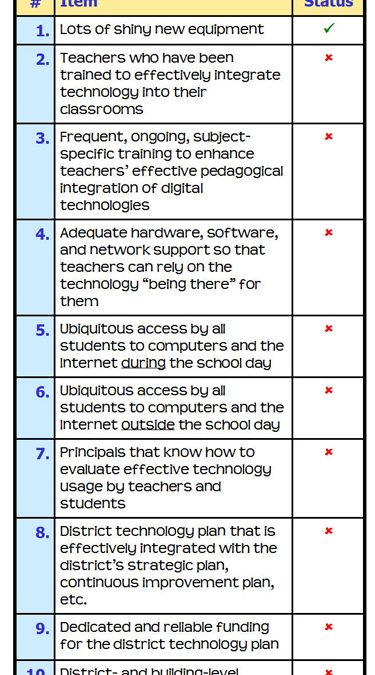
by Scott McLeod | Sep 5, 2006 | Leadership and Vision, Management and Operations, Planning and Funding, Professional Development, Tech Integration |
School starts today here in Minnesota. Let’s see how we’re doing.

Hmmm… Looks like we still have some work to do.

by Scott McLeod | Aug 15, 2006 | Law, Policy, and Ethics, Leadership and Vision, Planning and Funding, Professional Development |
Is anyone else tired of the constant struggle to get the federal government to invest in our nation’s future (hello, there’s a T in STEM!). I confess that I’m getting tired of hearing them talk out of both sides of their mouth simultaneously (see exhibits below). Aren’t you?
Technology is important!

Technology is not important!

Or, in graphical form…

[FYI, $272 million is the amount a single state, Pennsylvania, spent on child care two years ago. It’s also a little less than the movie Meet the Fockers grossed in the U.S. Divided by about 54.7 million public school students, it’s about $5 per public school student. Some national investment, huh?]
Maybe Tim Magner, our new director of the Office of Educational Technology, can do something positive. I heard his talk from the AALF conference (thanks for the podcast, Andy!) and it sounded like he was on the right track (now if only he and his office had more power and influence…).
In the meantime, please keep fighting the good fight:
