This week is Children’s Book Week. In honor of the event, I thought that I’d highlight 21 interesting e-books for kids. Collectively, these give us a glimpse into what the future of children’s publishing is going to look like. As I compiled this list, I was struck by how quickly the field of interactive e-books is moving. The iPad has been around just over a year…
Some folks are mourning the transition of children’s books from paper to digital. Despite having thousands of traditional kids’ books in my house, I’m not one of those people. The lines between electronic books, videos, animation, interactive games, and learning software are blurring and it’s going to be fascinating to see what gets created as authors, artists, animators, game designers, photographers, videographers, educators, and publishers work together over the next few years.
What do you think? After seeing the videos below and/or trying some of these e-books, how do you feel about the upcoming transition of kids’ books from paper to digital?
If you know of any cool e-books for kids that I missed, please share them. Also, for those who are interested, here’s my burgeoning collection of videos that envision the future of print. If this post is a success, I’ll do this again next year during Children’s Book Week!
You’re about to hand laptops over to their 12– and 13–year-old children. What do you tell your school’s parents? Here are some excerpts from what , ICT Director for the Diocesan School for Girls in Auckland, New Zealand, told his…
—-
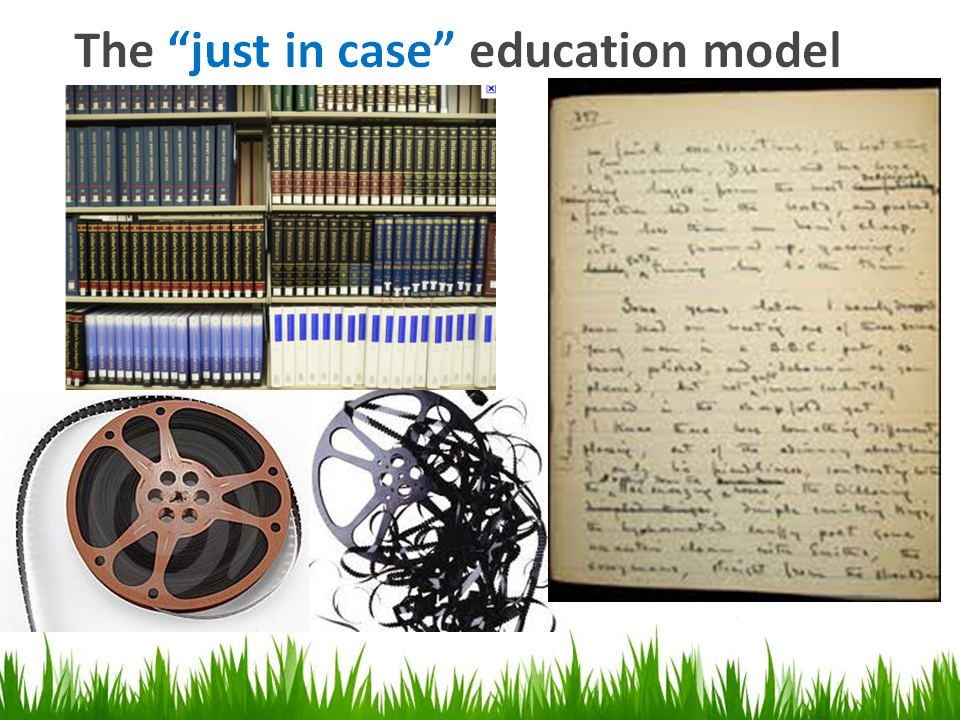
“Most of us went through school and, by and large, succeeded. When we had education done to us, we experienced what I call the “just in case model” of education. We learned things just in case they might be useful. Just in case they might be on the test. Just in case we might look for a job in that area. Just in case you might study physics later on.
And a key reason that education developed this model was that the predominant mode of teaching, and hence learning, relied on the predominant technology of the day: paper. . . .
The system kind of worked for a couple of reasons:
Not much had changed in the information landscape over the 20th century in terms of what was written down and accessible to students.
It was too expensive and lengthy to rewrite textbooks all the time.
Right up until 1986, all of the information that mankind had collated since the dawn of time – all 2.64 billion gigabytes of it – only 0.02 billion gigabytes was digital. So over 99% of the information we had to work with was analog - written down.
What we have witnessed in the past 10 years is unprecedented growth in information – all of it digital. From our 2.6 billion gigabytes in 1986, we now have well over 400 billion gigabytes of collective human information – and growing at a rate of 5 billion gigabytes every 3 days according to Google. The big difference now is that – since 2001 when traditional paper-based information and digital information gained parity – digital data now accounts for well in excess of 95% of all information. The info landscape reversal looks like this…
If you were charged with designing a new model for education – and you came to the conclusion that you could ignore 95% of available information and operate without the “tool of the time” – would your system be given the go ahead?
By the way – this is also the reason why everyone – not just students – should be online and connected. To not be is shutting off 95% of what’s happening.
But we need do more than just equip ourselves – our model needs to change from “just in case” to “just in time.”
You see, with such dramatic changes in information, we can no longer rely on outmoded means of working. We’ve seen what happens to organisations that don’t adapt to the digital world – CD stores and book store chains are recent examples in New Zealand.
The same for education. No longer does it make sense to focus on content just in case it might be useful. . . .
What has become important is the “just in time” model. A model which sees essential habits and attitudes of learning being the focus. A model which sees the ability to think about our own thinking as a focus.
And expect to see traditionally-held beliefs challenged. Here is a model of the human brain showing the areas that are being engaged as the same person (an experienced Web surfer) reads a book and, at a separate time, is browsing the Web.
Let’s debunk a myth or two: Writing will be affected. Well, looks like that may be correct.
Point England School has had its kids blogging for a couple of years. One of the outcomes is that its students’ achievement in writing and reading have increased dramatically over this time. They don’t write earth shattering stuff all of the time – take Silas’ story, for example. But someone made a comment that wasn’t from his class … or school … or country. How cool is that for a young writer?
In early 2009 we ran a trial program with Year 9 students. It ran for four weeks and they studied the Horizon Report, a report focussing on emerging technologies in education. Their project finished in April 2009. We now find that the web site they created is accessed by around 50 to 60 people per day from the U.S., Canada, the U.K. Australia, Russia, Ireland… Obviously the work they did has some value for a lot of people in other parts of the world.
My 13–year-old son: “Can I have a guitar?” Great, another fad. What about some lessons? “No thanks. I’ll learn online.” So he goes to YouTube and does just that – for hours. He played lead guitar at his school’s end-of-year function last year.
Me? I don’t read much and certainly don’t write much. And yet my blog is read in 30 countries and – because of the usefulness of RSS – I now get what I am interested in reading delivered to my phone, iPad, and computer every minute. I read far more than I did because I can…
. . . .
You may know that New Zealand has a digital strategy. It’s tucked away on the Ministry of Economic Development’s web site. It says this: “New Zealand will be a leader in the use of information and technology to realize its economic, social, environmental and cultural goals, to the benefit of all of its people.”
How many other countries have a digital strategy? And how many of them are putting education at the front end?
Peru, Afghanistan, Madagascar, Paraguay: just some of the countries involved in the One Laptop Per Child campaign aimed at trying to bring kids in developing countries on some kind of level playing field with kids in other countries.
In New Zealand, for education the government sees up to 100Mb bandwidth in 97% of schools by 2015. Too little, too late?
. . . .
What we need to do is to build the skills and attitudes with your daughters so that they can take advantage of the huge opportunities that await.
You need to give your daughters the opportunity to succeed in this ever-changing world. At the moment that means a laptop computer now is basically a table stake.”
—-
Nicely done, Rob, nicely done. Those of you with laptop and other learning technology initiatives, how have you framed the conversation with your parents?
We can’t state explicitly or emphatically what the future of learning will look like because things are moving so fast. But we can extrapolate some general characteristics from current trends. For example, in the future our learning will be even more …
digital rather than analog / ink on paper
informal
online and less dependent on local humans
mobile
networked / interconnected
multimedia
self-directed / inquiry-based
individualized / personalized
computer-based and software-mediated and less dependent on live humans
… than it is now. We’re not going to retrench or go backward on any of these. As educators, parents, and citizens, we need to begin envisioning the implications of these characteristics for learning, teaching, and schooling.
How do we design and operationalize our learning environments to reflect these characteristics? And if we don’t, can we have any hope of staying relevant to the needs of students, families, and society?
[What do you think of this list? Anything you’d add or change?]
I can’t attend Educon this year. Snow in Philadelphia has canceled school today so they’re moving to Plan B. I thought I’d share some questions for attendees to ponder as they interact with each other this weekend. These are some of the questions I asked attendees at last week’s ELMLE conference in Amsterdam.
7 billion people on the planet; 5 billion cell phones. 2 billion people on the Internet. 500 million people on Facebook. 200 million on Twitter. 85 million on LinkedIn. 5 billion photos on Flickr; 50 billion photos on Facebook. 17 million Wikipedia articles. 500 billion mobile phone apps were downloaded last year. 6.1 trillion text messages were sent last year. Apple will sell 20 million iPads this year. 35 hours of video is uploaded to YouTube every minute (or 176,000 full-length Hollywood movies each week). When are we going to start integrating technology into our schooling lives like we do in our personal lives and in our non-school professional lives?
What percentage of your school technology budget goes toward teacher-centric technologies – rather than student-centric – technologies?
Our kids live in a world in which they expect to be able to create, publish, share, collaborate, connect, and have a voice. What can you do to tap into the educational power of your students as online collaborators, creators, sharers, and contributors?
How can you tap into the power of open access and open educational resources for your staff and students?
How are you (or should you be) tapping into the power of technology to facilitate differentiated, individualized, personalized learning experiences for your students?
Schools typically move at incremental, linear rates of change. But everything around us is moving at an exponential, revolutionary rate of change. It’s like the Industrial Revolution crammed into 15 years instead of 150. Are you facilitating linear or exponential change in your school organization?
In all of our efforts to teach students safe, appropriate, and responsible technology use, are we forgetting the more important job of teaching our students empowered use?
Everything is moving to the Web. Everything. When we teach our students how to write, are we teaching our students how to do so in hyperlinked, networked, interconnected online spaces for authentic, relevant worldwide audiences? (hat tip to Will Richardson for this one)
When e-books or e-textbooks now can contain hyperlinks, embedded video, live chat with other readers, collaborative annotation where you see others’ notes and highlights, and/or interactive maps, games, and simulations, does it still make sense to call them ‘books?’ How might we tap into their advantages and affordances?
Electronic versions of books on Amazon now are outselling both their hardback AND paperback counterparts. Reference materials are moving to the Web at an exceedingly fast pace. When all of the books in your media center become electronic, will you still need a physical space called a ‘library?’ Will you still need ‘librarians?’
Do we really understand what our kids are doing with social media or is what we know primarily from the news media?
Are we intentionally, purposefully, and explicitly modeling these new technology literacies for our students?
What percentage of my job could be done by robust learning software that not only delivers content in a variety of modalities to students but also assesses them on their mastery of that content? What percentage of my job could be done by a lower-paid worker in another country who is accessible via the Internet? In other words, what percentage of my job requires me, the unique, talented human being that stands before you?
Do I truly ‘get it?’ Am I doing what really needs to be done to prepare students for a hypercompetitive global information economy and for the demands of digital, global citizenship? In other words, am I preparing students for the next half century rather than the last half century?
And if I’m not… If as a teacher I’m not incorporating digital technologies into students’ learning processes in ways that are relevant, meaningful, and powerful on a regular and frequent basis – should I get to keep my job? Or should I be replaced by someone who will get the necessary job done?
And if I’m not… If as an administrator I’m not creating, facilitating, and maintaining robust technology-infused, globally-interconnected learning environments for staff and students, should I get to keep my job? Or should I be replaced by someone who will get the necessary job done?
And if I’m not… If as a policymaker I’m not allocating fiscal and policy resources in directions that move schools and society forward in the appropriate directions, am I willing to be held accountable for sacrificing our children’s futures for the fears and political pettiness of the present?
Have fun in Philly, my friends. May your conversations be fruitful. May your learning be legendary. [and what would you add to this list?]
For a student who was in a school district’s middle-school-only 1:1 laptop program, it’s tough to go back to ring-binder-and-notebook-paper classrooms when she transitions to the high school.
For a child who had an opportunity to progress at his own pace while learning something that he loved (perhaps online or via an independent project or using robust learning software), it’s tough to go back to a undifferentiated, non-individualized learning experience.
For a kid who spent a year with a teacher that valued collaborative hands-on, inquiry-based, and problem-based learning, it’s tough to go back the next year to a teacher that has more of a lecture-based, isolated-seatwork-oriented approach.
For a principal who has been immersed in robust online learning networks, it’s tough (and perhaps unimaginable) to go back to the way things were before that experience.
…
For many teachers / administrators / parents / policymakers, it’s not tough to go back – and it’s easy to be skeptical about the importance of robust, technology-suffused learning experiences – because they’ve never been there.
Below is a nifty video, Mobile Year in Review 2010, that highlights some of the changes we saw last year related to mobile phones and computing. My favorite statistic is this one:
Mobile phone apps downloaded 2009: 300 million 2010: 5 billion!
respond when children’s digital interactions turn negative.
There are no easy answers here, but the solution is not for us or our children to withdraw. Withdrawing doesn’t change the behavior; it just removes our ability to know about it. Instead, we must engage with our children and be actively involved in these interactions – not in a behind-their-back monitoring sense but in a caring, responsible adult sense – so that we can help them navigate these new interaction spaces in which we all now live.
I’m going to recommend this article to every parent I know (yes, it’s that good), and I suggest you do the same. I’m also going to have my 12-year-old daughter read it and then we’re going to talk about it. Check it out. This is important stuff.
Any corporation, government agency, worldwide church, school, university, foundation, or other institution that enjoyed the ability to broadcast to the passive masses is going to have to get used to the idea that we now live in a world of conversation, not just dissemination. The information-pushout monopoly died at least 5 years ago. When will organizations adjust to (and design for) the new reality?
What will it take to move schools away from their unidirectional postal service mailings, paper newsletters, Friday folders, parent portal updates, e-mail listservs, and/or grainy public television channels and toward something that’s more multidirectional and interactive?
Why do parents – even digitally-savvy ones – fail to put much pressure on their local schools to use these powerful communication tools?
Are there schools or districts that you feel are doing a good job right now of using social media tools (e.g., Facebook, Twitter, blogs, YouTube) to interact with their relevant audiences (and, if so, do you have any links)?