by Scott McLeod | Dec 16, 2024 | Leadership and Vision, Learning and Teaching, Quotes, Slides |
I have read or revisited a number of education books in recent years as I’ve been visiting innovative, deeper learning schools all around the world. I could recommend many, but I keep returning to How Children Fail by John Holt. Below are 52 quotes from the book (click on the arrows to move through the album). I invite you to dive deep into – and reflect upon – each of these and their relevance to children and schooling today. Remember that Holt wrote all of this in 1964…
Individual slides are available for download here.
Thoughts?


by Scott McLeod | Dec 15, 2024 | Leadership and Vision, Learning and Teaching, News and Events |
I officially wrapped up all of my school visits for my Deeper Learning in Elementary and Middle Schools (DLEMS) book project last week. I have seen some incredible schools the past two years and am excited to finish writing up what I have learned. I am hoping to send the book to a publisher in Spring 2025!
The list of schools is below. I tried to get a decent mix of settings: 13 elementary schools, 16 middle schools, and 16 K-8 schools. 15 traditional public schools, 14 public charter schools, 3 public magnet schools, and 13 independent schools. I also oversampled Colorado a little bit…
- Anastasis Academy, Centennial, CO
- High Tech Middle Media Arts, San Diego, CA
- High Tech Middle Chula Vista, Chula Vista, CA
- Design39, San Diego, CA
- Vista Innovation & Design Academy (VIDA), Vista, CA
- Creative City Public Charter School, Baltimore, MD
- City Neighbors Hamilton, Baltimore, MD
- Science Leadership Academy Middle School (SLAMS), Philadelphia, PA
- Centre Learning Community (CLC) Charter School, State College, PA
- Delta Program Middle School, State College, PA
- Hudson Valley Sudbury School, Kingston, NY
- The Randolph School, Wappingers Falls, NY
- The Island School, New York, NY
- Reggio Emilia Schools, Reggio Emilia, Italy
- Watershed School, Boulder, CO
- Eminence Elementary School, Eminence, KY
- Explore! Community School, Nashville, TN
- Clayton-Bradley Academy, Maryville, TN
- Drayton Mills Elementary, Spartanburg, SC
- Anderson Mill Elementary, Moore, SC
- The Mount Vernon School, Atlanta, GA
- Drew Charter School Elementary Academy, Atlanta, GA
- STEM School, Highlands Ranch, CO
- Embark, Denver, CO
- Mountain Academy, Jackson, WY
- Impact | Puget Sound Elementary, Tukwila, WA
- Highline Big Picture Middle School, Burien, WA
- The Cottonwood School of Civics & Science, Portland, OR
- Down to Earth Forest School, West Linn, OR
- Cascades Academy, Bend, OR
- Peak Expeditionary School, Wheat Ridge, CO
- Jeffco Open School, Lakewood, CO
- King Middle School, Portland, ME
- Breakwater School, Portland, ME
- Miscoe Hill Middle School, Mendon, MA
- Atrium School, Watertown, MA
- South Middle School, Harrisburg, SD
- Minnesota New Country School, Henderson, MN
- Avalon School, St. Paul, MN
- Wingra School, Madison, WI
- Polaris Charter Academy, Chicago, IL
- EPiC, Liberty, MO
- Compass Community Collaborative School, Fort Collins, CO
- Fred Tjardes School of Innovation, Greeley, CO
- Grace M. James Academy of Excellence, Louisville, KY

by Scott McLeod | Dec 11, 2024 | Learning and Teaching, Quotes |
Below is a snippet from A.J. Juliani’s blog post, The relevancy problem: What can we do to make learning meaningful? I encourage you to read the entire post, which is an excerpt from his upcoming book, Meaningful and Relevant: Engaging Learners In An Era of Distraction. I already can tell that the book is going to be amazing.
We already know what works and doesn’t work.
Kids are not normally engaged in lectures, textbooks, homework, and traditional assessments.
Our best learning experiences as adults didn’t happen when compliance was the focus either.
We know what happens when kids can tap into relevancy, and curiosity, and solve problems.
We know what happens when students get to work on challenges that are meaningful.
We know what happens when learners dive into an authentic curriculum and project-based learning experiences.
We know what happens when kids CARE about their learning. Because we know what happens when WE care about our learning.
I think that A.J. says this really nicely, particularly those last couple of sentences. I encourage all of us to lean into this angle when talking with parents, policymakers, and others who think that grades, test scores, and compliance are more important than children’s interest and engagement.
by Scott McLeod | Nov 20, 2024 | Learning and Teaching, Student Agency and Voice |
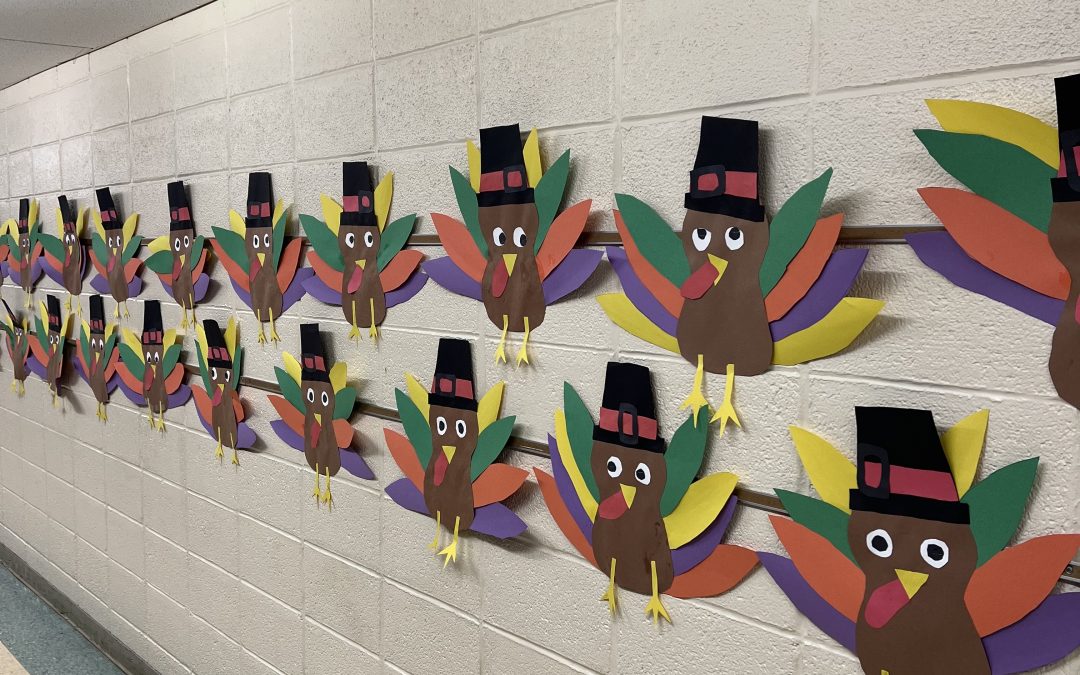
The fourth grade teacher who had students make these turkeys for art class said:
We know which ones didn’t follow the directions because of how their turkeys turned out.
4th grade art. ART. Control and compliance instead of celebration and creativity. [sigh]
by Scott McLeod | Jul 8, 2024 | Learning and Teaching, News and Events |
The folks who put on the annual Deeper Learning conference in San Diego, California have started sponsoring regional and global events under the umbrella label of DL Global. The main event each year is amazing, and the DL Global events also are incredible and well worth attending. For instance, the RemixED Conference in St. Paul, Minnesota was such a hit that it will be returning this October 16 through 18, with Dr. Gholdy Muhammad as the primary keynote. Deeper Learning LATAM (Latin America) happened last month in Medellín, Colombia. Deeper Learning China will be occurring on November 29 through December 1.
AND…
If you’re anywhere near the Hudson Valley in New York State, Deeper Learning New York (DLNY) is next week (July 16 and 17)! My new friend Peter Harris, who is the Assistant Superintendent of the Ulster BOCES, is a huge advocate for deeper learning and is on the planning team. Dr. Chris Emdin is going to be the keynote speaker, and Hannah Gallivan will be the featured student voice.
If you’re within reasonable driving distance or have some travel funds, I hope that you can attend. Your learning experience will be fantastic!

by Scott McLeod | Jun 19, 2024 | Learning and Teaching, News and Events, Tech Integration |
[ISTELive 2024 starts this week so I am resurrecting three blog posts from previous years. Below is Blast From the Past (BFTP) #2 from 2015!]
Five thoughts from the first couple of days here at the 2015 ISTE Conference…
- If “it’s not about the technology, it’s about the learning,” then why are we centering so many of our sessions on the tools?
- Are there uses of technology with students that would offend the majority of us so much that we would stand up and shout, ‘No! We should never do that!’? I see things here and there that concern me but many others seem to be pretty blasé about them or simply accept them as inevitable parts of the landscape (for example, behavior modification software, draconian Internet filtering of children and educators, and drill-and-kill systems ‘for those low-achieving kids,’ just to name a few)
- The work of transforming school systems is difficult work. School transformation stems from personal transformation, not from devices or apps or software. How many of us can say that we’re truly transforming more than a small handful of other educators?
- The work of transforming school systems is slow work. Some of us have been at this for a decade or two (or longer). How do we invest in and energize both ourselves and each other so that the frustrations, sluggishness, and setbacks don’t win?
- We should have more babies at ISTE. Who doesn’t love babies?!

by Scott McLeod | Jun 18, 2024 | Learning and Teaching, News and Events, Tech Integration |
[ISTELive 2024 starts this week so I am resurrecting three blog posts from previous years. Below is Blast From the Past (BFTP) #1 from 2015!]
Not including the more informal networking events, there generally are 3 kinds of ISTE sessions:
- Tools, tools, tools! These sessions focus on software, apps, extensions, productivity and efficiency, how-to tips, etc. Little emphasis on learning, heavy emphasis on how to use the tools.
- Technology for school replication. These sessions focus on the use of digital technologies to replicate and perpetuate schools’ historical emphases on factual recall and procedural regurgitation, control and compliance, students as passive learners, etc. Behavior modification apps, teacher content transmission tools, flashcard and multiple choice software, student usage monitoring programs, and the like.
- Technology for school transformation. These sessions focus on deeper learning, greater student agency, and perhaps real-world, authentic work. Learning technologies tend to be divergent rather than convergent, foster cognitive complexity, and facilitate active, creative student-driven learning.
We need more of #3. Lots more. Right now these sessions are still a significant minority of sessions at ISTE (and most other educational technology conferences).
Which kinds of sessions did you attend? What does that mean for your ability to effectuate change back home?
Which kinds of sessions did you facilitate? What does that mean for your responsibility as a presenter to help others effectuate change back home?
We’re wasting opportunities to move our systems…

by Scott McLeod | Apr 24, 2024 | Leadership and Vision, Learning and Teaching, Student Agency and Voice |
Breaking news! A nationally-representative poll of more than 1,000 teenagers finds that… students are still bored. Here are some key findings:
- 64% of teenagers think that school is boring
- 70% of teenagers say that all or most of their classmates are bored in class
- Only 41% of teenagers like going to school
- Only 40% of teenagers think that their homework helps them learn
- 30% of teenagers say that school is a waste of time
- Only 19% of teenagers say that most of their classmates want to be in school

These results just confirm earlier findings. This is a system that is fundamentally BROKEN. Everyone is expressing concern about students’ chronic absenteeism. But we’re just offering them the same old boring stuff. That’s not a successful sales pitch for a student who doesn’t want to come to school, is it?
What will we do about these recent findings? Probably the same thing that we’ve done in the past: nothing. As I said in an earlier post:
The biggest indictment of our schools is not their failure to raise test scores above some politically-determined line of ‘proficiency.’ It’s that – day in and day out – they routinely ignore the fact that our children are bored, disengaged, and disempowered. We’ve known this forever, but we have yet to really care about it in a way that would drive substantive changes in practice. The disenfranchisement of our youth continues to happen in the very institutions that are allegedly preparing them to be ‘life long learners.’
Shame on us.

by Scott McLeod | Jan 17, 2024 | Learning and Teaching |
I’m going to leave these screenshots here so I don’t forget them… [sigh] Text is underneath each one.

ME: It would be a terrible, terrible thing if students ever got to learn about things THEY wanted, not just what WE wanted?
THEM: Adult discernment and responsibility doesn’t end at the schoolhouse door. We decide what children eat and wear, when they sleep and wake, and dictate how they care for themselves without a second thought. But somehow, adult care and judgment becomes tyranny in the classroom?
ME: Do you think that students should never, ever have any say or choice in what they get to learn about in school? That they should just always do what we educators impose on them?
THEM: With respect, your use of the word “impose” betrays a doctrinaire POV (and a set of assumptions) that can only make this conversation unfruitful and unsatisfying.
ME: What verb would you like me to use instead that describes us always deciding what students do and learn instead of sometimes letting them make some choices?
THEM: Teaching.


THEM: No as this would not work for science, students have to learn things that make them uncomfortable, that they find difficult, that they don’t like. Novices aren’t good at having the expertise of deciding what is important about their subject matter.
ME: Whatever happened to scientific inquiry and the scientific method? Not for students, I guess. Understanding Scientific Inquiry Just teach them ‘science’ without engaging them as actual scientists… Inquiry in Science and in Classrooms
THEM: How did the very best scientists learn their science? Novices aren’t experts and only experts can apply the scientific method. Children are not scientists, they wouldn’t be doctors if I gave them a stethoscope and set them off treating patients in a hospital.
ME: “only experts can apply the scientific method” Huh. Our National Research Council and National Science Teachers Association here in the U.S. both disagree with you. But I’m sure you know better than they do…
THEM: Do you think that children having stethoscopes and being in a hospital makes them doctors? Americans can be wrong about thinks, just look at your approach to guns and healthcare sure. Or because they’re American ideas it’s fantastic?
ME: No, I’m absolutely sure that you’re right and that the United States National Research Council and our National Science Teachers Association are both wrong. Must be nice to be so much more brilliant than all of our dumb scientists!

THEM: A luxury belief stated by someone with the benefit of an education not chosen by a child
ME: It’s a luxury belief to feel that sometimes children should get to learn about what they want, not just what we want to impose on them? #yikes
THEM: Occasionally. A small number of elective courses in high school makes sense.

THEM: Amazing that the ed field’s ‘experts’ continue to produce ideas like these, isn’t it?
ME: It’s ‘amazing’ that educators know the research on self-determination, autonomy, and agency and the concurrent impacts on human motivation and engagement?


 ORIGINAL TWEETER: The six stages of belief in inquiry learning 1. Students learn better this way 2. Students learn better but not in a way that shows up on standardised assessments 3. OK explicit teaching is better for some basic things but inquiry learning is more motivating, right? 4. I have been doing this for years and I cannot have been doing the wrong thing all that time because I’m a good person who means well, right? …. …. 5. Maybe I’ll take a look at explicit teaching. 6. Why did I not know about this before!
ME: It would be a terrible, terrible thing if students ever got to learn about things THEY wanted, not just what WE wanted?
THEM: This is a fun way to reframe of what [he] posted, it doesn’t reflect the actual words he wrote though.
ME: His 4th stage literally says inquiry learning is “doing the wrong thing?”
ORIGINAL TWEETER: I know, right?
ORIGINAL TWEETER: You cannot *include* explicit instruction in an inquiry learning approach, at least not if you are using the form of explicit instruction that is backed by research. Why? Because it is a *whole system* that starts with teacher explanation/modelling and then gradually releases control to students. I do -> we do -> you do

THEM: I mean, no one is suggesting that kids not be allowed to pursue their own interests. They have a good 6 hours a day for that, plus summers and weekends. And sure, let them pick electives, genius hour projects, essay theses, etc. But are you seriously saying we should let kids make up the curriculum in schools?