[I realized that I am way behind on posting recent podcast episodes, so I am catching up!]
Adam Phyall and Carl Hooker were kind (brave? dumb?) enough to invite me onto their Future Ready Schools UnDisrupted podcast last month. In addition to lots of laughs (per usual) and a conversation about what technology tools schools should break up with immediately, we spent most of our time talking about the needs for more courageous leaders and more risk-taking in P-12 education.
I have read or revisited a number of education books in recent years as I’ve been visiting innovative, deeper learning schools all around the world. I could recommend many, but I keep returning to How Children Fail by John Holt. Below are 52 quotes from the book (click on the arrows to move through the album). I invite you to dive deep into – and reflect upon – each of these and their relevance to children and schooling today. Remember that Holt wrote all of this in 1964…
I officially wrapped up all of my school visits for my Deeper Learning in Elementary and Middle Schools (DLEMS) book project last week. I have seen some incredible schools the past two years and am excited to finish writing up what I have learned. I am hoping to send the book to a publisher in Spring 2025!
The list of schools is below. I tried to get a decent mix of settings: 13 elementary schools, 16 middle schools, and 16 K-8 schools. 15 traditional public schools, 14 public charter schools, 3 public magnet schools, and 13 independent schools. I also oversampled Colorado a little bit…
Anastasis Academy, Centennial, CO
High Tech Middle Media Arts, San Diego, CA
High Tech Middle Chula Vista, Chula Vista, CA
Design39, San Diego, CA
Vista Innovation & Design Academy (VIDA), Vista, CA
Creative City Public Charter School, Baltimore, MD
City Neighbors Hamilton, Baltimore, MD
Science Leadership Academy Middle School (SLAMS), Philadelphia, PA
Centre Learning Community (CLC) Charter School, State College, PA
Delta Program Middle School, State College, PA
Hudson Valley Sudbury School, Kingston, NY
The Randolph School, Wappingers Falls, NY
The Island School, New York, NY
Reggio Emilia Schools, Reggio Emilia, Italy
Watershed School, Boulder, CO
Eminence Elementary School, Eminence, KY
Explore! Community School, Nashville, TN
Clayton-Bradley Academy, Maryville, TN
Drayton Mills Elementary, Spartanburg, SC
Anderson Mill Elementary, Moore, SC
The Mount Vernon School, Atlanta, GA
Drew Charter School Elementary Academy, Atlanta, GA
STEM School, Highlands Ranch, CO
Embark, Denver, CO
Mountain Academy, Jackson, WY
Impact | Puget Sound Elementary, Tukwila, WA
Highline Big Picture Middle School, Burien, WA
The Cottonwood School of Civics & Science, Portland, OR
Down to Earth Forest School, West Linn, OR
Cascades Academy, Bend, OR
Peak Expeditionary School, Wheat Ridge, CO
Jeffco Open School, Lakewood, CO
King Middle School, Portland, ME
Breakwater School, Portland, ME
Miscoe Hill Middle School, Mendon, MA
Atrium School, Watertown, MA
South Middle School, Harrisburg, SD
Minnesota New Country School, Henderson, MN
Avalon School, St. Paul, MN
Wingra School, Madison, WI
Polaris Charter Academy, Chicago, IL
EPiC, Liberty, MO
Compass Community Collaborative School, Fort Collins, CO
Fred Tjardes School of Innovation, Greeley, CO
Grace M. James Academy of Excellence, Louisville, KY
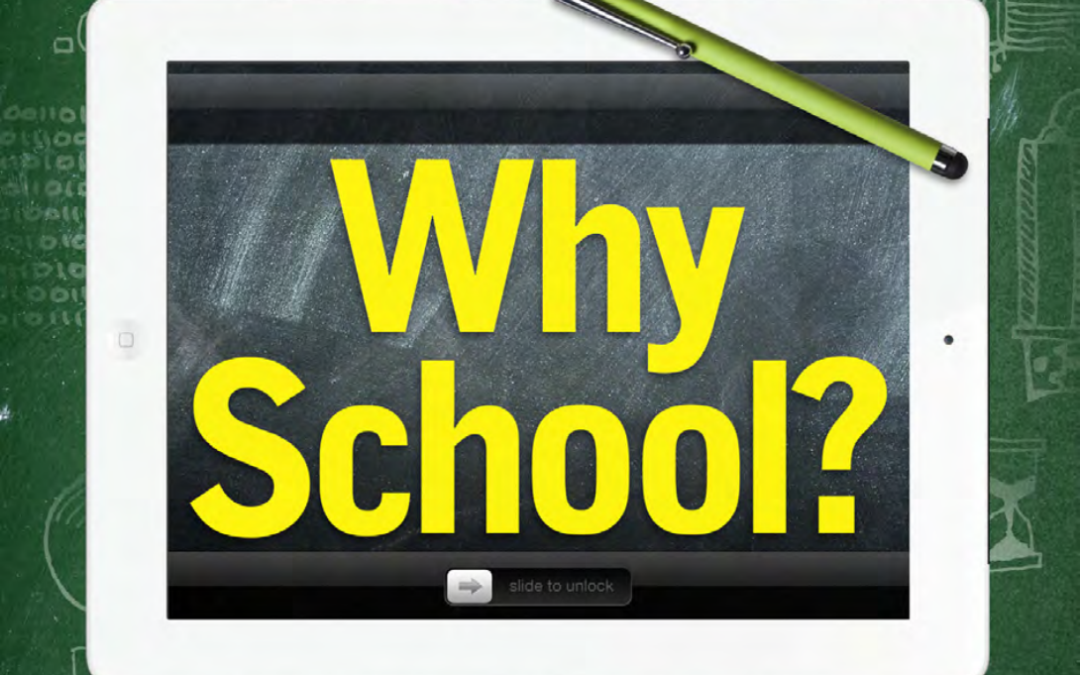
Twelve years ago Will Richardson published Why School?, a short but incredibly impactful ebook that has strongly influenced my own thinking about learning, teaching, and schooling. Published by the folks who run the TED conferences, it contained gems like:
What doesn’t work any longer is our education system’s stubborn focus on delivering a curriculum that’s growing increasingly irrelevant to today’s kids, the outmoded standardized assessments we use in an attempt to measure our success, and the command-and-control thinking that is wielded over the entire process. All of that must be rethought. Now.
AND
In this new narrative, learning ceases to focus on consuming information or knowledge that’s no longer scarce. Instead, it’s about asking questions, working with others to find the answers, doing real work for real audiences, and adding to, not simply taking from, the storehouse of knowledge that the Web is becoming. It’s about developing the kinds of habits and dispositions that deep, lifelong learners need to succeed in a world rife with information and connections. The emphasis shifts from content mastery to learning mastery.
The Why School? ebook was only available as a Kindle version but disappeared from Amazon a while back. Will posted recently that he regained the copyright and that it now can be downloaded for free. I am greatly appreciative of Will’s willingness to reshare it with the world again.
[ISTELive 2024 starts this week so I am resurrecting three blog posts from previous years. Below is Blast From the Past (BFTP) #3 from 2013!]
Here’s my guiding question for the ISTE conference this year (for both presenters and vendors). If you’re at ISTE right now, I encourage you to ask this question too!
This post from a school administrator came across my feeds this weekend:
Looking for suggestions of a great speaker for the first week of PD– motivational– reconnecting with your “Why” for staff. Thank you in advance for your suggestions!
I posted it to Facebook with the comment, “Does anyone think this is going to have any long-term impact whatsoever?”
Some folks thought that I was criticizing the speaker side of this dynamic. Just to clarify, I don’t actually have an issue with that side of things. If you’re offering something as a speaker or facilitator that others find value in and are willing to pay for, more power to you. That doesn’t mean that everyone will, but that’s okay. Find your niche. Try to do good work. Ignore the critics (or use their feedback to improve what you do).
Instead, I am greatly challenged by the request. There’s nothing in this generic call for a random ‘great … motivational’ speaker that says:
We are working on school culture and I need a carefully-targeted outside person who can build our capacity to do the following things, or
My teachers are really struggling. Who might be able to help me and my leadership team build better systems of support?, or
Based on robust feedback from my staff, we really need assistance with these key structures.
Instead, the request just feels like “Hey, I’d like to find some random person who hopefully can help us feel good and ignore our disengaging workspace for an hour and I’m willing to pay big money for it.” Um, maybe a standup comedian can do that for you? The long-term impact for your staff and school feels like it will be about the same…
There are at least three large concerns here:
The belief that teachers who are disconnected from their ‘why’ will somehow derive significant benefit from a one-off ‘motivational’ speaker,
The utter lack of follow-up or overall strategy that is built into this request, and
The apparent lack of awareness that what is in need of fixing is local systems (which are primarily the leaders’ responsibility), not teachers.
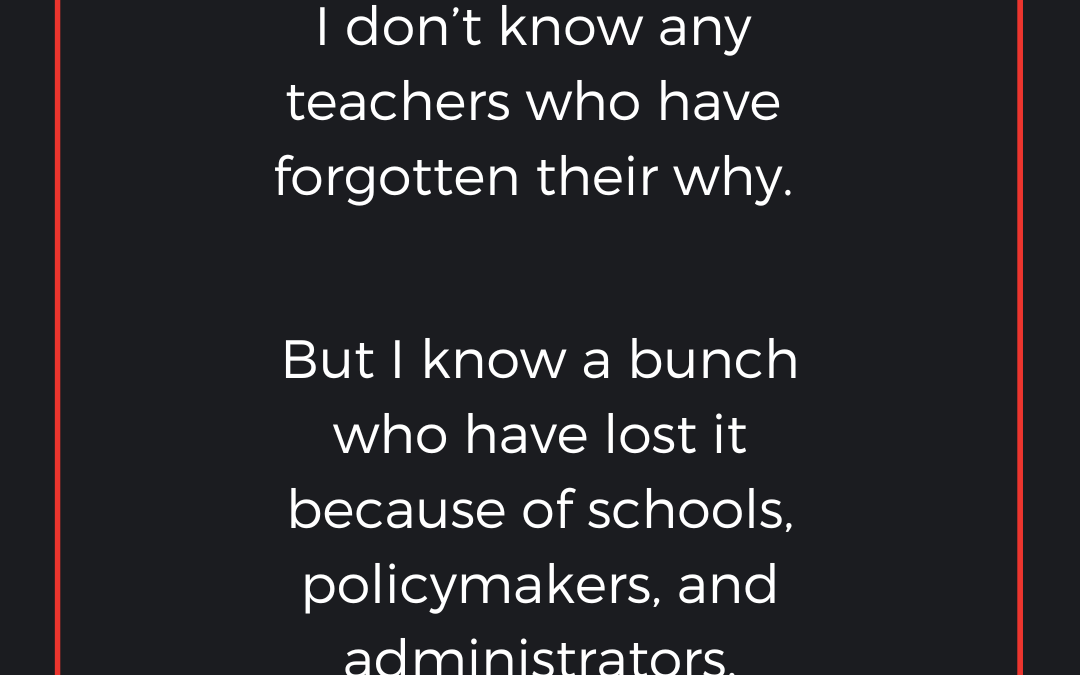
Brad Weinstein aptly said, Asking teachers to remember their ‘why’ can be viewed as blaming teachers for losing their passion for teaching instead of working on improving the conditions that actually burn them out.Similarly, Mandy Froehlich said in a comment to my Facebook post, Most teachers know their why. They don’t know how to do their why in their current situation or the state of education.
School culture is critically important for organizational success, and the best facilitators that I know on this topic work with schools long-term from a coaching stance to help build both better systems and individual capacity. That is a whole different ballgame than “The culture and systems that I am responsible for are broken and I am hoping that a high energy, one-hour talk will paper over it.” Teaching is really hard, and it’s particularly difficult right now. As school leaders who are supposed to serve those in our care and also have limited professional learning funds, we owe our educators better than this.
Breaking news! A nationally-representative poll of more than 1,000 teenagers finds that… students are still bored. Here are some key findings:
64% of teenagers think that school is boring
70% of teenagers say that all or most of their classmates are bored in class
Only 41% of teenagers like going to school
Only 40% of teenagers think that their homework helps them learn
30% of teenagers say that school is a waste of time
Only 19% of teenagers say that most of their classmates want to be in school
These results just confirm earlier findings. This is a system that is fundamentally BROKEN. Everyone is expressing concern about students’ chronic absenteeism. But we’re just offering them the same old boring stuff. That’s not a successful sales pitch for a student who doesn’t want to come to school, is it?
What will we do about these recent findings? Probably the same thing that we’ve done in the past: nothing. As I said in an earlier post:
The biggest indictment of our schools is not their failure to raise test scores above some politically-determined line of ‘proficiency.’ It’s that – day in and day out – they routinely ignore the fact that our children are bored, disengaged, and disempowered. We’ve known this forever, but we have yet to really care about it in a way that would drive substantive changes in practice. The disenfranchisement of our youth continues to happen in the very institutions that are allegedly preparing them to be ‘life long learners.’


![Building a new, student-centered school [NAESP]](http://dangerouslyirrelevant.org/wp-content/uploads/2025/01/NAESP-Logo-Square-1080x675.jpg)
![How Children Fail [SLIDES]](http://dangerouslyirrelevant.org/wp-content/uploads/2024/12/How-Children-Fail-Quote-38-1080x675.png)


![[BFTP] The one question I’m asking at ISTE 2013](http://dangerouslyirrelevant.org/wp-content/uploads/et_temp/jumpforjoy-202505_550x675.jpg)