I was honored when Scott asked for my contribution to this series of posts on what teacher want from an administrator. It just so happens I have a thought or two on the subject. 🙂 My name is Adina Sullivan and I currently teach 4th grade about 1/2 hour north of San Diego, CA. I’ve taught at the elementary school level (K, 3, 3/4, 4) for 12 years. Prior to that I worked with adults for about 10 years, both in a corporate trainer capacity and as an adult literacy tutor and tutor trainer. At the elementary school level, I used to work in a predominantly middle-class school and now teach in a school where 90% of our families are low-income and 90% are English language learners. We’ve improved from a school labeled as “failing” to one that now meets state achievement levels. Much of that success can be contributed to positive leadership of a dedicated staff.
In this piece, I tried to include what I’ve seen work well, the opposite of what I’ve seen fail, and the dream of what I’d like to see. Before I really get into it, I want thank all administrators who strive to be the best and never forget they are still educators and not just managers.
What’s Really Important
Stay in touch with the realities of the classroom. Visit a few classrooms each day and not just for performance reviews. I know this may not be popular with teachers who believe they should have free rein behind a closed door. Students and staff should see your presence as a natural occurrence. If they only see you for performance reviews or when there is a problem, it becomes a distraction and teachers are uncomfortable. When you do visit, take a moment to write even one sentence about what you noticed. Mention something positive. If there was something that didn’t look right, as about it first. It may be that you saw it out of context. It it really is a problem, discuss it right away. Visit other schools in your area as well. It may help to provide some perspective.
Teach students periodically. I know one administrator (approx. 1,000 student school) who takes a small group for 1/2 hour each day. Another didn’t understand why teachers were struggling with a particular group of students until she actually taught that group for 1/2 hour each day for a week. She was then better able to offer suggestions and make decisions about how we work with those small groups.
I believe both of the above apply even for those at the district office and university college of education level. “Ivory tower syndrome” is a terrible disease that can set in and results in teachers having less respect for your suggestions and frustration at top-down management decisions. The teaching environment is changing. The pressure I felt and teaching strategies I used 12 years ago are different from five years ago. Today is different still–dramatically different. I know you are busy, but how much impact is all your work having if teachers don’t believe you know what you’re talking about.
Just About as Important
Provide and support sustainable professional development opportunities and allow staff input on what and when.
Set high expectations, but no higher than you set for yourself.
There are times when a teacher is not performing well. If you’ve been making classroom visits, you can better recognize patterns for that teacher and won’t be making judgments based only on test scores or a couple of performance reviews. Give that teacher concrete suggestions and a reasonable time to make adjustments. Demonstrate what you are asking him or her to do. Sometimes it’s also appropriate to have them visit another classroom for examples. If this is the case, find out if it would be preferable to visit another school rather than a site colleague. If a teacher is doing genuine harm or is indifferent to making change, take action. Otherwise it’s bad for morale and feeds into the argument that tenured teachers’ jobs are guaranteed. Yes, it takes an effort. Sometimes it needs to be done.
Promote collaboration, not competition. Staff should be encouraged and given time to plan, create, and share together. Comparing teachers doesn’t push any teacher I know to out-do someone else. It only breeds resentment.
Know why you are asking for something (technology, new programs, pedagogy changes, etc.). Popular doesn’t always mean better. Sometimes it just means better salesmanship. Don’t fall for bright shiny objects unless you have a clear view of how they not only support, but improve student learning.
Be willing to admit you are wrong and allow for respectful disagreement. If you don’t, you run the risk of either having your staff ignore you, or saying one thing to your face and another behind your back. I absolutely cannot stand when colleagues to do this, but I can see why they sometimes feel it’s necessary.
And Don’t Forget These
Make parents comfortable on campus and a valuable part of decision making without allowing them to take over. Decisions should never be made due to fear of how a parent will react because he/she didn’t get their way.
Allow students to have meaningful input. They should be allowed to have at least some input on decisions in a place where they spend so much of their lives.
Honor my time. Staff meetings should be held to time limits and stick to agendas. We run our staff and grade-level meetings in a facilitation format. It has made a huge difference. If you’ve never had facilitation training, it’s worth a little practice. In return, you should require that staff honor that time by actually focusing on the meeting and not holding side conversations or doing other work during that time.
Give credit for positive things that happen and take responsibility for the negative. Allow your staff to shine, and you will will shine as a result.
Be the biggest supporter of your school to the rest of the district and the community. Be willing to fight for what is right for your students and staff. Seek out grant opportunities. Be willing to stand up when a policy, procedure, or situation is not right. Stand up even when it isn’t popular to do so.
Stay informed and read something new. Try reading a variety of books, blogs, magazines and research written from different points of view (other administrators, teachers, parents, students, etc.) You may not agree with all you read. Think critically about why.
Whew! It’s a long list. You have hundreds of other items already on your to-do list. I truly believe though, that these ideas can go a long way toward making our schools positive, productive, and happy places for students, staff, parents, and you. We’re in this together.
What do I need from administrators? It seems to be a huge question, and I am not sure why. Administration, in my experience in elementary schools in California’s Bay Area, seems to be a tool of policy makers, not defenders of good, wholesome educational practices–they are the purveyors of fads. Or maybe they are simply trying to stay employed.
I have had principals who never taught in an elementary classroom. I’ve had principals who have been out of a classroom for 20 years, yet still think they are current. My district has gone through 3 superintendents in 10 years, each with his/her own “bee in the bonnet” about something that has more to do with money than educating kids. It’s a sorry state of affairs.
Administration/principals in a school, IMHO, should be made up of current teachers. Actually, administrator should be a non-education based job–administrators should not be principals. At big hospitals there a managers who manage the business side, leaving medical personnel to do medicine. Sure there is a chief medical person, but that person is chiefly medical and only meets with the MBAs when money versus best practices is at issue, not to decide on medical procedures, ideally.
I want this for schools. Principals are too busy dealing with budgets–being the tools of the board and superintendent. School districts spend an inordinate amount of time dealing with money–cutting programs, overworking staff, eliminating positions–because America has chosen war over children, or something similar. Principals, who started as teachers, are not best used as OMB-type employees. They started out as educators, and should remain leaders of education in schools, not budget cutting consultants who come in fresh, ready to cut and slash.
I would like to see an administration separate the double role principals play into 2 distinct roles: the money role (administrator) and the educational leader role (principal). I propose to do it like this:
Let’s assume a district with 12 elementary schools–a 1-high school town. In this town there would be an MBA type administrator (or 2) who would deal with the money for all schools–budgets would be prepared and analyzed by this MBA’s staff and then presented to the educational leaders at each school. I call them educational leaders because they would be teachers. Let me explain, because here is where I go nuts:
The principal of an elementary school should be working with parents, teachers and children, not budgets and money management. In order to have an educator (teacher) as principal we would need to do something very different in terms of credentialing. Imagine if all teachers were not just credentialed as a teacher, but also as an administrator (principal)? The administrator classes one needs to take to get an administration credential are few, making them an easy addition to a regular credential program. By combining a regular credential with an administrator supplement, making a new, more robust single credential, there is suddenly a large number of those who could be principal.
In my scenario, teachers with the new credential would rotate from year to year as principal. Sure, it is similar to a teacher-led school, but my idea changes credentialing and traditional administration of schools. If I am a classroom teacher this year, I might be principal next year, then my buddy teacher the year after that with me returning to the classroom. This puts educators and colleagues in charge of the school–with no worries about finances because they are taken care of by the “money-man.”
I like the idea because my experience with administration has been an adversarial one with money pitted against what’s best for kids. What would this new principal/teacher be able to do? Freed from an Excel spreadsheet a principal would have time to help with the actual teaching of students and professional development of teachers. Staff meetings would take on an air of a team working toward more cohesion and attentiveness to the needs of students as opposed to the constant strum and drang of management-speak.
A principal should be a classroom expert, especially in elementary school. They should be part of the school team, not part of the management adversariat.
Teachers should run schools. Schools are not businesses.
The Frustrated Teacher is a former elementary school teacher with 13 years of classroom experience in Title I schools. Before that he ran summer camps and after school programs for affluent kids. He has worked with young children for 30 years. He left the classroom to pursue a private consulting practice where his penchant for calling it like it is won’t be such a downer.
As a founding member of the Teacher Leaders Network and a guy who is passionate about trying to stay in the classroom for my entire career, I’ll never forget the first time that I paged through IEL’s seminal report, Redefining the Teacher as Leader.
Strange, huh? People remember lots of “first times”—riding a bike, kissing a girl, driving a car, landing a job, getting a paycheck—but remembering your first time with a policy document churned out by an edu-think-tank?
Not so much.
Maybe that’s why I feel like such an odd duck—a label that my TLN colleagues and I wear with pride.
(Image Credit: Orange Duck by Ansik, licensed Creative Commons Attribution)
Admittedly, there’s not a lot of teachers whose skirts get blown up by policy documents.
But there are TONS of teachers who care deeply about serving as leaders in their schools and communities, creating what the IEL team writing Redefining the Teacher as Leader almost a decade ago described as:
“A potentially splendid resource for leadership and reform that is now being squandered: the experience, ideas, and capacity to lead of the nation’s schoolteachers” (p. 2).
And there are TONS of edu-experts that argue about the importance of teacher leadership all the time. Need a sampling? Take these two quotes for a ride:
“A crying need exists for excellent, practicing teachers to advance—to lead—by taking a more formal and explicit role in the supervision and improvement of instruction.” Mike Schmoker
“The leadership shortage may be dire, but the leadership development potential is great, if only schools and systems will tap into the potential of teacher leadership. Even though 50,000 leaders will retire in the first few years that this book is in print, hundreds of thousands of teachers will be at the peak of their professional experience.” Douglas Reeves
Sadly, I’m here to tell you that the vast majority of our districts are still squandering the experience, ideas and capacity of our nation’s school teachers.
Then consider that over half (53) of the 140 teachers I recently surveyed are dissatisfied with the teacher leadership opportunities available to them and that just under half (49) don’t believe that teacher leadership is valued in their schools.
Pretty discouraging, huh? Teacher leadership has been an uber-buzzword for so long that you’d think we’d see more promising trends in these kinds of numbers.
Now, knowing full well that us odd ducks can be a bit hard to understand, I had some of my buddies share their thoughts on the kinds of things that teacher leaders need from administrators.
Here’s a sampling of what they wrote:
“I need a principal to do more public acknowledgement of the work and effort we’ve put in.” David Cohen
“What I wish every administrator knew about teacher leaders is that whether they’re born or made, genuine teacher leaders are outstanding teachers first and foremost.” Gail Ritchie
“I would like to be utilized…I would hope that I could bring a vital perspective to problem solving in the school and be asked to be involved at that level.” Heather Wolpert-Gawron
“I need to know that my principal is a true member of our school. I need to see his/her face in the hallway, at PLC meetings, and at sporting events.” Sarah Henchey
“As a teacher leader,I need an adminstrator who trusts me to think independently, make on-the-spot educated decisions, and have the ability to problem solve educational issues.” Cossondra George
“Teacher leaders need the freedom to try new things in their classrooms. We are intelligent leaders who are learning and may hear about things before you do!” Becky Goerend
“Teachers need…a safe place to wonder in and personalize their learning. We do not make it easy for students to learn by making it difficult for teachers to learn.” Nancy Stuewe
“Teacher Leaders need trust, freedom, and instructional leadership from our administrators.” Paul Cancellieri
“Teacher leaders need an administrator who allows others to have input into how to (i) set the direction of the school, (ii) redesign the organization; and (iii) manage the instructional program.” Tania Sterling
“I would say I need to be listened to, and to receive honest and helpful feedback on my ideas.” Bill Ivey
Interesting stuff, huh? Basically, what we’re saying is that teacher leaders need nothing more than the confidence and trust of their administrators.
And the even better news is that, in my survey of my teacher leader friends, “informal words of thanks and praise from principals” rates as the most important reward necessary for encouraging teacher leadership—-placing higher than release time from classroom responsibilities AND additional compensation.
To put it simply, we’re competent and qualified—we’re reading as much as you are, we’re studying our craft in deep and meaningful ways, we understand the social dynamics of our buildings, we’re perfecting our professional development skills—and putting our knowledge and skills to work ain’t going to cost you anything more than a willingness to let us lead!
There are only so much bagels and coffee to go around. Most of the staff will have their pickings from the muffins (usually gone by the 50th staff member), and some will surely be on a diet or have eaten already, and they’ll decide to skip over the principal’s peace offering for the first staff-wide meeting of the school year. They salute people they either haven’t seen in a couple of weeks or a couple of months, begrudging the first long speech of the year as well. They’ll sit through the introductions, the mixed news, the goals, the one or two jokes, and the promise for a new and better year. But all the excess cream cheese dries up, the coffee gets cold, and the utensils run out. The world is starving while people dump the leftovers in a big garbage bag. If, as a principal, that’s the only support you provide for your staff, then you’ll wonder if that’s the only part of your school that’ll go stale.
As a teacher (and math coach), I’m looking for a few things from my leader. Food is supplemental in this equation, but not the true sustenance for the grueling 180-day season that is school. When a principal mentions things like autonomy, professionalism, and high expectations, this teacher’s heart grows aflutter. It’s as if the principal actually decided they’d actually fortified their spines with irons. Anytime a principal has confidence in their staff to do the job right, treats them like in-house specialists, it speaks volumes to the sorts of things he or she expects from the staff member.
It also means that a principal has to have those expectations met satisfactorily. Any staff member has incentive to work less hard if they know specific members of the staff get some undue privilege. Any teacher worth their weight in chalk won’t fall for that, but the staff members who need the most help are the ones who’ve become disenchanted with the school system, the unwarranted changes in leadership, and the occasional letter in the file for not having dressed up a bulletin board. A principal here is expected to have reasonable and equitable judgment in these cases, help advance those teachers in their profession, and be the proverbial kick-in-the-pants when they’re not meeting expectations.
We’re professionals. We should be able to handle it.
That’s not what’s out there, though. As the distorted voiceboxes of the current educational system have it, teachers are nothing less than union-hugging, unpatriotic, apathetic curmudgeons, even when the regular American would disagree vehemently. At least with the apathetic part. (Ed: Jokes, folks.) Thus, because of this view, people expect principals to instantly fire “bad teachers” and turn test scores around by any means necessary, even to the detriment to the school culture. In the short term, a wack-a-teacher strategy may work, but in the long term, I can’t imagine this schema to be equitable, sustainable, or vital to the school community.
I ask that principals have cojones to stand up and say “This is what’s best for the students in this community, my students. This is what’s best for my teachers.” Not to simply go with the trend, but form their own opinion based on real research and experience. Not sway too much from the original vision, but have the clarity to include key voices from the community. Not to cowtow to the higher-ups when things look most dire, but to reflect and judge based on conscience and care. Not to let ego and derision run their living fluids dry, but lead by voice and example.
No teacher’s asking for anything they can’t demand of themselves for their students. Perfection isn’t the goal. In extremes, the flaws become that much more obvious. Thus, those of us who take our jobs seriously in education ask for guidance, for clarity, for focus, all attainable and available.
More importantly, we ask for cojones. The courage to lead, even when there’s no more cream cheese.
Guest post by Jose Vilson, who’s a writer, teacher, and web designer at TheJoseVilson.com. He’s currently part of a team of writers whose book, Teaching 2030: What We Must Do For Our Students and Our Public Schools – Now and in the Future, is slated for January 2011 release.
Scott McLeod asked a bunch of teachers, me among them, to write about what they thought teachers needed from an administrator. What are my qualifications for this task other than having a big mouth, and a modestly popular teacher blog? Well, I’ve seen a lot of administrators in my day. To start, until this year, I’ve changed jobs or sites every three years. Before that, I spent my first year with my own classroom at a year-round school working with four different principals (yeah, it was that kind of year, and that kind of place). I started my career substitute teaching, so I saw a lot of different schools with a lot of different administrators. I have only ever worked in urban, Title One schools, so my advice skews towards that demographic. In addition, the school I’ve taught at the last three years (and I am returning to) is currently being reformed using a “transformation” model (50% new, 50% existing staff) for being “persistently failing“.
Here is the wisdom that I’ve gleaned from that experience; moderation in most things will not only save your sanity as an administrator, but make you a better boss for your teachers. Now that’s a pretty general, and potentially banal, bit of advice. Most administrators I’ve worked for are concrete thinkers and those types maybe wondering, “What the heck?” So I’ll try to explain this in a little more detail with examples that could come from your life.
Let’s start off with a task of being an instructional leader. This is frequently invoked, but a not always seen skill in administrators. My experience is solely in elementary, so most of what I’m going to talk about pertains to that, but there are points that apply at all levels. First, if you want to see the kids do it, and the teachers do it, you need to be able to do whatever that “it” is as well. Somewhere in my state, I’d rather not say where, there was an administrator in charge of Language Arts curriculum. This administrator did not have a background in this subject at all (they had taught Home Economics), but much worse than that, they once said something along the lines of, “I really hate to do writing, and I always have.” Not surprisingly, this administrator pushed a program that was highly scripted and demanded teachers practice “program fidelity” (following the teachers’ edition and pacing guide religiously). I’m sure this approach seemed reasonable to someone with both no background, but also no interest in the subject they were in charge of. My current, and brand new, administrator has attended all of the trainings we’ve had this summer, including ones on writing, and has participated in them actively. This not only sets the tone, it tells us he knows what we will be doing and what to expect from us.
This story brings me to my next point, workers who have a greater sense of control and efficacy about their work are happier and less stressed. Give me options and treat me as a professional. Good teaching requires constant monitoring and ADJUSTMENT and children will not learn without it. If fidelity to the program is something you can’t live without I’m going to suggest a new career, something like accounting or regulatory compliance–where rule adherence is a positive attribute–because you should not be working with children. What can this look like? Larry Ferlazzo’s post about how his school is working with the California Writing Project is good example. In talking to Larry, and his principal, Ted Appel, I found out that this project started at staff request, and is sustained by staff efforts. They like the program, and are willing participants because of the control and success they feel. Even as my site is undergoing some pretty extreme reforms, I can see my administrator looking for opportunities to give staff choices and the opportunities to come up with their own approaches, and offering these to teachers.
While you give control to staff, it is important that someone be in charge. Most work staffs (and not just in teaching) have their own anthropology, and we can be a little crazy with the usual mix of personality disorders, and control freaks. Just like teachers need to make the classroom safe for kids, you need to make sure that those crucial and courageous conversations are not just an excuse for bullying by certain staff members. Also, you need to realize that you, and your staff, cannot do it all. Be focused, and set limits on your time and efforts, and help your staff to develop this as well. My school is heading into a process that could be overwhelming, transforming a “failing” school. The new administrator has asked us explicitly to be careful about over-committing and taking on too many tasks. This contrasts with other administrators I have known who demanded staffs do it all. To sum things up, give your staff as much control as they need, and can handle (i.e. don’t “over-delegate” because their first priority needs to be teaching).
Here is my final point; do unto me, as you would have me do unto you. Let’s talk about lying (I know, I just dive right in, don’t I?) I bring this up because in the slew of recent trainings I’ve had to attend as part of my school being reformed, an administrator (not one at my site) shared a story (which he said was okay for public consumption and occurred in another district) about how he had moved up from being a teacher to being an administrator. He had friends among the teachers that he was now supervising. One of his friends lied to him. Like most teacher lies, it was stupid because what he was lying about something would not have gotten him fired. So he risked a friendship, and his professional “honor” for something that wasn’t even going to put his job in danger.
What’s the lesson for administrators? If you have a teacher who lies about something that isn’t a career-ender (e.g., “I warned the kid 3 times” when they didn’t, “I called the parent and left a message” when they didn’t) use this as a teachable moment (as the administrator who told me the story did). If a number of staff members are lying to you then you have to ask yourself, are they scared to tell you the truth, or have you have set a standard that lying is acceptable by doing so yourself? If you are a practitioner of lying, even on an occasional basis, you need to stop it now for your own professional health and the health of your school. Don’t lie to your staff. Don’t lie to the students. Don’t lie to the parents. You can say, “I can’t answer that,” or “I don’t know”, but if you don’t want people lying to you (or not trusting you) don’t lie. I know this seems obvious, but you would be surprised how many administrators out there think it’s okay to fib to the kids, lie to parents, and bs their staff.
So these are my “rules” for being my BAA (Best Administrator Always): to be a curriculum leader, you need to know curriculum; give your teachers control–but stay in charge and keep things focused; and don’t lie and don’t let your staff get in lying habits.
Now most of this is about site administrators, such as principals, and is not so much about central office administrators (except for Ms. Fidelity to the Program who didn’t like to write). I’ll tell you why, because it’s a good lesson for those of you heading towards that type of job. I haven’t seen many central office administrators around at the school sites I’ve worked at until recently (when we got a new Superintendent). I once asked a teacher who had “bumped” back down to a classroom position why we never saw folks from the central admin office at our school site. “We were too busy working on projects, “ was her answer. So they basically spent all day writing reports, and going to meetings. When they wanted to “talk to the sites” they called the administrator up to listen to them. All the communication was coming down the org chart, and everyone was “looking” up to see what was going on, and what to do. This is part of the reason why my school is in the lowest 5% of performance on state tests, and had to be reformed. We had members of the school board visiting more often than central office administrators. We had the State Superintendent of Instruction spend more minutes on our campus than some of our Associate Superintendents. I’ll spell it out for those of you who haven’t figured out the lesson. If you are a central office administrator, you need to go out to the school sites on a regular basis to really find out what is going on. Reading test scores, and getting reports from site administrators will not take care of your job for you. If you aren’t spending time at school sites, you are not doing your job.
Hi, my Name is Brian Crosby. Scott has asked me to kick off his week long series, “What do teachers need from administrators?” You can learn about me on the “About” page on my blog, Learning Is Messy, and about my students here.
The short version is that I have taught for about 30 years. I currently teach in a very “at risk” elementary school – almost 100% free lunch and almost 90% second language learners. I usually “roll” a class for 3 years. I get them as 4th graders and keep them through 6th grade. Poverty causes a high rate of turnover, so I usually end with a little more than half of the students I started with after 3 years. Some years I have 20 or more changes in my classroom. I have the only 1:1 elementary laptop classroom in a school district of 63,000 students. My state (Nevada) funds education 50th in the country.
I’m not going to pull any punches on this topic, and because it is focused on what teachers need from administrators, I’m sticking to that. Just know that administrators need plenty from teachers too, so don’t take what I share here as dumping this all in administrators’ laps. They need our support and guidance as much as we need their’ s. Remember I teach elementary, so my feedback will be shaded by my experience.
I’m pointing my post at all school administrators not just principals. What do teachers need from administrators?
– Give us, and advocate for us, more time to plan. Effective teaching requires, more than ever, effective planning. I would love to have as much as 2 weeks (not including a day or two to set up my classroom) at the beginning of the school year. Time to plan as a staff, unit (for example – upper elementary grades), grade level and self. I know this costs money … might be some of the best money spent.
– It’s the 21st century – let’s go there with our schools! If a teacher from 100 years ago, or even 50 could pretty much move right in, that’s not good. Would that work in medicine or business?
– Teachers should have the most say in the professional development they receive – some of that 2 weeks time at the beginning of the year could be PD teachers planned to help drive their teaching and their plan for the year.
– We are glad you get to attend conferences during the summer. Don’t make us adopt, adapt and integrate the great thing you saw or heard about there at the beginning of each school year. We don’t get enough planning time as it is – see above (in my school district we get 1 day and have to set up our room too), it usually just adds to the stress and have you noticed they are usually a bust.
– “Research Based” does not necessarily mean good, or right for our situation, great, effective, or proven over time.
– There are many, many powerful, important, effective, innovative, sometimes transformative pedagogies that are NOT research based. Maybe we should try some of them too.
– “Not everything that can be counted (tested) counts, and not everything that counts can be counted (tested).” – Einstein
Please, please, please – remember that when you are making decisions that narrow the curriculum for our neediest students (or any students). And yes, I know you’ve seen that quote before.
– Changing course constantly is very bad. Teachers that are constantly put in a position of dealing with changing rules, curriculums, programs, principals, other colleagues, your pet project from your summer conference (and the assistant supes too), “We have dealt with the new reading adoption for a year and I see us struggling with it. And so even though we were told (as we always are) that we need 2 or more years to adjust and make this new program work, lets change things up some – oh, and remember this year we ALSO have a new science adoption to start-up,” – “Oh and our writing scores dropped some so we are going to try this new writing approach …” – “Now let’s go out there and be the best dang teachers and school ever! – BTW please have your discipline plan, school improvement plan (sorry, the school district requires that), and back to school night plan to me before you leave today.”
– Don’t tell us that teachers are “the salt of the earth” and that we are the best darn teachers and staff that was ever assembled, and then explain to us all the “top-down” decisions we have to implement that we have little to NO real voice in. We, mostly, have master’s degrees, years of experience and current experience (you, as an administrator, don’t have current full time classroom experience). Let us use ours – trust us and hold us accountable for that. Hold us accountable for our planning, lesson design, creativity (and the results of that planning time you are advocating for).
– You can’t hold us accountable for student learning by making us use a program – and use it strictly – if we really follow the program. How come we never blame the textbook/program companies that “promised” 5% or 10% 0r 20% or more percent increases in student test scores if we followed their program (that we paid big $ for) ????? Do you ever mention that?
– Are the tests (assessments) we give students to decide if they have learned what they are supposed to learn actually good, valid tests? Do we REALLY know if a student passes them (or not) they are a good or poor student? If you are not sure – please speak up.
– Don’t have meetings or set-up committees or trainings unless they are a REALLY valuable, powerful use of teachers’ time.
– This is harsh, but – If you have been an administrator for more years than you taught full-time in an actual classroom, you are probably disconnected from what it is like to be a teacher. If you taught for less than 4 or 5 years … sorry, but you probably don’t know what it is like to be a full-time classroom teacher (there are exceptions).
– This might be the most important – Be open to creativity and innovation. No, BEG for creativity and innovation from your teachers and students. Then support what obviously works, and ask for changes and tweaks to what doesn’t. Then hold us accountable. (But remember the planning time!)
– Please help teachers have voice, and ask us to help you have voice. There is too much education bashing going on, partly because we tend to take it and don’t push back. Our kids pay the price (and it isn’t fun for any of us either).
Lastly, where are the great examples of what works? What is awesome that happens in your schools with your teachers and students and parents!? Do you have some examples to share? Then shout out about them in every way you can think of!! Right now only others that have a different agenda (and lots of money and connections) seem to have a voice, so they are the only ones being heard. Where are your “Working, breathing, reproducible, intriguing models!?” Tell the world about them – better, have your teachers and students and parents tell about them too!
OK, I actually have more, but I’ve challenged you enough, and there are more educators this week to challenge you more. Remember, I was asked to share. Thanks for your time,
I’m excited about my new guest blog series. I asked seven education bloggers to respond to this question: What do teachers need from administrators? Next week we’ll see what they have to say…
[UPDATE: I had enough interest for two people per day for the week of September 20. All the slots are full now. Thanks. I’m looking forward to the week!]
I’m looking for 5 to 7 volunteers to guest blog on the topic of Reconciling standards- and data-driven accountability with the ‘21st century skills’ movement.
Posts could pertain to curriculum, instruction, assessment, leadership, policy, professional development, or any other relevant issue. If you’re interested in writing a thoughtful, reflective piece of approximately 5 to 8 paragraphs on this topic, would you drop me a note?
This would be for the week of September 20 to 26. You will be able to cross-post on your own blog(s) and also can put a blurb at the bottom about yourself and your social media sites, so this should give you some good visibility.
[This is a guest post from Carl Anderson. If you’re interested in being a guest blogger, drop me a note. Happy reading!]
By now it is an old story but still a pressing contemporary issue. Industries that have traditionally relied on a top-down hierarchy of power distribution are folding. We see it today most readily in the newspaper industry but it is painfully obvious that other industries, especially those who deal in information currency, are under siege as well. It is clear that the schools are a part of this list.
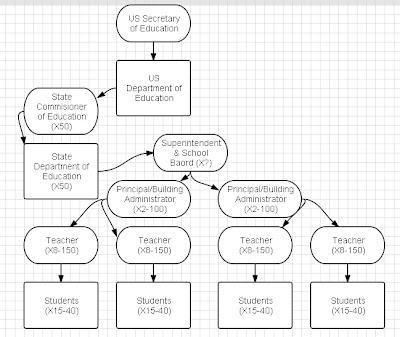
Traditionally, or for as long as anyone alive today can remember, most school systems have operated under a very clear top-down hierarchy. The Department of Education passes down edicts to states. State Departments of Education (headed by a commissioner) then pass funding & accreditation requirements and curriculum standards down to school districts. School districts are headed by superintendents operating with an authority given to them by school boards delegating responsibilities to principals and other building administrators. These administrators then delegate responsibilities to teachers and other school employees who then deliver the state mandated standards-driven curriculum to students. I realize this is a very simplistic picture of our school systems and there are great differences in the nuances between schools but for the most part this is the type of system most of us operate under.
This system was very efficient for many years and was necessary for a long time. However, when we hear criticisms of schools operating under an industrial model of education looking more like factories it is not just what goes on in the classroom that causes this comparison but also how they are structured. This structure looks like almost any corporate business hierarchy with the CEO and shareholders at the top and the workers and consumers at the bottom. Just as the corporate structure is designed to make as much profit for those at the top this system best ensures that the needs of those near the top of the pyramid are met. Today, in education, this hierarchy is most concerned with administering RTTT and NCLB measures like curriculum standards. Hence, the overly high concern with high stakes testing and “teach to the test” messages many of our teachers end up hearing. Who does this system serve? With whom lies agency in learning?
There is a new structure of learning emerging that is gaining momentum, one which appears to have no regard for edicts issued via a top-down hierarchy. Web 2.0 & social media technologies have given teachers and students agency in their own learning through the creation of what has been collectively referred to as “personal learning networks” (PLNs). Through PLNs learners choose their own learning agendas and self-select who they listen to and what curriculum (if any) they follow. Through the use of popular technologies like Twitter, YouTube, Blogs, and Facebook informal learning is quickly becoming a viable option. Teachers no longer have to look to their school system for support, they can find it through the networks they have created. This same kind of network structure and powerful informal learning is also what has made this latest phenomenon of unschooling actually seem like a viable option for some. The more our networks grow the more they challenge the authority of the traditional top-down hierarchy.
While unschooling is a little bit extreme and probably not right for most kids the fuel giving this movement momentum is something we need to address in education or our formal institutions of education will suffer the same fate as the newspaper industry. I am reminded of this slide from a TED Talk by Devdutt Pattanaik called,East vs west — the myths that mystify..
In this talk Dr. Pattanaik discusses how the fundamental belief structures between east and west cultures clash. He illustrates this with a simple story about Alexander the Great meeting a gymnosophist, “When they met, the gymnosophist asked what Alexander the Great was doing. To which he replied, ‘I am conquering the world. What are you doing?’ ‘I am experiencing nothingness,’ replied the gymnosophist.” Neither could see the point in the others endeavor because the denominator for Alexander’s life was One and the denominator for the gymnosophist’s life was Many. This fundamental element of belief informed everything about how both individuals interpreted these actions. The traditional hierarchy that has dominated our school systems has a denominator of one while PLNs, student-centered learning environments, and movements like unschooling operate with a denominator of many. If our industry is going to survive we need to find a way for both equations to find a common denominator. We have to look for ways to invert this hierarchy.
One potential method that our schools could use to help address this issue of one verses many is teacher professional partnerships (TPPs). TPPs are similar to law firms where the practitioners own their own practice. In TPP schools there is no administration but instead the teachers in the TPP work together to share the responsibilities normally delegated to building an district administrators.
This solves a few problems that teachers and schools face. First, it brings more decision making responsibility closer to those who are directly effected by those decisions. It places agency closer to those served by schooling and in so doing elevates the teaching profession. With agency comes responsibility and built-in accountability. If a teacher is held responsible for their own performance via a personal stake in ensuring that they offer a quality learning environment that students will want to participate in there will be no need for complex systems of teacher performance pay or other measures like those in RTTT. With a TPP a teacher’s performance is shown in their enrollment and whether a school thrives or fails depends entirely on how well they manage their own practice. What’s more, TPPs eliminate the need for teacher unions since the partnership is in itself a union of sorts.
Currently there are just ten TPP public schools in operation in the United States and so far they all appear to be doing well. This model of school organization holds a lot of potential addressing the problems and issues facing schools and education including the inevitable irrelevance of our traditional school hierarchy. Ted Kolderie from Education|Evolving will be Steve Hargadon’s guest on his Future of Education series this Thursday, July 8, 2010 to discuss Teacher Professional Partnerships. For more information on TPPs I urge you to attend this free online discussion in Elluminate or at least listen to the recording afterwords.
Carl Anderson is an art and technology teacher, technology integration specialist, and adjunct instructor for Hamline University’s School of Education. He writes the Techno Constructivist blog and is @anderscj on Twitter.
Earlier this week I read web posting about replacing your technology coordinator/director with a building administrator. As a guy who has spent the last twenty-three years serving at a small K-12 I disagree. However, I do understand a growing frustration led by Scott McLeod and many less known names around our country and our world. Getting rid of your technology director and filling that position with a building administrator would only exacerbate the problem. I came to my position in 1987 at a time when most schools had technology coordinators who were re-purposed mathematics teachers many of whom taught a programming class or two, with languages like Pascal. I am not a mathematics teacher and had no experience and only a B.S. in Liberal Arts. What I lacked in experience I made up for with verve and enthusiasm that has remained my trademark. We had about fifty Apple II and IIe computers along with a smattering of Commodores. Since then our department has grown to group of several microcomputer technicians but only one of which is available each day to serve the needs of over five hundred computers, nearly a hundred printers, dozens of software applications, twenty-nine file servers which a year ago were virtualized and now we are even supporting a cloud infrastructure that insures our students, teachers and administrators have twenty-four x seven access to nearly all applications whether at school or at home and even from some java enabled mobile phones.
In a small school district with meager resources I took it upon myself to learn all that I could and along the way I earned a Masters in Educational Psychology with an emphasis on Learning and Technology. I became a hypercard programmer, taught students to keyboard and write using word-processing software. We used FredWriter which was free and an alumni (who is now a Facebook friend) donated 5.25 inch disks which had FredWriter on one side and a data disk on the other. While I attended the State University of New York at Buffalo enroute to the M.A. I met Dr. Douglas Clements and with the aid of my wife a third grade teacher at the time instructed elementary students in Apple Logo and a special geometry curriculum written by Dr. Clements and his colleague, Mike Battista. In the early 1990’s we had our first local area network using Lantastic and I had to learn a bit about star topologies and running cable. A few years later we put in category 5 ethernet when everyone around us was putting in IBM Token Ring. Research and hard work saved our district tens of thousands of dollars initially and if you factor in not getting taken in by the Token Ring crowd we saved the district from cost of rewiring. I was an early adopter of both Windows NT and Windows 95 and we became the first school district in our area to move in that direction at a time when everyone else was using OS/2 Lanserver and Novell. This too saved tens of thousands of dollars. We were early adopters of so called "white box" open architecture computers which were custom designed and made from quality components.
My efforts have always been to knock down walls and to build bridges to places of opportunity for our students, our faculty, our administration and our community. I see my role and those of my fellow technology directors and now technology integrators, curriculum directors, curriculum specialists as people who can and do encourage innovation. We owe this to our various constituencies. We do not serve them well when we accept the status quo. When someone tells me that this or that can’t be done I make it my business to prove them wrong.
Ten years ago we were forced by fiat to filter in order to comply with E-rate. I railed at the idea of having to filter and it was during a conversation with a vendor of a particular filtering product that the salesman, who was no doubt tiring of my soapbox lecture about the first amendment, suggested that I build my own filter with Linux. I accepted his challenge and bought my first copy of Suse Linux from Amazon and proceeded to hack my way to a filter eventually using open source products Squid and Squidguard to fit the bill. At the same time I encountered stiff resistance from IT traditionalists upstream who insisted that I was treading in dangerous ground. I called SLD and made sure that I was not breaking the law and kept moving forward. Eventually we began to use Red Hat and later Fedora Linux with Squid and Dansguardian another open source product that created a great filter. The upstream skeptics were silenced and others followed my lead.
The experience gained with filtering led me to an exploration of Linux in much greater detail and now a liberal arts guy with no computer science in his background began building Linux servers in closets and using hardware that no one else wanted. Eventually I was able to secure some special legislative funds from the late New York State Senator Patricia K. McGee who rewarded my entrepreneurial initiatives and granted us sufficient funds for a couple of us to get more advance professional training in Linux and other open source tools. My Linux training and my love of design led me to open source web systems using Apache, MySQL, PHP and eventually to PhpBB, WordPress, Drupal and now Moodle. Long before I laid eyes on Drupal & Moodle I could see how PhpBB could be used for student learning. From my earliest days I have loved learning and sharing what I learn with others.
A few years ago one of our previous superintendents asked me to examine how we could excite student on the edge. Many of these students were very bright by virtue of their IQ scores but remained listless in traditional classrooms. Around that time too my daughter introduced me to text messaging and so another epiphany occurred and I began to see a connection for learning and teaching using cellular phones. At a time when many of my peers in both the teaching and administrative ranks disdained cell phones, I was looking for ways to connect them to student learning. This journey has led me to an integration of cell phones, web applications using WordPress, Drupal and Moodle and student learning.
A year ago our high school principal gave me an opportunity to return to the classroom that I had been gone from for five years due to administrative overload. He asked me to consider teaching a class that would teach students what not to do with Facebook and cell phones. I asked to think about it for a few days. A bit less than a year ago I began to write a curriculum that was influenced in part by a trip to NECC 2009 in Washington, DC and some of ISTE’s materials including Mike Ribble and Gerald Bailey’s book on "Digital Citizenship in Schools." I spent last summer reading their book and many others, following tweets from my personal learning network on Twitter and Facebook and writing a curriculum that is a work in progress. I finally learned a bit more about using Moodle including how to build your own Moodle server in our virtual server cloud. Now, in addition to my technology director duties I teach two classes each day of truly amazing young people who have animated my life in a way I never dreamed possible. They have encouraged me along with my personal learning network to continue to grow both personally and professionally. They are eager to learn and love our class times. Their is a waiting list for my classes. We emphasize digital citizenship and students are encouraged to blog each day and to use their cell phones for educational purposes. I’m indebted to many including my personal learning network of Katie McFarland (@katiemc827); Rick Weinberg (@rickweinberg); Mark Carls (@mcarls), Liz Kolb (@lkolb); Steve O’Connor (@steveoc) and many more whom I follow on Facebook, LinkedIn and Twitter.
What all of this has taught me is never to accept status quo and always to keep pushing ahead for the sake of those we serve, the students and staff of our respective school districts. Putting a building principal into a position like this one with little or no preparation could be a disaster. A technology director ought to be a bit of a rebel, a diplomat, and a life long learner. Today’s technology directors have to work together with curriculum directors and technology integrators to make sure that today’s students are really being prepared for the twenty-first century. Today’s technology directors must be agents of change, they have to envelope pushers but at the same time they have to work with other professionals who can shape curriculum. No one can do everything and certainly not everything well without help. We are bridge builders who should be familiar enough with the building blocks that underpin our networks. We have to be open to change too. Just today a technology integrator friend was expressing some frustration from an IT guy who told him that DropBox couldn’t work on their network. What the IT guy isn’t saying is that he fears that someone can put a rogue file into the network by way of DropBox. While that’s possible it is no excuse for not opening DropBox so teachers and even students can use it. I know that the IT guy is blowing smoke and already I told my friend and fellow technology integrator that we’re going to try it on our network and that we will be able offer empirical evidence that will allay the other person’s fear.
The nuances of technology direction and management are many and unless the particular building administrator has some keen interest in technology there would be nothing in their professional background either as a classroom teacher or a building administrator that would prepare them. I can say this because I have now completed half of the coursework at a local university that will lead me to administrative certification. Until now, and I can only speak for my own State of New York, no one has picked up the ball. Since the inception of computer technology into schools which began in the late 1970’s now there has been no real standard for technology director or coordinator. Some like me are designated as teachers although like me we have functioned as de facto administrators. Many of us are ten or sometimes eleven month employees when in fact we ought to be twelve month employees and many like me find themselves functioning in a "no man’s land," where we are mistrusted by both teachers and administrators. Generally, we are highly principled, ethical and driven individuals who are charged with managing chaos. One of my best friends and a fellow technology director has a quote from Dante’s Inferno taped over his door, "abandon all hope ye who enter here."
Today’s technology coordinators/directors should be grandfathered into administrative positions. Higher Education and State Departments of Education need to prescribe a program of study and certification for technology directors and it ought to include much of what I’ve studied in my administrative course work, but in addition to that it ought to include a special track that emphasizes technology skills and that ought to include network planning and implementation, technology visioning and planning and it ought to include curriculum integration too. Education needs geeks but we need a special kind of geek who is one of us.