

[I am teaching a Leadership for Deeper Learning elective for one of our doctoral cohorts this summer and thought that I would share what is happening each week.]
Class 03 was… interesting. We are following the flow of In Search of Deeper Learning, which sets up a staggering contrast between Dewey High in Chapter 2 and No Excuses High in Chapter 3. Dewey High is a mature project- and inquiry-based learning model. No Excuses High is exactly what you think it is… a school that focuses on tightly-scaffolded, heavily-chunked academic content in the name of college readiness; some occasional Socratic discussion (with SLANT!); and command-and-control classrooms with draconian discipline for even the most minor infraction.
Additionally, my students read several articles that extolled the virtues of direct and explicit instruction and articulated why inquiry-based learning is terrible. I also asked them to watch numerous short videos of educators training students how to track the speaker, students chanting academic answers in unison, and teachers making students line up over and over again while explaining that this “prepares them for college.” There may have been a video or two of uber-happy dancing students and teachers standing on desks at Ron Clark Academy. We also read a research brief on teaching differences in math between Japan, Germany, and the United States.
We started our class with two activities. I have been a participant in the nationwide EdPrepLab+XQ Faculty Working Group this year. We have been exploring the utility and integration of the XQ Power-Ups and The First Class film in our university educator preparation programs. EdPrepLab and XQ asked us to get some student feedback on the Power-Ups, so I asked my doctoral students to complete at least one module. For our first activity, we spent about 25 minutes unpacking the Power-Ups and my students’ comments were positive and insightful. For our second activity, we watched a classroom video of ‘classic education,’ read a short piece describing Lisa Delpit’s ideas about school culture and ‘codes of power,’ and engaged in a walk-and-talk conversation in pairs.
We also articulated theories of action (and some competing ones) for No Excuses High, and posted them on our Continuum Wall. With Dewey High on the Deeper Learning end and No Excuses High on the Traditional Grammar of Schooling end, I believe that we now have established our end posts. We will place future schools that we discuss along the Continuum Wall as the class progresses this summer.
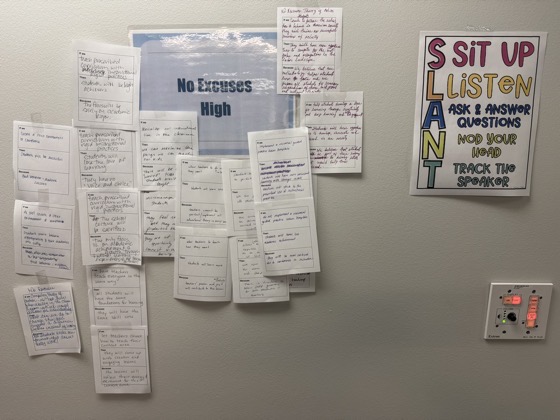
One of my design principles for this doctoral course is student co-ownership. I am trying to preserve half of every class for student-led, small group discussions. Accordingly, we spent the second half of the evening unpacking our readings and videos. Some of the questions that my students posted beforehand on the Class 03 Padlet included:
- Why are visuals of order (straight line, no gaps, smile, hand raised correctly, stand when I count, clap when I clap, lid on the marker exactly when I say) so important in these schools? What purposes do these practices serve?
- Does the use of explicit instruction require the use of heavy-handed, demeaning school and classroom management techniques? Would it be possible for schools to use explicit instruction methods while at the same time respecting students?
- Is there a middle ground of an amount of structure and routine that is predictable and creates a “safe and inclusive learning environment” but that also allows for students to be valued and cherished children and individuals? What could the “Goldilocks” school look like?
- The explicit instruction and cognitive load readings suggest that structure can be essential for learning, especially for students who are still developing foundational knowledge. However, I keep wondering whether these cultures of engagement can also unintentionally reflect and reproduce broader patterns of inequality, depending on which students are placed into which kinds of learning environments. If some schools are able to combine high structure with high expectations, while others are framed as needing strict control rather than rich learning, how do we know when “culture-building” supports learning versus reinforces systemic differences in opportunity?
- The steps of explicit instruction are often included as accommodations in IEPs and 504 Plans. Mehta & Fine (2019) found that many of these steps “work against longer, more open-ended, and more uncertain explorations” and that students are not proud of their work. Are IEP and 504 accommodations getting in the way of achieving deeper learning in a school setting?
- Ron Clark Academy seems to spend a lot of time and effort on appearances; it is almost the TikTok/Instagram-ified version of a school. Based on what you learned about the school, does it seem to truly serve kids or is it all appearances? Additionally, do you think the house system contributes a sense of healthy competition to schools or is it detrimental? Do you think a house system could help boys feel more connected to schooling in a time when they are struggling in academic settings?
- If achievement differences across countries are influenced less by isolated teaching methods and more by the consistency of instructional design across an entire system, what does that suggest about the role of leadership in building shared instructional practices without oversimplifying cultural context or reinforcing unequal expectations across student groups?
- Are we trying to build human encyclopedias, or are we cultivating critical thinkers who love learning once the basics are locked down?
- How can education leaders pivot away from individual teacher evaluation and instead build cultural systems needed for continuous, shared lesson design?
- Are there any schools/programs tracking their students’ “success” through alternative means, like eventual career placement and salary, happiness in their life, positive contributions to society? Should that data be more important than getting into (and graduating from) college, and how can we track that?
Most interesting for me this evening were my doctoral students’ attempts to try and bridge the two far ends of the Traditional Grammar of Schooling-Deeper Learning continuum (after all, we did discuss the Hegelian dialectic last week!). I heard many comments like “Well, our students need to learn content and to pay attention, and the school does well on the SAT” and “Are there ways to combine these two philosophies of schooling?” and “Ron Clark Academy looks fun. I love the idea of student houses!” and “Let’s be honest. We do a lot of these things ourselves.” I planted a few conversational seeds regarding behavior modification through conditioning techniques, including both swift punishment for small offenses and house-style point reward systems. I am eager to see how our discussions progress this summer about how we want to learn and teach, and how we want to treat the children who are in our care.
Our readings / viewings for Class 03 are listed below. The theme for the evening was Academic Rigor. End-of-class evaluations were again very positive.
- In Search of Deeper Learning, Chapter 3
- Putting students on the path to learning: The case for fully-guided instruction
- Explicit instruction
- Why inquiry-based approaches harm student learning
- Navigator Schools – Teacher radar and least invasive intervention
- Uncommon Schools – Ms. Youngman
- KIPP – How to teach students to track the speaker
- Veritas College Prep – Do it again (“this will help us get into college”)
- Critical thinking wins the day at KIPP high school
- ‘Harvard of middle school’ (Ron Clark Academy)
- Fertitta Middle School and the Ron Clark Academy method of teaching
- The Ron Clark Academy house system
- Teaching math: USA v. Japan v. Germany
- Does the no excuses model benefit our kids?
- EXAMPLE: Storytellers of the land
- EXAMPLE: Growing beyond earth
Previous posts


I abhor slant. Body autonomy is the least we should expect. Looks like a compelling course, Scott!
Yeah, SLANT’s pretty awful… 😢