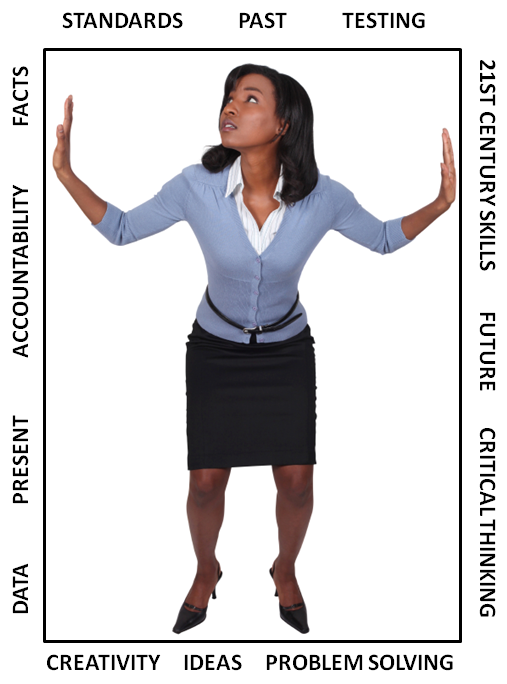
by curtisfuller | Oct 4, 2010 | Guest Bloggers, Leadership and Vision |
I was a big fan of the recent series on Dangerously Irrelevant about what teachers want their administrators to realize. As a school Principal going into my sixth year with my current school, I’m looking for ways to grow and expand professionally, and appreciated the candid responses the educators provided. After reading the posts, I wondered what advice would be shared in the opposite direction, from administrators to teachers. After I commented as much, Scott invited me to be one of the contributors for this new series. Let me start off by saying that I’m generally a blog-reader, not a blog-writer, so coming up with these ideas has been a challenge for me over the last couple weeks.
I’m privileged to work with an amazing staff who truly care for our students, and work hard to see them succeed. The vast majority of all of the teachers I have worked with in my role as an administrator have been fantastic, however, I am firmly of the mindset of continuous improvement, even the best can be better. So as I tried to come up with some general thoughts, here is what I’ve come up with: We are a team of professionals who come together to serve the students and make learning our goal.
I moved across the country to take my administrative position. I was struck by how isolating it can be to serve as a school administrator. While I spend most of my days talking to people, I often feel like an outsider. So my first thought for teachers: Realize we are a team. Please don’t look at your administrator as an “us against him” scenario. We as administrators care about the same things you do, and we can accomplish more when we work together. In order for that to work we need open relationships. Talk to your administrator honestly and keep us in the loop. If you’re having a problem, let us know. Probably the worst situations I have had to deal with result when a teacher has not given me a heads-up on something before it blew up, or the teacher tried to cover something up. As an administrator, I feel my role is to support my staff in their growth, but in order to do that I need an honest perspective of the challenges and successes you have had. Don’t isolate your administrator; keep them informed of both the good and the difficult points of your job.
I firmly believe that the profession of education needs a dose of professionalism. Teachers need to be proud of their profession, and need to take it seriously. I’ve heard many great speakers talk about the nobility of education and the pride we should take in our role, but along with that come the responsibilities of making sure we stay current and learn best practices. As educators we all need to build professional networks, and ways to stay up-to-date on what is changing in our profession. Along the same lines teachers need to present themselves as professionals; this can range from everything from the way we contact parents to the clothes we choose to wear. If teachers want to be paid and respected as highly educated and professional people, it is important that we play that role.
As a charter school principal I am probably more keenly aware of the ideals of school choice than a majority of public school administrators. Regardless of whether choice is a daily concern, I believe that teachers need to realize that schools are setup for students. The students and their families are our clients, and we serve them. No, we don’t bend over backwards to make their lives easier, but we do need to realize schools are there for the kids, not to give us a place to hang out during the day, but a place where students needs come first. I’ve heard horror stories about teachers at other schools who do not respond to phone calls or emails, and with whom it takes weeks to get an appointment with a teacher. Teachers need to understand we are in a service industry, and that our students and their families are the client.
While it is the last thing I bring out in my thoughts, it is probably the most important point: learning is our goal. Truly preparing our students for their future is the purpose of this learning… not preparing them to fill in bubbles, not preparing them for the classrooms of 50 years ago, and not preparing them to drop out of high school. We need to help our students learn the 21st century skills they are going to need for their future, and I don’t mean just technology, but the ability to think for themselves, the ability to analyze, question and create. Teachers need to be spending more time at the higher end of Bloom’s Taxonomy, helping students to develop their creativity and higher order cognitive abilities and less time with textbooks, rote memorization and mundane tasks. Let’s make learning fun and exciting for our students. Let’s engage them and teach them what they will really need to know for their future!
I love my role as an administrator. I have the opportunity to go into the classrooms of some fantastic teachers nearly every day and see the great things they are doing with students. I want to support them, I want to help them to serve as the professionals they are, to help the school succeed and to make sure that the students leave our school with what they need. I believe that teachers and administrators need to be a team of professionals who come together to serve the students and make learning our goal.
—
is Principal of Pinellas Preparatory Academy in Largo, Florida. He attempts to blog, but hasn’t found the niche yet… when he does, it will be found at http://principalfuller.com

by Scott McLeod | Oct 4, 2010 | Guest Bloggers, Leadership and Vision |
In September I had an awesome guest blog series on the topic of what teachers need from administrators. Curt Fuller, a principal in Florida, said I should have a series on what administrators need from teachers. That sounded good to me, so this week we’ll hear from school leaders on that issue.
Curt starts us off today, followed by six other excellent administrators:
As usual, anyone else is welcome to play along. Just leave a link in the comments area of any post in the series. Happy reading (in advance)!

by Scott McLeod | Sep 27, 2010 | 21st Century Skills, Assessment, Guest Bloggers |
Last week was another phenomenal week of guest blogging here at Dangerously Irrelevant. I had invited guests to reflect on how to reconcile standards- and data-driven accountability with so-called ‘21st century skills.’ Some of the best posts of the week were when my guests all but ignored the assignment!
Here are all of the posts from last week:
- An Apple (Inc.) in 21st century classrooms
- How to teach for jobs that don’t exist
- Ignore the test
- Teach wisely, teach well
- Can we just skip the whole “data-driven” part if the technology is free?
- Collaboration: The lost skill?
- The death of subjective values
- 26 centuries of skills
- Writing – The elephant in the class room
- Reclaiming the language
- To whom are we accountable?
- It’s all about building culture
- Can states assess creativity?
- Sharing reconciliation with the people formerly known as the audience
Thank you Shawn, Aaron, Jason, Karen, Kyle, Tony, Carl, Dave, Joe, Dan, Matt, Tyler, Richard, and Andrew for an incredible week of writing, thinking, and reflecting. I am humbled by the thoughtfulness (and excellence) of your work and your willingness to share your perspectives with me and my readers.
Happy reading, everyone. I strongly encourage you to click through at each post and see my guests’ other writing. Also, feel free to forward this wrap-up post on to your local school administrators and/or university educational leadership professors; there’s lots of good stuff here for them and/or their students!
by andrewsmith | Sep 26, 2010 | Assessment, Guest Bloggers, Learning and Teaching |
by Andrew Smith at Learning Out in the Open
Lately there have been a few words that have become ubiquitous in media discussions of education. That’s right: standards and data are everywhere when education comes up as a topic. Everything in education is either “standards-based” or “data-driven” no matter what the topic is. Whether it’s the adoption of a new set of standards or a supposedly well-intended instance of agitation, in education the words ‘standards’ and ‘data’ manage to resurface often. But in being given this opportunity to guest blog, the word that haunted the build-up toward approaching the topic of reconciling standards and 21st century learning was not standards but data. In a fit of 21st century research it can be found that data is defined as
–noun
2.
(used with a plural verb) individual facts, statistics, or items of information: These data represent
the results of our analyses. Data are entered by terminal for immediate processing by the computer.
3.
(used with a singular verb) a body of facts; information: Additional data is
available from the president of the firm.
In all of the angst that surrounds the lemming rush of educational systems surging to become standard-based data-driven entities the definition of data gains new importance. If data is simply a set of items of information, educators need to keep this fact in mind when the word ‘standard’ is wielded as a weapon. It is this writer’s fervent belief that educators everywhere really are doing good work with students every day. What has been lacking has been a succinct way to communicate this fact. Cynicism aside, testing and the use of data has arisen as a part of the problem that education wants for ways to articulate what it does. In the midst of heated editorial pages and town-hall levy meetings achievement testing has become a baleful blade possessed of precious few handles. But how much do those strident voices demanding accountability even know about what is on those tests?
The debate surrounding accountability and standards is often presented within a frame of binary solutions when what is truly needed is reconciliation. Wanting more for students is no more wrong than wanting a real assessment of learning. If education is to move forward and repair relationships with all stakeholders it must be with a sense of reconciliation. As
Daniel Pink shows us, some surprising things can be learned from data
particularly in relation to motivation.
But if the tests used to derive the data only reward lower-order thinking how can education survive when its very funding is tied to
what some consider to be the antithesis of higher-order thinking? The answer lies within the word ‘data’. If data is a body of facts, education must use standards as a basis of learning not as a myopic and duplicitous lens. Data is present in everything education does. Data does not stop with a test score. But then how is the picture to be properly painted to all involved? How can accountability, standards, and the need for 21st Century skills be reconciled for all involved?
When you buy a machine that lets you consume digital content, you also buy a machine to produce it.
The binary distinction of student and teacher loses focus in the context of 21st Century technology and skills. If education is to repair the schism between 21st Century skills and standards-based education it must come through the sharing of data. The items of information for such sharing can come from the activities already going on in classrooms today. Data doesn’t have to come from a one-shot testing window; data can come from qualitative learning experiences that still use educational standards. But such sharing will require a change on the part of educators.
If educators are to reconcile educational standards in the context of a 21st century world, the “four walls syndrome” must cease. The times of saying that “<insert educational initiative name here> is just a fad” and will pass must become the past. No more closing the doors to the world and teaching within one set of four walls. To begin this reconciliation educators don’t have to be Scott McLeod, or
Shelly Terrell, or
Will Richardson. Your school doesn’t need to be on a laptop initiative or have a seamless online class management system. Use your cellphone to record a great student discussion, create a
Facebook page for a class, have students concoct a
Twitter hashtag to conduct larger discussion, or
join a PLN yourself. But educators must share what is going on in their classroom with all stakeholders within the community and world around them. Isolation cannot be the default for those that feel educational data selection is subjective.
Karl Fisch and others are taking steps to change educational paradigms; all you need to do is start to share the good that you do. Share this reconciliation of education with the people formerly known as the audience.
Andrew Smith is an English Language Arts educator in suburban Minnesota.

by richardkassissieh | Sep 26, 2010 | 21st Century Skills, Assessment, Guest Bloggers, Learning and Teaching |
by Richard Kassissieh
 A student gazes at a mystery solution. Its contents are unknown. The student reaches into her toolkit, a set of known solutions, and one by one, combines them with a small portion of the mystery solution. One test changes the color to bright yellow. Another produces a milky, solid substance. Gradually, the student pieces together the clues that allow her to identify the unknown solution.
This qualitative analysis laboratory required the student to recall properties of different solutions, understand reaction processes, and synthesize the results of different experimental tests while under pressure. To practice, the student had worked together with classmates to identify a series of mystery solutions and shared their findings with their classmates.
Did this performance assessment play out in the classroom of an innovative, 21st-century educator? No, the qualitative analysis laboratory has been part of British national chemistry examinations for decades.
It is tempting to rail against high-stakes state tests in the United States. They emphasize basic skills and fact recall, pressuring school districts to strip programs to the basics and eliminate or reduce “non-core” subjects such as art and history. For example, many school districts “double dose” language arts and mathematics classes in order to improve students’ performances on state tests (see this EdWeek article).
Are large-scale, standardized assessments bound to forever measure a narrow range of skills and knowledge?
Summative work has to insist on standards of uniformity and reliability in collection and recording of data, which are not needed in formative work, and which inhibit the freedom and attention to individual needs that formative work requires.
External tests which are economical are bound to only take a short time. Therefore, their reliability and validity are bound to be severely constrained: they can only use a limited range of methods and must be limited in respect to their sampling of relevant domains.
Paul Black, Testing: Friend or Foe?
On a brighter note, some national assessments include hands-on performance assessments. Not only do we have the IGCSE national examination described above, but the U.S. Advanced Placement examinations test higher-order thinking skills through essays in many subjects and the submission of a portfolio of work in art.
The International Baccalaureate program, originally from Switzerland and growing in popularity in the U.S., includes summative assessments that measure creative problem solving, analysis and presentation of information, and argumentation (IB Diploma Programme Assessment Philosophy).
The Partnership for 21st Century Skills reports on work in progress in several states to develop “demonstrations of 21st century skills graded based on a common rubric” (p21.org).
The U.S. college admission process represents another effort to assess higher-order thinking skills fairly across a broad pool of candidates. Most selective colleges use multiple measures to evaluate students: essays, standardized test scores, lists of accomplishments, interviews, the reputation of one’s high school, and letters of recommendation.
It may well be possible to develop standardized assessments that measure 21st century skills. Cost is the main obstacle. How much would it cost to systematically test problem-solving, collaboration, and presentation skills across all U.S. schools?
Though we may see inconsistencies between standardized assessments and 21st century skills, we can advocate for an increased role of performance assessment and the assessment of higher-order thinking skills in these high-stakes tests.
Richard Kassissieh is director of information technology at Catlin Gabel School (Portland, Oregon, U.S.A.) You may find him at http://kassblog.com and @kassissieh.
Photo credit: judybaxter on Flickr
by mattlandahl | Sep 25, 2010 | Assessment, Guest Bloggers, Leadership and Vision, Learning and Teaching |
I have been mulling over the theme “reconciling standards with 21st century learning” for a few weeks now, or to be honest, for the last sixteen years or so (I have been in education for seventeen years). The first year of teaching, there was no mulling or reflecting, just surviving.
Since I an relatively new to the world of blogging and tweeting, I thought I would first tell a brief bit about myself and so you could put my thoughts into some sort of context. I began my teaching career in a very large, urban elementary school in the early nineties as a Teach for America teacher. I absolutely loved it, became a certified teacher, and stayed for a total of five years at my placement school, three years beyond the two year commitment most TFA members serve. I served at my school during an interesting time period because I taught there before there were any sort of state standards and while I served standards were put into place by the state of Maryland. I have to be honest, I am not anti-standards in any way, shape, or form. Before standards were instituted, my school was the education version of the wild west. Everybody just did their own thing and there certainly was no sheriff in town to keep things orderly. I survived on some old textbooks, an educator’s library card from Baltimore County that allowed me to check out vast amounts of books, and my wits. My colleagues, once they saw I was not a quitter (which was well into my second year of teaching) started to help me too.
Toward the end of my tenure in Baltimore, standards were put into place. I felt a certain a sense of relief that I did not have to come up with everything myself. I also liked that I had some sort of measure to strive for with my students. I also knew our school, with new leadership along with the state standards, began to take the education of poor, minority children much more seriously than they had before.
Fast forward ten years and I am now an elementary principal in Albemarle County, Virginia in a school that is a majority minority school with two thirds of our students qualifying or free/reduced lunch. I was placed in the school, my second as principal, to “turn it around”. Turning a school around, in case you have not been reading anything for the past five years or so essentially means getting those test scores up. My first year at the school in 2007, I was confident I could raise those test scores from I guess my sheer presence. That first spring, the test scores actually went down.
That began the major “aha” moment that has carried me through the last three years of leading my school. With the scores going down that year, we qualified for a school improvement grant from the state and used some of the money on some powerful staff development the folks from Responsive Classroom and Expeditionary Learning. What I started to learn that year from this professional development that I experienced with our staff was that it was all about building our culture and it was not just about test scores. Sure, we went on to significantly raise our scores two years ago (with a dip in reading this past year) but we started to make some intentional changes in our community of learners, adults and children, that have allowed us to attempt the reconciliation between 21st century learning and the standards movement (for the purposes of this post, 21st century learning standards equals our work with expeditionary learning, hands on learning, authentic products, public audience etc.)
So now, a few years later, our school is on a continual path of working deeply and thoughtfully with state standards in a way to make them meaningful to 21st century learners, our students. We have a long way to go in the process, but I have learned some things along the way as a leader that I think, helps support teachers in public schools to deal with the tests and also make learning engaging and meaningful.
- All learners in the building must have social and emotional needs attended to through respect and basic human kindness. Our work through Responsive Classroom has been powerful and transformative and has taught us that adult learners have a need for support and connection as much as kids do. Most of our meetings have some sort of connective time that allows to value each other or just plain have fun.
- To borrow a phrase from Bob Sutton, the principal must serve as a “human shield” from this awful world of punishment and corrective action that we experience with NCLB. A true leader never uses threat and “if we don’t get the scores up bad stuff is going to happen” kind of language with a staff. Of course, I have probably resorted to this a time or two over the years, I am human and have been in a high stress position. But as soon as a staff is threatened, innovation and change end. And I have not done it in a long time.
- The leader must model not only good quality instructional practice, but also be completely honest when things go wrong. When you ask a staff to innovate, mistakes will happen all of the time. They are wonderful mistakes, and they will happen a lot, but mistakes must be seen as reflective opportunities and we must model that constantly. People will want to take more risks when they see a leader or colleague to the same. When I lesson plan a meeting, and the lesson does not go according to plan or was just plain bad, I admit it. That can be a powerful thing.
- Leadership must be distributed throughout the school. I am lucky to work with a very powerful group of people. I used to try and make all or most of the decisions, and I did it poorly. Now, we are creating structures to tap into the real leadership that is evident throughout our building and are helping us to build a culture of honesty and collaboration at a level that I have never experienced before. In a committee meeting just two days ago, teachers were having a lively and spirited discussion about what true achievement in math really means in an elementary school. If that comes from me in a meeting, it is about a tiny fraction as powerful as it is when it happens among colleagues.
- A leader needs to set in place feedback loops from both parents and staff that help keep us on course and also help us realize where we are not communicating very well. Everything always makes perfect sense in my head. My first year at my current school, everything was in my head and no one had any sense of what was wanted. Beginning this fourth year, I am trying relentlessly to see if people are understanding all of the goals and trying to get feedback about where we are in terms of that communication.
A good leader of a public school in this country is in constant reconciliation mode between standards and 21st century learning. If you put supportive, honest, and strong structures in place to help everyone in the building learn and take risks, I firmly believe that we can live well with the standards without losing engagement and deep understanding. It is a long hard journey, but in my mind, the only one worth taking.
Matt Landahl
Greer Elementary School, Charlottesville, Virginia
For more about our school’s journey, check out my personal blog: http://elementaryleadershipmattlandahl.blogspot.com/
Twitter: @mlandahl

by tylerrice | Sep 25, 2010 | Guest Bloggers, Learning and Teaching |
Guest post by Tyler Rice

As a husband, I am accountable to my wife, not to the county in which our marriage license was issued.
As a father, I am accountable to my children, not to the State.
As a teacher, to whom am I accountable? Am I accountable to the State? Or am I accountable to the Office of the Superintendent of Public Instruction? Maybe I’m accountable to the board of directors for my school district – aka, my employer? Perhaps I’m accountable my superintendent or my principal? Could it be that I’m accountable to my colleagues?
The answer to all of these questions is a resounding, “NO!”
I am accountable to the past, present, and future of each and every child who enters my classroom.
I am accountable to my students as learners and as human beings. I am accountable to my students’ families. Children are not vessels to fill with standards and 21st Century skills, but rather living, breathing people with immense potential. My job is to nuture and enhance that potential. Every interaction with a student is a opportunity to do this.
Every decision I make in the classroom must be guided by one ideal; the ideal that my students deserve the very best education that I can possibly facilitate for them, each and every day.
This means I must be willing to allow my students to hold me accountable. I must take a step back, absorb their input, honor it, chew on it, and use it to inform my instruction. Too often, we teachers hide behind The “State”, “The District”, “The Standards”, or “The Test.” We blame poor instruction on these amorphous entitities. We do this to deflect student and parent criticism. We are human and it is hard to absorb criticism. It is even harder to admit that the critics are right, especially when those critics are a room full of intermittently mature adolescents.
………………………………………………………..
My students were venting to me about their classes – and school in general – yesterday. I regularly ask my students for feedback on what we are doing in class, so that we can adjust our course. This is an important part of our classroom community. Opening up the feedback can, though, sometimes leads to a discussion of larger issues. Kids don’t often receive honest invitations from adults for feedback. When they do get them, they tend to do one of two things, either (1) they don’t believe you truly value their feedback and clam up/ give superficial feedback, or (2) they spew a litany of pent up complaints about anything and everything even tangentially related.
So I told them this: “education should be something done WITH you, not something done TO you.” They stared at me with blank faces for a silent eternity (okay, it was more like 5 seconds) before lightbulbs started to flicker on around the room. Of course, several of them thought I was lecturing them to work harder and push themselves. A few of them got it, though.
Hopefully, my democratic ideals haven’t ingited their anarchist tendencies…
……………………………………………………
I have all of the accountability I need; thank you very much.
Doing the absolute best I can for my students and their families every single day is all of the motivation I need.
My classes are held accountable by producing work for an authentic audience. The transparency of our classroom, via student and class blogs, and via sharing our work publicly, keeps us plenty accountable.
Accountability comes from generating rigorous projects for a real-world audience. I am accountable to my students and their families. They are accountable to their audience, not to me.
Students are not motivated by “it’s on the test” or “the state says you have to learn this.” Students are motivated by engaging, rigorous content, real choice in how they interact with that content and what they create from it, and the opportunity to collaborate with peers. (Credit to Alfie Kohn, “Punished by Rewards“).
By the way, this kind of accountability motivates students much, much more that either the carrot or the stick ever could. Students who are driven by grades, will work extremely hard when they know they have an audience. Other students, who have no interest in striving for ‘A’s and no fear of ‘F’s, work much harder for an audience than they ever would for a grade. That is accountability.
I am accountable to my students and their families. I am accountable to myself. I need no other accountability.
Tyler Rice is a High School Science teacher in central Washington. You can read more of his work on his blog, Wisdom Begins with Wonder. You can also follow him on Twitter: @MrTRice_Science.
photo cc licensed from the flickr stream of R Kurtz

by Joe Bower | Sep 24, 2010 | 21st Century Skills, Assessment, Guest Bloggers, Learning and Teaching |

Have you ever taken part in a conversation about progressive education or school reform and left the dialogue wondering if you were even talking about the same topic? Often I’m left wondering how this can happen. How can two people talk about the same topic with very similar vocabulary, and yet be having two separate conversations at once?
It would be convenient if we could simply differentiate the discussion via politics; however, it would also be inaccurate. There’s a reason why Rep. John Kline (R-MN) recently remarked with chilling accuracy that the Obama-Duncan education game plan is “straight from the traditional Republican playbook.” The larger point to be taken here is that it doesn’t matter whether you are speaking with a liberal, a conservative, a Democrat, a Republican, reading the Washington Post or Newsweek – when it comes to education, most of them are indistinguishable from Fox News.
So how do we differentiate between the authentic and the rhetoric? In his article The Case Against ‘Tougher Standards’, Alfie Kohn states, “Today, it is almost impossible to distinguish Democrats from Republicans on this set of issues — only those with some understanding of how children learn from those who haven’t a clue.” So who has a clue?
To sort out who does and who doesn’t, I think we need to understand how one Washington DC activist put it, “It’s gotten to the point where I’m almost embarrassed to be associated with the word ‘reform'”. There is nothing inherently wrong with school reform – but there is something amiss with the way the word has come to be defined. Words like achievement, data, 21st century skills and accountability have been bastardized by those who haven’t a clue about real learning.
A real discussion about 21st Century education would require us to understand how wrong we got it in the 20th Century. Some might say that there is a war going on in schools between behaviourism and constructivism and the kids are losing while others have written “One cannot understand the history of education in the United States during the twentieth century unless one realizes that Edward K. Thorndike won and John Dewey lost.”
If we really want to have an authentic discussion about 21st Century education and data-driven accountability then we better reclaim the language.
ACCOUNTABILITY: in it’s current context, accountability is simply a code word meaning more control for people outside the classroom over those who are inside the classroom. Ever wonder why we can’t get school reform right? I won’t profess to have the definitive answer, but I have a feeling it has something to do with the fact that education is being run by people who have no practical experience or professional training in how children learn. What’s worse is that these clueless dictators have the audacity to enforce their ignorance through manipulative legislation, and when those who know better speak up, they are beat down by the accountability club.
So how do we reclaim the word accountability? We need to redefine it. John Spencer, a teacher from Arizona, says “accountability should mean that when you wander off too far, there is a group of people calling you back and saying, ‘Look, you belong here. You are important to us.'” For those who claim we need accountability in its current form, I encourage them to look to Finland who don’t even have a word in their language for accountability, so they use responsibility – the difference being much more than simple semantics.
DATA: Number crunching, data mongers see children as data-in-waiting. Their bodies are simply transportation devices for their number two pencils. And yet, one test isn’t even enough for these spreadsheet junkies, so they feed their mania for reducing everything to numbers by having tests that prepare kids to take a benchmark test before they take the test. Sadly, the worst teachers don’t teach to the test any more, they test to the test. The problem here is that if their goals are simply higher test scores (raise achievement) then their methods are not going to be worth much. In other words, even if we achieved all the test scores the policy makers could ever want, we would end up providing the kids with nothing they really need. Things go very, very wrong when a teacher knows more about how to raise a kid’s test score than how to raise a kid.
If we want to reclaim data, and we do need to, we need to stress that real learning is found in children not data. The best teachers never need tests to gather information about children’s learning nor do they need grades to share that information with others. They know that there is no substitute for what a teacher can see with their own eyes when observing and interacting with students while they are learning, and any attempt to reduce something as magnificently messy as real learning will only ever conceal more than it will reveal. I might go so far as to say that the best educators in the 21st Century understand that “measurable outcomes may be the least significant results of learning” except that this has been true in every century. Anyone using data must understand that what we see largely depends on what we look for and there’s a huge difference between valuing what we measure and measuring what we value – but again, this is true regardless of the date on the calendar.
21st CENTURY SKILLS: Unfortunately, most people who speak about 21st Century Skills actually think that something changed because the date on the calendar advanced. They also (mis)assume that we are in some competitive race for the finish line – except there’s no competition and there’s no finish line. Education reform built on the foundation of competition is a house of cards just waiting to be toppled over.
If we really care about getting school reform right in the 21st Century, then we have to go back to two men from the previous century who have framed how we think of truly progressive education – John Dewey and Jean Piaget.
Dewey’s message focused on democracy as a way of life, not just a form of government, and that “thinking is something that emerges from our shared experiences and activities.” Piaget taught us that “even very young children play an active role in making sense of things, ‘constructing’ reality rather than just acquiring knowledge.
If we take the work of Dewey and Piaget seriously, we have to acknowledge that the best kind of education we can provide our children has nothing to do with the date on the calendar and more to do with understanding how children learn.
In the end, I have one question about the 21st Century: will the politicians and policy makers figure out what Dewey and Piaget figured out in the 20th Century, and will they listen to the modern day education experts such as Linda Darling-Hammond, Deborah Meier, Alfie Kohn, Yong Zhao and Constance Kamii before we get to the 22nd?
——
Joe Bower teaches in Red Deer, Alberta, Canada and is the author of for the love of learning.

by danmcguire | Sep 24, 2010 | 21st Century Skills, Assessment, Guest Bloggers, Learning and Teaching |
In the 35 years since I got my first job teaching writing, a few new tools that make writing easier have been invented. I used a retractable fountain pen, one of the green marble ones, when I was in 3rd grade to write those ‘important papers’ – really messy. I thought mechanical pencils were cool -I think the ones I used worked better than the cheap ones floating around my class these days. Copiers were a big improvement over mimeographs; computers are way better than IBM Selectrics which were way better than Remington ‘portables.’
For the last three years, the 21st Century tool, Moodle, has enabled me to make writing fun for 8 and 9 year olds, the ones who start welling up with tears when you tell them that all of the words they just managed to get on a piece of paper with a pencil should be reordered or changed. A word processor and the Moodle software make editing, all that adding and subtracting of words, peer comments, and teacher comments easier and doable for the young minds and fingers that are still wrestling with this puzzle called written language. (I share Donald Murray’s notion that writers never really quit wrestling with language.)
Moodle was designed in the early days of this century as a distance learning tool. It’s rapidly becoming an invaluable tool for teaching in all kinds of classrooms. There are over a million teachers in over 200 countries using it, so far. Last spring on Earth Day, my class was paperless for the day. We took a learning walk and explored the history and science rich neighborhood near our school. I posted this and and a few other photos when we got back from our walk. In less than an hour my students had posted over a hundred comments on the pictures. (With a click or two, I can show them to you, too.)
Moodle also enables me to post pictures from our sessions with the U of Mn Teaching Smart scientists that then serve as prompts for my students to go deeper into their understanding of the activities they do with the scientists by writing and sharing their writing with each other and me.
 U of Mn biologist, Brandon Breen, showed the students how to identify scavengers.
Some of those scientists who can’t get away from their labs at the University use Moodle to act as online tutors for my 3rd and 4th graders in their science writing- a real win-win-win. It’s real time authentic assessment, and it’s engaging students with their wider learning community, connecting them with real doctors of science who know about insects and worms and skulls and rocks and butterflies, the kind of things that excite 8 and 9 year old kids.
Already this year, my students have taken to using our new Google Apps like ducks to water. Google docs adds some nice new capabilities for formatting, printing and sharing that weren’t as easily available with Moodle. Google Apps and Moodle work very nicely together.
The ‘standards’ based curriculum being prescribed by the data-driven accountability that put my school on AYP hardly mentions computers or 21st Century communication tools of any kind (and I don’t think that’s atypical of most curricula in K-12.) The guest speaker at our summer elementary science professional development session spent a whole day talking about how important writing is to scientific inquiry, but never said a word about the tools that almost every scientist uses these days to record and write up their data and reports – computers. The irony is that these new writing and reading standards based curricula that ignore computers like the Taliban ignores razors are based on the process theory of writing fathered by Donald Murray who noted way back in 1985 how computers significantly improved the writing process (his observations are listed down the page in this post.) Murray said in his last days, “Click the computer on and I am 17 again, wanting to write and not knowing if I can.”[1]
Our students need instruction and practice using the tools that the world is now using and will be using in the future for writing of all kinds. 21st Century tools like Moodle, Google docs, and e-Portfolios can replace data-driven accountability with knowledge and skill driven accountability. The National Education Technology Plan 2010 does a good job laying out the way to get where we need to go; we just need to start working the plan.
Dan McGuire is the 1976 recipient of the Archer B. Gilfillan Prize for Poetry. He lives with his wife and children in Minneapolis in the vortex of the Hiawatha, Minnehaha, Nokomis, and Keywadin neighborhoods. He’s on Twitter as @sabier

by davecormier | Sep 23, 2010 | 21st Century Skills, Guest Bloggers, Learning and Teaching |
In the past several years I’ve been very fond of saying that moving into the 21 century has very much been a return to our roots. We are finding words like ‘tribe’ and ‘community’ ringing through the din of post-war individualism and we are turning to each other with words of trust and collaboration. Some of us are starting to see the established (and, pre-internet, necessary) forms of identifying reliability, competence, insight and creativity as outdated and difficult to work with. We are looking to the whole identity of a person, to the ways in which they have built the work and network they have as method of vetting the people we wish to work and innovate with. We are less interested in degrees, in ‘certificates’, as, for many of us in technology or education, these degrees do not actually mean very much. These are not new things… they are very old things… very old words, coming back to us.
26 centuries ago, a now very famous philosopher was bemoaning the advent of writing. Socrates was very much afraid that people would use the text of a written book to simply recall things that were said… that there would be no need for them to understand and engage with the work itself. He very much worried about the ideas that were printed in a collection of pages, that once written down they would not be able to defend themselves, that the ideas would become stagnant and unmoving. He wasn’t wrong, I don’t think, to be worried about these things, as texts have very much become things that are static, that can be stagnant, and they’ve become things that we in education expect people to simply be able to ‘recall’ and not to understand.

St. Michel de Montaigne
5 centuries ago, a quite excellent philosopher was sitting in his reading room at what is a quite incredible Chateau. He was a very odd philosopher in some ways, as he saw working on books as a conversation with the authors themselves, and, indeed, as a long term conversation with himself. He would leave three or four paragraph reviews on each of his books, giving himself or a future reader of the book a sense of what they had to expect from this book should they ever pick it up. He was also fond of the personal essay. He would write of himself, of ethics and morals, of the things that were important to him in an open, easy style, that focused on the audience as much as the ideas. He was, in many, many ways… a blogger
80 years ago, a senate resolution was considered on the banning of dial telephones from every senators office. They claimed that this new fangled technology contributed not one whit to the efficiency or ease of use of the telephone, that it simply complicated matters, and they wanted to return to the manual phone. They complained that in order to efficiently use a dial telephone one had to be constantly concerned about the light being in the right position, and, iniquity of all iniquities, if one did not turn the dial the entire way around, one was connected to the wrong person. It was an impossible situation. And one, I might add, that was only solved by the installation of two entirely different sets of telephone systems running side by side inside the same building. One manual, run by operators, the other automated through the use of dials.
Three simple examples of people being a bit outside of their time. Our poor friend socrates was watching the dialectic, open discussion as the pathway to enlightenement and the refining of the intellect slowly drain away. Montaigne was out there, blogging to us, from 500 years away. And 100 powerful men were afraid to change, nervous of new ideas, and complaining that they didn’t work, rather than make the little adjustments they needed to make in order to live in a world that was changing around them. We are playing out one of the many sine waves of history. Control centralizes, and it moves apart. We need to lock many people up in one location to build a pyramid, then spread them out to ride horses through Gaul. We brought them back together again to work in the factories and are now coming to terms with spreading them out again.
One thing that certainly hasn’t changed is that the old guard is still slow to adopt. They are still comfortable in the ways that brought them to power, and many see any change of the status quo as an implicit threat to the power that they worked hard to get to. And we ourselves have mostly lost track of what we are trying to do when we educate people. Socrates, he was sure I think. We wanted people to understand justice, love, honour. He thought that if you forced people to question their ideas enough, you would come to see the truth. For Montaigne, he saw the sharing of himself, of his thoughts, of his humility of spirit as the best gift he could hand off to his fellow man[sic]. So often, though, education is just about maintaining what we had before.
If we are to teach 21st century skills, what are they for? Are they for the world we feel we know they need to live in, as with Socrates? Are we moving forward with Montaigne’s humility? Or are we simply going to try and make them the things that we understand… the three Rs of remembering and testing?
dave cormier is a lover of cast iron pots, a believer in the power of communities and a inveterate blogger and educational theorist.