
by danmcguire | Sep 24, 2010 | 21st Century Skills, Assessment, Guest Bloggers, Learning and Teaching |
In the 35 years since I got my first job teaching writing, a few new tools that make writing easier have been invented. I used a retractable fountain pen, one of the green marble ones, when I was in 3rd grade to write those ‘important papers’ – really messy. I thought mechanical pencils were cool -I think the ones I used worked better than the cheap ones floating around my class these days. Copiers were a big improvement over mimeographs; computers are way better than IBM Selectrics which were way better than Remington ‘portables.’
For the last three years, the 21st Century tool, Moodle, has enabled me to make writing fun for 8 and 9 year olds, the ones who start welling up with tears when you tell them that all of the words they just managed to get on a piece of paper with a pencil should be reordered or changed. A word processor and the Moodle software make editing, all that adding and subtracting of words, peer comments, and teacher comments easier and doable for the young minds and fingers that are still wrestling with this puzzle called written language. (I share Donald Murray’s notion that writers never really quit wrestling with language.)
Moodle was designed in the early days of this century as a distance learning tool. It’s rapidly becoming an invaluable tool for teaching in all kinds of classrooms. There are over a million teachers in over 200 countries using it, so far. Last spring on Earth Day, my class was paperless for the day. We took a learning walk and explored the history and science rich neighborhood near our school. I posted this and and a few other photos when we got back from our walk. In less than an hour my students had posted over a hundred comments on the pictures. (With a click or two, I can show them to you, too.)
Moodle also enables me to post pictures from our sessions with the U of Mn Teaching Smart scientists that then serve as prompts for my students to go deeper into their understanding of the activities they do with the scientists by writing and sharing their writing with each other and me.
 U of Mn biologist, Brandon Breen, showed the students how to identify scavengers.
Some of those scientists who can’t get away from their labs at the University use Moodle to act as online tutors for my 3rd and 4th graders in their science writing- a real win-win-win. It’s real time authentic assessment, and it’s engaging students with their wider learning community, connecting them with real doctors of science who know about insects and worms and skulls and rocks and butterflies, the kind of things that excite 8 and 9 year old kids.
Already this year, my students have taken to using our new Google Apps like ducks to water. Google docs adds some nice new capabilities for formatting, printing and sharing that weren’t as easily available with Moodle. Google Apps and Moodle work very nicely together.
The ‘standards’ based curriculum being prescribed by the data-driven accountability that put my school on AYP hardly mentions computers or 21st Century communication tools of any kind (and I don’t think that’s atypical of most curricula in K-12.) The guest speaker at our summer elementary science professional development session spent a whole day talking about how important writing is to scientific inquiry, but never said a word about the tools that almost every scientist uses these days to record and write up their data and reports – computers. The irony is that these new writing and reading standards based curricula that ignore computers like the Taliban ignores razors are based on the process theory of writing fathered by Donald Murray who noted way back in 1985 how computers significantly improved the writing process (his observations are listed down the page in this post.) Murray said in his last days, “Click the computer on and I am 17 again, wanting to write and not knowing if I can.”[1]
Our students need instruction and practice using the tools that the world is now using and will be using in the future for writing of all kinds. 21st Century tools like Moodle, Google docs, and e-Portfolios can replace data-driven accountability with knowledge and skill driven accountability. The National Education Technology Plan 2010 does a good job laying out the way to get where we need to go; we just need to start working the plan.
Dan McGuire is the 1976 recipient of the Archer B. Gilfillan Prize for Poetry. He lives with his wife and children in Minneapolis in the vortex of the Hiawatha, Minnehaha, Nokomis, and Keywadin neighborhoods. He’s on Twitter as @sabier

by carlanderson | Sep 23, 2010 | 21st Century Skills, Assessment, Guest Bloggers, Learning and Teaching |
This summer I have been conducting an experiment. Rather, I have been engaged in a personal project. I call it Twitter Book Club. Twitter Book Club is rather simple, it has one member–me. The goal of Twitter Book Club was three-fold: 1. To see if social construction can be simulated in a solitary activity; 2. to place into the Twitter stream voices of others who would not otherwise post their words in that space on their own; and 3. To provide personal motivation to read, or re-read through slow digestion of text, books that I had not read but feel I should have, books that I read a long time ago and feel a need to revisit, and books I read or were exposed to in graduate school but had not taken time for slow digestion. The day following each chapter I archive the tweeted quotes and their resulting conversations on my blog and add my own personal reflections and commentary.
The result of this project has been profound for me. Nearly every night when I sit down to read I end up engaged in conversations with others on the topics brought up in the book(s). These conversations sometimes continue on throughout the next day. I also have noticed a lot of related talk on other people’s blogs and in the nature of the conversations among educators I have been following. I don’t know if this is due to Twitter Book Club or if Twitter Book Club has placed me on alert to these topics and themes and thus I am more apt to find them. Either way it has benefited my own personal learning. I have also found that through the conversations I have had with others around these books I have brought upon myself an obligation to continue night after night. This obligation becomes a powerful motivation to keep reading and keep the Tweets coming.
Additionally, the books I have read for Twitter Book Club have given me the words to express many things that I have long felt but lacked the language to articulate. This is especially true for issues related to the nature of learning, standards, accountability, equity, and oppression. The books which, I feel, have contributed the most to my clarification of thought on this matter are John Dewey’s Experience & Education, Ivan Illich’s Deschooling Society, Seymour Papert’s The Children’s Machine, and Paulo Freire’s Pedagogy of the Oppressed.

I Am An Art Teacher in Exile.
Before I explain the thinking that these four authors helped me to clarify I believe it is important to briefly relate to you my own story. I began my teaching career in the year 2000 as an art teacher. Time and time again, despite repeatedly receiving high marks and awards for my performance I found myself in the position of looking for a new job. With one exception where I chose to leave to move closer to family every art position I ever held was eliminated. In the course of seven years I held five different art teacher positions in five different school districts. When I left these jobs I was the last to fill them and no one would be hired to take my place. I would take this personally were it not for other art teachers in these and neighboring districts also loosing their jobs or forced to work for reduced FTEs. Naturally, I began to wonder why this is happening when it seems the arts embody so many of our culturally shared values. No one will openly tell you that the arts are not important yet what is happening in our schools in this past decade seem to contradict this value.
Especially difficult for me was the loss of an art teaching position at an alternative school serving “at-risk” students who did not find success in the traditional school system. When a student at a school is not finding that environment suits their educational needs schools will do what they can to place them in another setting. Often this ends up being alternative schools. Our school was special. It was small, only nine teachers and three educational assistants. We had a part-time principal but her time had to be split in such a way between her other jobs that she was not able to handle many of the daily operations of our school. She entrusted the day to day operations and decision making to the teachers. We grew to be a tightly-knit family of nontraditional educators. We shared a common workspace by choice and regarded instructional spaces in the school to be shared resources. We were responsive to the unique needs of the students we had and over the course of a year developed a program that tended to collect and keep the kinds of kids who typically get passed around the system. We found our work worthwhile and felt like were were making a real difference for the students we served.
Our program grew fast and by the end of the year our superintendent told us he needed to bring on a full-time administrator to help us run the school. Within a year most of the authentic organizational structures our team had built were disassembled. Our shared spaces were subdivided and assigned to us as “our own” spaces, our common workspace was broken up and we were officed in our own classrooms. Bringing on this administrator meant that we had a projected budget deficit. We were told that we would have to further increase our enrollment or we would be forced to make cuts. Of course, those cuts would not involve the newly hired full-time principal, they would be program cuts. Additionally, we were all asked to make the case for how our programs added value and should be kept. Of course, this pitted us against each other and led our family into a state of dysfunction. The end result was that kids left. Some dropped out and others transferred schools. In fact, our enrollment dropped so drastically that nearly half the staff was forced to be let go in the end, including myself.
So, having been burned so many times trying to support my family as an art teacher I decided to make a career change. Now, as an art teacher in exile, I serve schools a technology integration specialist. In that role I have witnessed both the loss of fine arts FTEs in schools continue and the continued passing around of the children left behind by our current education system. Why is that? The answer to that question is what Freire, Illich, Dewey, and Papert clarified for me.
Objective Versus Subjective Assessment
“The appeal [of back to basics education] may be temporarily successful in a period when general insecurity, emotional and intellectual as well as economic, is rife. For under these conditions the desire to lean on fixed authority is active. Nevertheless, it is so out of touch with all the conditions of modern life that I believe it is folly to seek salvation in this direction.” John Dewey (1938)
Dewey wrote this statement in 1938 (or at least it was published in that year). In that time the world was well into the Great Depression and as far as general insecurity goes, the general public likely looked a lot like the general public today. Dewey characterizes traditional education, of which standards, subject matter, and textbook curriculum are all paraphernalia, as an education of the past. In changing times, in times of instability and insecurity, it is natural for many people to want to hold on to the past and a good way to do that is with scripted standardized curriculum.
The problem is, standards require a world view that is fixed and objective, a world view that can be measured and assessed objectively. It is hard, if not impossible, to create standards based on subjective reality. For this reason, state standards in content areas with stronger subjectively added value and areas that are best assessed via subjective means are pushed aside for they pose a problem. How do you objectively assess the value of a painting, song, dance, poem, or play without killing that which we find value in it? Paulo Freire (1970) tells us that this kind of denial of subjectivity is naive and simplistic. He takes it one step further by saying,
“The separation of objectivity from subjectivity, the denial of the latter when analyzing reality or acting upon it, is objectivism.” Paulo Freire (1970)
This is exactly what is happening in education today. By denying the value in subjectivity and placing all value on what are perceived as objectively defined standards and assessments we have objectified the subjects we teach.
The Objectification of Subjects
“The notion that some subjects and methods and that acquaintance with certain facts and truths possess educational value in and of themselves is the reason why traditional education reduced the material of education so largely to a diet of predigested materials.” John Dewey (1938)
We are living in a time of heightened accountability. The world is changing and people want to know who to hold accountable when things fail. This is easier done objectively than subjectively so when we need to know if our kids are learning what they should be learning in school we give them standardized tests to objectively measure their progress. Of course this is easier to do for subjects like math, science, and reading than it is for the fine arts, social studies, or anything else that requires subjective reasoning. A Scantron machine cannot tell you if your painting is good or how beautifully you played a melody. When students fail to meet adequate yearly progress on these objectively measured assessments schools prescriptively move resources to those areas that are being measured. An addition in one place requires a subtraction in another. Therefore, the subjects that offer subjective value are cut.
In an attempt to justify their existence and fit them within the framework of standardized curriculum all school subjects are necessarily objectified. This objectification kills the subject, a point Seymour Papert (1993) addresses, “The learning of a dead subject requires a technical act of carving the knowledge into teachable bites so that they can be fed to the students one at a time by a teacher, and this leads straight into the traditional paraphernalia of curriculum, hierarchy, and control.” The standards movement also narrows the curriculum immensely and in its comprehensive inclusion of benchmarks that need to be taught eliminates an infinite number of types of learning to occur or subjects to be examined.
“The extreme conservative side is to follow what is already in the school curriculum: There is already more there than children seem to be able to learn; reformers will do better to improve teaching what is there than aggravating the situation by quixotically proposing new subjects. But on my reckoning, the fraction of human knowledge that is in the curriculum is well under a millionth and diminishing fast. I simply cannot escape the question: Why that millionth in particular?” Seymour Papert (1993)
“The planning of new educational systems…must not start with the question, ‘What should someone learn,’ but the question, ‘What kind of things and people might learners want to be in contact with in order to learn?'” Ivan Illich (1970)
“The capability of banking education to minimize or annul the students’ creative power and to stimulate their credulity serves the interests of the oppressors, who care neither to have the world revealed nor to see it transformed.” Paulo Freire (1970)
The Objectification of People
“Plato once defined a slave as the person who executes the purposes of another, and, as has just been said, a person is also a slave who is enslaved to his own blind desires.” John Dewey (1938)
By eliminating subjectivity from our assessment of student and teacher performance on standardized assessments we thus objectify the people we measure. I believe this is what lies at the heart of the teacher accountability debate. It is where John Merrow and Grant Wiggins get it wrong on this post and why the LA Times article listing “ineffective” teachers based solely on objective measures is wrong. According to Freire this kind of action constitutes an objectification of teachers and their students. He also says that objectification is an act of oppression and violence.
As I read Paulo Freire I can’t help but put his words in the context of the current debate regarding standards, P21, and teacher accountability. It seems as though P21 folks and curriculum standards folks are pitted against each other in this debate in a polarizing way. If the standards movement and high stakes testing represent the pedagogical strong arm of the dominant class then the P21 movement is a counter movement that threatens the cultural heritage embedded in the standards-based structure. However, P21 looks as though it has set itself up to be equally oppressive, it has all the trappings of the standards movement including a “core curriculum,” strictly segmented subject areas, predefined skills, etc. 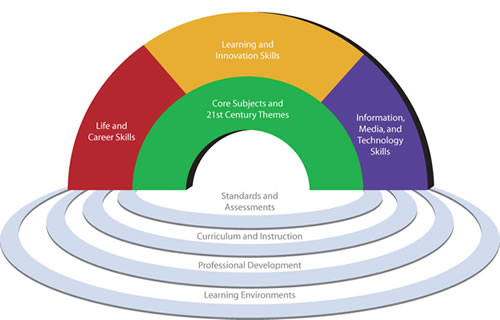
“[The oppressed] are at one and the same time themselves and the oppressor whose consciousness they have internalized.” Paulo Freire (1970)
This is a profound thought for me and a key point for Freire’s book. That the oppressed are simultaneously oppressed and their own oppressors is a fascinating concept and, I think, a difficult realization for many. The truth is we have internalized this struggle between subjective values and objective assessment. It is why many arts advocates fail in their efforts to save programs from being dissolved and their funding reallocated. In this case we are our own worst enemies. Our own fear of liberation prevents us from renouncing this internal oppressor. So, under this oppressive system we are forced to live with a decrease in the capacity for inquiry and the elimination of subjectively measured subjects, subjects which best help students develop critical thinking skills and creative capacity.
Critical Thinking
Subjective assessment involves critique. It is in the areas of study that require personal and group critique in their assessment where the ability to think critically is developed. To critique a painting, a piece of music, a dance, or poem requires one to observe, analyze, interpret, and evaluate in ways that require higher order thinking. A math equation requires these steps too but only in an objective capacity. The type of knowledge our standardized tests measure in this capacity is rather shallow. It is only in the study of subjectively measured learning that this capacity can be deepened.
This critical capacity is not self-serving though, it carries through to the solving of problems in all areas of life. I am a better technology integration specialist because I have spent a lot of time in the creative arts. Because of my creative capacity I am able to see solutions to problems other “technologists” cannot. The reduction of the sorts of programs in schools that allowed me to develop this capacity means that fewer people will be given the same opportunity to develop this capacity in themselves for the future. Thus, we will end up with a deficit in critical capacity. I will let Paulo Freire finish this line of thought for me in these four quotes
- “they react instinctively against any experiment in education which stimulates the critical faculties”
- “dialogue cannot exist unless the dialoguers engage in critical thinking”
- “Without dialogue there is no communication, & without communication there can be no true education.”
- “In their political activity, the dominant elites utilize the banking concept to encourage passivity in the oppressed, corresponding with the latter’s ‘submerged’ state of consciousness, & take advantage of that passivity to ‘fill’ that consciousness with slogans which create even more fear of freedom.”
Alienation & Lost Histories
“Schools by their very structure resist the concentration of privilege on those otherwise disadvantaged.” Ivan Illich (1970)
Through extended loss and reduction of the fine arts from our schools we are alienating not only those subjects but the people who most closely value them. If we continue to allow the arts to be repressed in the name of standards and accountability over time their history and tradition will be lost.
I know for a fact that many of the students at the alternative school I worked at stayed with us and stayed in school because of my art program. I know many of these students were deemed undesirable by the system. Yet, though they may not perform well on a standardized test they were particularly gifted at drawing, painting, sculpture, poetry, creative writing, dance, music, etc. When my position was eliminated from our school these were the first kids to go. I still hear about many of my former students who left our school when we were divided and crushed. Many of them dropped back out of school. Every once in a while I see in the paper that one of them has been arrested or has been sentenced to time in prison. I worry about the ones most who I have not heard from or about. Did they find another school? How many more times did they get passed around the system? So much for leaving no child behind.
“People who have been schooled down to size let unmeasured experience slip out of their hands.” Ivan Illich (1970)
Carl Anderson is an art and technology teacher, technology integration specialist, and adjunct instructor for Hamline University’s School of Education. He writes the Techno Constructivist blog and is @anderscj on Twitter.

by kylepace | Sep 22, 2010 | 21st Century Skills, Assessment, Guest Bloggers, Learning and Teaching |

First I’d like to say thanks to Scott McLeod for the opportunity to write a post for Dangerously Irrelevant. The topic of student collaboration is one that has been bouncing around in my head for quite some time. I want to disclaim at the forefront that I want this to be a conversation. I want to learn from you. I want you to make me think. This is not the end-all be-all about collaboration. I want to talk about the necessity of this 21st century skill and how I think it dwindles as a necessary skill as students move away from elementary school.
My daughter is almost 6 years old. She just started Kindergarten. Recently she was at a playground with her brother and numerous other kids. As I watched her play, I noticed how comfortable she was going up to kids she’d never met, introducing herself, and engaging these kids in conversation which led to a new playtime opportunity. She was probably doing whatever she could to not have to play with her younger brother for a while. 🙂
If you have young children it’s really an amazing thing to watch. She just went right up to these other kids, and started in like she had known them already. Right away I thought about collaboration. Even if it’s in the most simplest form, she is collaborating. It doesn’t matter if it’s in her kindergarten classroom or on the playground. She wants to have a productive play/learning time. That is her goal. It would seem, that she is eager to collaborate for this to happen. I feel like I’ve been a positive guide for her to be this way; but it wasn’t decreed like, “You shall speak to all of your peers and engage them!” I am blown away by her comfort level. Even when I’m in a classroom of younger students (I’m thinking Kindergarten through 2nd grade), I am always intrigued at their collaboration skills (as basic as they may be) to achieve a common goal.
All of this thinking on collaboration and 21st century skills led me to ask this via Twitter, “What field of expertise DOESN’T require some form of collaboration to succeed?” I didn’t get one serious response. My friend Andy Marcinek, however, gets the award for funniest response. “A mime.” Seriously though, how can we say that students don’t need the skill of effective collaboration? I want to hear your thoughts on this.
I have seen tweets and blog posts recently about frustration that teachers are having getting their students to collaborate. These were mainly secondary teachers and library media specialists. It was even an #EdChat topic a few weeks ago: “How do we engage students who find participatory learning uncomfortable?” What do you find most difficult when getting students to collaborate? Criticism from their peers? A bad experience with a previous teacher? It seems like there’s so many factors that can come into play.
How are we fostering this skill beyond kindergarten? What have you found that really is motivating for students to collaborate? What gives them true ownership of their learning? There’s awesome digital tools that aid in collaboration, but those tools don’t MAKE the collaboration. It’s a skill that still has to be fine tuned. It’s a skill we should all be modeling effectively if we want our students to do it effectively. If you’re looking for some great suggestions on how to foster collaboration in your classroom, I would suggest reading Michelle Bourgeois’ post titled: The Collaborative Classroom: It’s a Juggling Act. In this post Michelle tells a story of teaching students how to juggle and says. “Just like the art of juggling, there are several skills that need to be balanced and constantly monitored in a collaborative classroom to make it all come together.” Please be sure to check out Michelle’s post on how to monitor and keep balance of some essentials in classroom collaboration.
This leads to my questions, “Where does this skill go?” Am I the only one that thinks younger students are better at collaboration than older students? Shouldn’t this be the opposite? This is something we want our students to be better at right? We should be fostering this skill in our classrooms, not hindering it. How often are you allowing students to collaborate? Not to say that awesome things can’t come out of individual thinking, but as I always like to say, “We’re better together.” Sure, one mind can do awesome things, but a collective could really rock someone’s world.
Thanks for reading.
Kyle Pace is a K-12 instructional technology specialist from Kansas City, Missouri. He works with teachers in his district to provide professional development, resources, and strategies to implement instructional technology to impact student learning. You can follow Kyle on Twitter by visiting http://twitter.com/kylepace and you can find his web site at http://www.kylepace.com.

by tonyvonbank | Sep 22, 2010 | Assessment, Guest Bloggers, Learning and Teaching, Tech Integration |
I’ve been pushing Google Apps for a while now. I have been pushing colleagues and speaking to groups and faculties and school boards. I have written at length about it both online and on lined paper. Like a street hustler, I have been teasing out a bit of a taste to anyone who will give me the time of day, and whether they really like it or not, I now have my whole school district on board. I even write a blog about using it. I know I am passionate about it, and if you want me to, I can tell you why–but that’s not what this piece is about. This story could really be about Skype, or Moodle, WikiSpaces, or Elluminate, or SmartBoard programs. What I am talking about today is WHAT HAPPENS NEXT?
Earlier this year, the Oregon State board of education announced that it was moving all districts in the state to Google Apps for Education. The decision, several prominent articles speculated, was part of an ever-progressive Oregon approach to technology in education, such that most public school districts might only dream of. This was all accurate, sort of.
Likewise, in the past year, several local districts here in Minnesota also made the leap into the clouds of Google. My own district is transitioning as we speak. So what will all this cloud-visiting and Google App-ing do for students? How will schools use it to write curriculum? What are these relatively major technology shifts going to do for the test scores of the students? Probably nothing. In fact, the likelihood of these 21st-century tools to be able to actually affect change in the realm of standardized tests, authentic assessments, or just good old-fashioned quality learning is meager at best. But it doesn’t have to be that way.
The addition of collaborative software, standardized mail and electronic calendars (not to mention the auxiliary tools Google provides like Maps, Blogger, Sites), should pave the way for a new consciousness that leaps the school, district, or (in the case of Oregon) whole state firmly into the 21st century. It should open faculty and administrators to the richness and accessibility of Web 2.0 and cloud-based tools so they can build up to much more data-driven techniques that embed the desired outcomes in a wealth of industry-current technology. Google Apps has the ability to bring students from all over the planet into collaborative work that utilizes higher-order thinking and yet builds upon the benchmarks provided for in the curriculum.
The problem is that even when offered the keys to a brand new shiny red sports car, it seems as if the inclination is to just let it sit in the driveway. When I have asked teachers and administrators in nearby districts who have gone to Google Apps for Education how they are using it as part of their overall mission or goals, I get blank looks. Many don’t even really know what they have. There are plenty of individual teachers making great use of the Google Apps suite, and some districts are farther along than others, but the overall lack of a cohesive plan to leverage the power of these tools is generally not clear, in its infancy, or just plain absent. In my district these conversations have only just begun, and I can already see how difficult it is. While some users are in full command of interactive document creation and building document forms into formative assessments, some people just struggle with a different e-mail interface. We have a new tool, with no real plans as to how specifically it will lead us to our 21st century goals.
The reason for the apparent leap before you look approach seems to be because of the cost. When a big change is expensive, it requires a lot of scrutiny, lots of data, rationale, test groups, and other cost/reward studies. However, many very powerful Web 2.0 or cloud-based tools are free or at minimal cost to schools. I think this creates the cure before the disease is fully understood. Do I think that schools districts should use Google Apps for Education and other online tools? Absolutely. But I also think that schools and districts need to keep asking how THEY will make these tools effective additions to how they educate a student. Without that understanding or plan, that Corvette isn’t going to get on the open road at all. When I spoke to Corin Richards from the Oregon Virtual School District, a subsidiary branch of the state board of education, about Oregon’s plan, he did mention there was a plan to use Google Apps as a gateway into other technology they used. I think this is a great reason. I don’t think it takes much. But having a powerful educational tool without a reason to use it isn’t much better than not having one at all.
Anthony VonBank has been teaching English and Global Communication in public school for 12 years. He is currently a doctoral student at Minnesota State University in Mankato, MN. His research interests are in education with cloud computing and education reform. He maintains a regular blog about integrating Google Apps in the classroom: teachingwithgoogledocs.blogspot.com.

by karenszymusiak | Sep 21, 2010 | 21st Century Skills, Assessment, Guest Bloggers, Learning and Teaching |
The Current Landscape
These are challenging times in the current landscape of learning and teaching. The standards movement is pressing upon us and students and teachers are being measured in the narrowest of ways. I know that any and every measurement can tell me something about a child and I fear that focusing on any single measurement can be dangerous. The biggest mistake we can make is to be single-minded. Relying on a standardized score or focusing on only the standards that we are required to teach will not allow us the opportunity to create a variety of rich, interactive, collaborative and thoughtful experiences that enrich learning and teaching.
In the worst situations, it’s not the data that is problematic, but how the data is interpreted, generalized, and misused to make educational decisions. All measurements can be helpful in creating a clear and precise profile of a learner. I tend to lean toward more authentic measurements and what they tell me about students. However, every piece of data is a piece of the mosaic of a child’s learning life. What targets for learning and measurement results can do is clarify the most effective instruction and help us be responsive to each student’s needs. Some knowledge and skills are easily measured. Some are not. When it comes right down to it, a good teacher knows her students well and teaches in response to what she knows abou t the individual child.
I worry that we look at standards and data the way we narrow a Google map search. We can narrow in on the smallest of detail but knowing the big picture is also important. We can consider standards, measurement and data and completely lose sight of the bigger picture. Each educational measure we put in place is part of the whole and we must not forget that. What does a standard or test score tell us about a student’s persistence or level of self-efficacy? How can we support students by giving them the skills they need for more critical thinking, inquiry and thoughtful pursuits?
What Next?
Whether or not we agree with standards and accountability, it is an immense part of the learning landscape. So we need to help others understand the role of standards and accountability in the big picture.
The most important question we can ask when we are presented with any kind of measurement of progress is to ask “What next?” How will we formulate learning experiences that will move each child forward? What will we focus on? What are the strengths of the child and how can we teach from those strengths instead of focusing on the deficits?
It’s not helpful to consider data and assign causation for low and even high performance that is generalized and misaligned. Some educators are “guessing” why students perform the way they do and linking to practices that may not have a positive impact on student learning. In some cases, programs and practices are being implemented that detour us from focusing on 21st century skills.
Let’s Remember
- Stay the course and make decisions based on what’s right for children.
- Embrace 21st century learning.
- Use measurement results to teach from a child’s strengths.
While it’s the most challenging time in education, it is also the most exciting. We are increasing the potential for our students to be active and participatory learners. We are encouraging them to build a learning community both locally and globally that will help them follow their passions. We cannot abandon our efforts to give our students what they will need to help them be successful in learning and life.
Karen Szymusiak is principal of Glacier Ridge Elementary in Dublin, Ohio. She can be found online at twitter.com/karenszymusiak. Karen has coauthored Beyond Leveled Books, Still Learning to Read, and Day to Day Assessment in the Reading Workshop. Her favorite moments are those spent with children. She says, “If we really listen to children, they tell us all there is to know about teaching wisely and well.”

by aaroneyler | Sep 21, 2010 | 21st Century Skills, Assessment, Guest Bloggers, Learning and Teaching |
It’s not “OK” for us to simply abstain from teaching kids to think simply based on the fact that we have to administer a test at the end of the year that’s expected to assess something as nebulous as learning.
How about a profound statement? Even if the tests went away tomorrow, very little would change in a lot of classrooms around the country, and teaching kids how to think would still take a back seat to teaching kids what to think. Call me cynical, but I don’t see a lot of teachers releasing their herculean grip from subject content in the name of teaching “21st century skills.” Why? Our education system has never been about innovation and adaptation; it’s been about perpetuation.
How do we reconcile standards and data-driven accountability with the “21st century skills” movement? The first step we need to take is forgetting about the test and teach kids to be curious while asking really, really good questions. I’ll never say that the tests are a positive, but I also won’t allow for them to be the scapegoat for why kids walk out of school without an ability to ask great questions of the world around them. Evidence? Multiple-choice tests existed in almost every classroom prior to the standardized testing movement, and they will exist long into the future regardless of what metric we use to assess student learning.
We also need to practice some serious introspection and ask ourselves what “21st century skills” are. I hear a lot of people boil “21st century skills” down to simply using technology. That’s a pretty myopic and cynical way of looking at the future of human progress. The truth is that “21st century skills” do have to do with adapting to new technologies effectively, but it has much, much more to do with being able to think deeply about topics, solve complex problems, and being capable of synthesizing information to form new solutions. If kids go through school unable to practice these skills, then everything else is for naught.
We kill curiosity in kids the same way that Sir Ken Robinson says we kill creativity. We point our fingers at standardized tests and cry out that they prohibit us from teaching the skills kids need, but we’re also not willing to accept that many classrooms wouldn’t be that different without them.
We, as educators, simply need to give ourselves a reality check on the messages that we send our kids that stunt their curiosity. I can’t tell you how many times I hear this comment and want to cringe:
Anything that we ever need to know in this day and age can be found on the Internet via Google or some other search engine.
Is that really the message we want to be sending kids? Do we want them to walk away from our classrooms believing that every, single question ever asked has been investigated by someone else and answered? What are they to do when they have questions that Google can’t answer? How, in those classrooms, do we teach kids to ask the really, good questions and solve the really complex problems that they will experience in their future? How is that statement any different from having kids select “A-E” without even getting a chance to contemplate “F” as the correct answer?
Throughout this post, it may seem as though I’ve ignored the very question that Scott has asked me to answer. Rest assured that’s exactly what I’ve done. The answer to the question is simple: start constructing lessons and classroom instruction around developing curious kids who inquire about the world around them. Ignore the tests. Until we live in a world where classrooms would look entirely different without the tests, we really have nothing to complain about while they’re here.
Aaron Eyler is a high school history teacher in central New Jersey. He has an M.A. in Educational Leadership from Rutgers University and is the writer of “Synthesizing Education” and (more recently) “The Democratic Classroom.” For his daily musings and rants, please follow him on twitter via @aaron_eyler.
by Scott McLeod | Sep 17, 2010 | 21st Century Skills, Assessment, Guest Bloggers |
In August I put out the call for guest bloggers on the topic of Reconciling standards- and data-driven accountability with the ‘21st century skills’ movement. I had a number of people volunteer to take on the issue (enough for two per day!). Next week we’ll see what they have to say…
I know these will spark some great conversations. Happy reading (in advance)!

by Scott McLeod | Aug 29, 2010 | Assessment, Learning and Teaching, Research and Evaluation |
The Economic Policy Institute’s new report, Problems with the Use of Student Test Scores to Evaluate Teachers, cautions against heavy reliance on the use of test scores in teacher evaluation.
Authors of the report include four former presidents of the American Educational Research Association; two former presidents of the National Council on Measurement in Education; the current and two former chairs of the Board of Testing and Assessment of the National Research Council of the National Academy of Sciences; the president-elect of the Association for Public Policy Analysis and Management; the former director of the Educational Testing Service’s Policy Information Center and a former associate director of the National Assessment of Educational Progress; a former assistant U.S. Secretary of Education; a former and current member of the National Assessment Governing Board; and the current vice-president, a former president, and three other members of the National Academy of Education.

by Scott McLeod | Aug 21, 2010 | 21st Century Skills, Assessment, Guest Bloggers |
[UPDATE: I had enough interest for two people per day for the week of September 20. All the slots are full now. Thanks. I’m looking forward to the week!]
I’m looking for 5 to 7 volunteers to guest blog on the topic of Reconciling standards- and data-driven accountability with the ‘21st century skills’ movement.
Posts could pertain to curriculum, instruction, assessment, leadership, policy, professional development, or any other relevant issue. If you’re interested in writing a thoughtful, reflective piece of approximately 5 to 8 paragraphs on this topic, would you drop me a note?
This would be for the week of September 20 to 26. You will be able to cross-post on your own blog(s) and also can put a blurb at the bottom about yourself and your social media sites, so this should give you some good visibility.
Thanks in advance!
by Scott McLeod | May 25, 2010 | Assessment, Guest Bloggers, Leadership and Vision, Management and Operations, Tech Integration |
[This is a guest post from Doug Green. If you’re interested in being a guest blogger, drop me a note. Happy reading!]
Update: see also Don Watkins’ response to this post.
With the coming of computers to schools, district leaders felt the need to hire district level administrators to oversee instructional and administrative computer systems. After about 30 years, some districts are finding that they can do without their own technology gurus. Has the school district technology director gone from life on the cutting edge of technology in education to obsolescence? The purpose of this article is to explore reasons why this may be the case.
Things Have Changed
At one point is was possible for at least a few educators to have a good grasp of what computer technology could do and understand what it took to maintain stand alone systems. With the advent of school and district-wide networks, however, there was a need to add network specialists to maintain the district infrastructure. As the number of workstations in classrooms and offices expanded, there was also a need for staff that were trained and dedicated to maintain them. This meant that the technology director was leading a growing staff of non educators at the same time computers and other technologies were expanding into every niche of the instructional program.
To some districts it makes no sense to have an administrator who was most likely a former teacher responsible for computer networks. Such networks now resemble other utilities such as electricity, natural gas, and telephone service. They can be purchased from a private vendor or from a local school district service bureau such as the Board of Cooperative Educational Services (BOCES) system in New York State. As for administrative computer services, the software and support are purchased from somewhere. Rather than going through the technology director, the people responsible for the services like the director of attendance for student information, the principals for scheduling and mark reporting, and the business office for functions like payroll can just deal directly with the agency selling and supporting the service.
On the instructional side, the mere existence of a technology director can allow other leaders to think that they are not responsible for the integration of instructional technology. They see it as something separate rather than a part of the big instructional picture. When principals and teachers see instructional technology as someone else’s job, they are less likely to adopt in an effective manner anything that the “technology person” pushes into the classrooms.
The Great Enabler?
As the job of the technology director has been taken over by organizations like BOCES and other district administrators I have seen people in these position look for ways to be useful which can often enable bad habits among their fellow administrators. In one district I found the person helping the assistant superintendent for instruction count the number of days school had been in session to make sure that the end of year plan would comply with state regulations. His massive spreadsheet made the task seem complicated when all one needed to do what take a calendar and count up to 180.
Studies summarized by Rogers (2003) show that top down decisions are less likely to enjoy successful adoption in education than in other organizations. This is due to the fact that teachers with masters degrees think they know what they are doing and enjoy a sense of freedom that gives them a good deal of control over how they deliver the curriculum. In order to get teachers to implement a new technology effectively, it helps if they feel some ownership for the decision to adopt. The technology director may also be seen as a person who can do things with technology that are beyond most teachers. Teachers are more likely to follow a peer who they feel has technical expertise similar to their own.
In effective schools, decisions about instructional technology initiatives are more likely to come from district or building shared decision-making teams. This gives the decisions a bottom up aspect that increases the likelihood that they will work.
The Data Piece
Another function that can land in the technology director’s portfolio is that of chief information officer (CIO). This is a title that the New York State Education Department has asked districts to use so that they have an entry point for dealing with instructional data including scores on state tests. A look around the central New York region shows that this title can land just about anywhere. While some districts give it to an assistant superintendent, others bestow it on the technology director, and still others give it to a programmer, a teacher, or even a secretary.
In essence, this job has two main functions. One is to lead the district and the individual schools as they analyze test results and other instructional data in order to make informed instructional decisions. As Burdet, City, and Murname (2005) show, this is a job that should clearly run through the superintendent’s office and the offices of the principals and should involve committees of teachers. Giving it to some technology person may produce fancy charts and graphs, but it is not likely to make the kind of instructional impact that in intended.
The other part of the job is caring for the data itself and making sure it is correctly reported to the state in a timely manner. I did this for my former district during the year after I retired so I know what it involves and I have seen how many other districts deal with it. Whoever does it will need rudimentary data processing skills and a modest understanding of relational databases. It certainly should not fall to a high paid administrator. It could even be given to a capable clerk or sent to a regional support service.
All Administrators Should be Tech Savvy
As part of the work I do teaching leadership for teachers seeking administrative certification, I read the job postings each week in the New York Times. I look for common themes and trends so I can let my students know what districts are looking for in the way of knowledge, experience, and expertise in their new hires. Many ads contain a bulleted list of items that include communication skills, collaborative leadership styles, and a vision of how all students can succeed. For the last several years, however, they also usually include something like the following found in a recent posting:
Has expertise in the use of instructional technology and the utilization of achievement data to advance student learning
When microcomputers first entered the classroom in the late 1970’s and early 1980’s, many of the members of the administrative class had attended college in a era where they could submit hand written work or pay someone else to do the typing. Even today I still know of administrators who don’t do email simply because they can’t use a keyboard. One even told me that he only wanted “one button to push.” You can imagine how happy he was when I set him up with a computer that had a one-button mouse.
Now the classes I teach feature some students who are almost digital natives as they don’t remember a time when their schools didn’t have computers. As more future leaders show up with computer skills, districts are in a position to expect that their new leaders can manage instructional technology without having to ask a district technology person what to do.
And a Child Shall Lead Them
In 1976 when my district got its first computer, I was the science department chair. I had no time to figure out how it worked so I let some of my students who had an interest “play” with it. I soon became the “adult” expert even though I knew less than the students and within two years became the district computer director. Two years later I was hired by a larger district as their first Director of Computer Services with a big raise and an office next to the superintendent.
As part of my doctoral research I noticed that teachers who learned from their students were often the ones who did the most with instructional technology. With the coming of the Internet, the students had easy access to the world of information which made finding facts like shooting sitting ducks (McKenzie, 1998). As one superintendent told me, “we don’t own the information any more” (Green, 2001).
I recently worked with a doctoral student who was reviewing her work from the early 1990s. This prompted me to make a list of the technological innovations that have arrived since 1991 that I felt were likely to have some impact on instruction.
New Technologies with Possible Impact on Education Since 1991
- 1991 QuickTime Introduced
- 1991 First Smartboard becomes commercially available
- 1994 Netscape 1.0 browser available for Internet surfing
- 1995 The first Internet Wiki
- 1996 Cell phones become common in United States
- 1996 First Mobile cell phone with built-in PDA
- 1996 Hotmail – Free web-based email for anyone
- 1996 Java and Javascript programming languages add applications to the Web
- 1998 The First web log also known as a blog
- 1999 QuickTime 4.0 supports streaming video
- 1999 Macromedia Flash 4.0 handles inputs and MP3 audio files
- 1999 iMovie is free with iMac purchase
- 2000 Google – The world’s search engine
- 2000 Instant Messaging starts to take off
- 2000 PayPal makes it easy and safe to pay for Internet purchases
- 2001 Douglas Green uses speech recognition to transcribe dissertation interviews
- 2001 iPods and iTunes become available
- 2001 Text messaging starts to take off
- 2002 USB flash drive memory cards become available
- 2002 The term is Blogoshpere adopted to represent the world of blogs on the Internet
- 2004 Facebook & Myspace make social networking more available
- 2004 Podcasting allows new form for media distribution
- 2004 Duke University gives an iPod to each freshman
- 2004 GarageBand allows for easier music editing
- 2005 Eye tracking systems become available for disabled
- 2005 RSS (real simple syndication) adds a new type of spam
- 2005 Guitar Hero joins the gaming culture
- 2005 YouTube allows anyone to publish and access videos
- 2006 PornoTube adds to the worries of parents and teachers
- 2006 Student Response Systems (clickers) become affordable for educational use
- 2006 Flickr available to customers in United States for storing and organizing media
- 2006 Skype becomes available for free calls and video conferencing
- 2006 Sherburne/Earlville, NY Schools place a SmartBoard in every classroom
- 2006 Wii adds a physical aspect to gaming
- 2006 Twitter adds yet another type of spam for Internet and cell phone users
- 2007 Wikipedia becomes the largest encyclopedia ever with more than 2 million articles
- 2007 iPhones are introduced bringing countless capabilities to cell phone users
- 2009 A USB flash drive costs about $20 for one gigabyte
A look at this list should lead one to think that many students are more comfortable with some of this technology than their teachers. I have had many of my administrative students tell me that they would be lost were it not for the computer help they get from their own teenage children.
When a technology innovation comes to the classroom by way of the technology director it is likely to focus on the technology. When it arrives as the result of initiatives owned by the teachers, it is more likely to focus on the content. An example from the art department that I have seen in many schools makes this point. If computers in the art rooms have a technology focus the likely result will be courses that teach how to use software such as Photoshop and Illustrator. If the computers are introduced by the art teachers they are more likely to use these tools to focus on artistic concepts and to promote artistic craft.
This month, for example, the magazine Edutopia (Bernard, 2009) has a cover story about an article where students offer lesson plan ideas that feature items from my list. My point here is that any school district looking for ideas about instructional technology is unlikely to get all they need from a single source technology director.
Goodbye Wizard of Oz.
Once a district decides to eliminate the technology director position the next questions is what happens to the person in that position. If the person is seen as bright, hard working, and knowledgeable they can be moved to other positions of leadership. Depending on their talents they might make successful principals or assistant superintendents, which are much better positions from which to promote the use of instructional technology. They might also return to the classroom where they can become a model for innovation technology use. They may be able to retire as I have seen in several local districts or they might be able to secure employment with one of the district’s technology vendors or the local school-support agency.
In 1993 when I held this position I was able to un-invent myself by convincing the superintendent that the administrative and network supervision aspects of my job could be sent to our local BOCES and that the responsibility for the instructional piece should be placed in the hands of the building principals who could look to a district level staff developer for support when they needed to help their staff learn how to use new technology. At the time, the district saved $35,000 as a result of this move.
I should also point out that a reason for making my job disappear was so that I could become a principal in a building were the decision making team had a strong interest in moving ahead with instructional technology initiatives. My goal in writing this article, therefore, is not to put my fellow directors out of work by making them look like modern versions of the Wizard of Oz. My goal is to help schools make more effective use of their technology dollars as they empower all administrators, teachers, and even students in finding ways to allow instructional technology to facilitate and motive all learners. A job that has become impossible for one person can become possible once it is viewed as everyone’s job.
References
- Bernard, S. (2009). Kids Talk Tech. Edutopia. June/July 2009, 22-27.
- Boudett, K. P., City, E. A., & Murname, R. J. Eds. (2004). Data Wise: A Step by Step Guild to Using Assessment Results to Improve Teaching and Learning. Harvard Education Press: Cambridge, MA.
- Green, D. W. (2001). The Impact of Internet Access of Elementary Classroom Teaching: A Constructivist Perspective. (Doctoral Dissertation, Binghamton University, Dissertation Abstracts International, 63 no. 01A(2001): p 151.
- McKenzie, J. (1998). Grazing the Net: Raising a Generation of Free-Range Students, Phi Delta Kappan, 80(1), 26-31.
- Rogers, E. M. (2003). Diffusion of Innovations, 5th ed. Free Press: New York, NY.
Douglas W. Green, Ed.D., was an administrator for 30 years and has 300+ publications in technology, education, and leadership. He retired to care for his wife who had Lou Gehrig’s disease and started blogging after her recent death. His blog at DrDougGreen.com features book summaries and news items that makes it easy for busy educators to keep up to date.


