The promise of the digital is not in the way it allows us to ask new questions because of digital tools or because of new methodologies made possible by those tools. The promise is in the way the digital reshapes the representation, sharing, and discussion of knowledge.
Well, I finally wrote the article I always wanted to write: a letter to my 3,000+ faculty peers in Educational Leadership preparation programs all across the country about how our collective inattention to technology-related issues is an embarrassing indictment of our lack of relevance:
Regular readers of this blog will recognize some of the language that I used in my broadside against my own profession. Here are a few quotes to whet your appetite:
We also are witnessing the early adolescence of a vastly different global economy. For instance, the rapid growth of the Internet and other communication technologies has accelerated the offshoring of jobs from the developed world. Complex corporate global supply chains locate manufacturing work wherever costs are lowest, expertise is highest, or necessary talent resides. Geographic or product niche monopolies disappear in the face of Internet search engines. Micro-, small-batch, and on-demand manufacturing techniques facilitate customized, personalized production. Whatever manufacturing work remains in developed countries is high skill, is high tech, and, more often than not, requires greater education than a secondary diploma. The low-skill industrial system that was the backbone of the developed world’s economies in the previous century is increasingly a bygone memory.
Like manual work that is non-location-dependent, knowledge work also is frequently done cheaper elsewhere. Service jobs are increasingly fungible, able to be located anywhere in the world that has an Internet connection. Ongoing workflow and final products are exchanged at the speed of light via e-mail, instant messaging, and other corporate networking tools. The same technologies that facilitate interconnected global conversations also facilitate interconnected global commerce. As was done in previous decades for manufacturing work, the next two decades will see many complex service jobs broken up into component parts. Once these tasks are disaggregated, they will be done by lower-skilled workers who can do these discrete components of the overall work, facilitated by software. In other words, many high-paying service jobs will turn into globalized piece work. Since the service professions represent over three-fifths of America’s economy, the impacts of this are going to be quite significant.
AND
If every other information-oriented societal sector is finding that transformative reinvention is the cost of survival in our current climate, schools and universities shouldn’t expect that they somehow will be immune from the same changes that are radically altering their institutional peers. We shouldn’t pretend that these revolutions aren’t going to affect us too, in compelling and often as yet unknown ways. And, yet, for some reason we do.
As long-existing barriers to learning, communicating, and collaborating disappear – and as what it means to be a productive learner, citizen, and employee shifts dramatically – it’s worth asking how we as educational leadership faculty and programs are responding. Are we doing what we should? To date the evidence is pretty clear that most of us are not.
AND
Can we as educational leadership faculty do better? Given the scale and scope of the transformations occurring around us – and their power and potential for student learning – we MUST do better. It’s embarrassing to consider how little we’ve done to stay relevant. A learning revolution has occurred and – given the attention we’ve paid it – it’s as if many of us didn’t care.
AND
We know, simply from projecting current trends forward, that in the future our learning will be even more digital, more mobile, and more multimedia than it is now. It will be more networked and more interconnected and often will occur online, lessening dependence on local humans. It frequently will be more informal and definitely will be more self-directed, individualized, and personalized. It will be more computer-based and more software-mediated and thus less reliant on live humans. It will be more open and more accessible and may occur in simulation or video game-like environments. And so on. We’re not going to retrench or go backward on any of these paths. We thus need school leaders who can begin envisioning the implications of these environmental characteristics for learning, teaching, and schooling. We need administrators who can design and operationalize our learning environments to reflect these new affordances. We need leaders who are brave enough to create the new paradigm instead of simply tweaking the status quo and who have the knowledge and ability to create schools that are relevant to the needs of students, families, and society.
Like teachers, administrators, and media specialists, educational leadership faculty have a voluntarily-assumed (and paid) responsibility to be relevant to the needs of children and education today and to prepare administrators as best we are able for tomorrow. Our professional priorities must be aimed at preparing our graduates for the world as it is and will be. Otherwise, what are we here for? In other words, who’s going to prepare these school leaders if we don’t?
Please share this widely
Want to help further my cause of fostering technology-savvy school leaders? Share the Summer 2011 issue of the UCEA Review with any Educational Leadership faculty members that you know. I also think the article is good reading for most practicing administrators; in 4 short pages it sums up much of what I think principals and superintendents should be thinking about right now regarding 21st century schooling. Other great reads in the issue include Matt Militello’s article on technology integration challenges (p. 15), Jon Becker’s article on open access (p. 17), and the interview with John Nash (p. 12), one of my CASTLE co-directors.
All thoughts, reactions, and suggestions regarding my article are most welcome. The ironies of publishing my piece in a print / PDF medium are not lost on me, but sometimes you have to put your writing where your intended audience can find it.
Dissertations are difficult things. There are multiple reasons why most folks don’t have one. Here are some words of wisdom that I’ve heard from others and now pass along to my own doctoral students…
Big ideas are good but you’re not going to save the world with your dissertation. Scale it down. Bite off something manageable and doable and save the rest of it for future work – by yourself or others.
Along those lines… the best dissertation is a done dissertation. Get it done. Put the ‘Dr.’ in front of your name. Celebrate yourself for completing a large, hopefully-worthwhile task. Move on with your life. Go do great things!
The key to the successful completion of a dissertation is to treat it like a regular course that you might take. Block off the time that you’d ordinarily take to a) drive to and from class, b) be in the class, and c) read and/or do outside work for the class and then make that time REGULAR AND INVIOLATE (to yourself, your family, your friends, your employer) just as you would a traditional course. Pretend you have face-to-face accountability even though you don’t. Otherwise too many more-immediate and less-amorphous events pop up and you’ll never, ever finish. The percentage of students who are ABD is appalling…
Chunk it. The idea of writing a 150– to 250–page book is awfully intimidating. The idea of writing 2 pages is much more manageable. Set small, achievable goals for yourself (in the next hour I will write 2 paragraphs…; during this session I will find 5 new sources…).
A dissertation always takes longer than you think it will. Get used to that idea now.
Pick a topic that really interests YOU, not someone else (like your employer or your advisor), because no one’s with you at 1:00am on a Saturday night when you’re ready to tear your hair out. Pick something that hopefully will sustain you through the tough times.
And, finally… I always tell my advisees that at some point in the process they will hate me. It all will be good in the end, but there will be moments when they curse my name. I’m okay with that: my job is to get them successfully past the entire committee.
What other words of wisdom do you have for educators working on their dissertations?
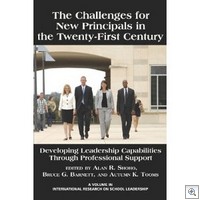
the future of public schooling in the United States – and what it will mean to be a leader in public schools – by focusing on the issues that are most likely to have an impact on American society within the next 20 years.
Translational Leadership: New Principals and the Theory and Practice of School Leadership in the Twenty-First Century
New Headteachers in Schools in England and Their Approaches to Leadership
So You Want to be a Headteacher?: “Liabilities of Newness,” Challenges, and Strategies of New Headteachers in Uganda
Problems Reported by Novice High School Principals
Accelerating New Principal Development Through Leadership Coaching
From Mentoring to Coaching: Finding the Path to Support for Beginning Principals
I know many of the editors and authors for this book, and I’m sure it’s going to have some good, research-based information for new principals. But I confess I’m highly skeptical of the book title…
I understand that the role of school principals encompasses many things besides digital technologies. That said, should school leadership books be allowed to include phrases like ‘challenges’ and ‘21st century’ in their titles if they substantially ignore the leadership and learning issues related to digital technologies? I’m not sure they should…
What do you think? Is this a good idea? If so, is this logistically feasible for school systems (e.g., could professors have any real responsibility or would it be like doing a preservice administrator internship)? What would need to change in colleges and universities for this to work? Head on over to Michelle’s post and contribute to the discussion!
My colleague, Dr. John Nash, sent me two messages recently that I think are worth some attention. Like John, I agree that university educational leadership programs need to wake up to the implications of these funding decisions. Your thoughts?
Message 1
The Prudential Foundation gave $700,000 to New Leaders for New Schools for general operating support and to help expand the group’s regional work in Newark, New Jersey.
I’d like to point out that the grant for New Leaders from Prudential was for general operating support!!! Not for any particular part of their program – just to keep the lights on!
Prudential also gave $300,000 to Teach for America, which will use the funds to support its School Leadership Initiative and increase the number of alumni who enter school leadership positions in low-income communities,
TFA is going to run its own leadership program. Again, we’re not needed.
These are two more big shots across the bow for our program, and all others in the country. Money is flowing like crazy to “innovative” programs like these and we have an opportunity to cherry pick the parts that a) we think are effective, and b) DE [the Iowa Department of Education] won’t choke on and then use our new profile/program as a way to obtain external funds, such as those from foundations like Prudential, to expand and have greater impact.
Or we can wait for New Leaders, TFA, and others to show up and just take all our students.
Setting aside for the moment whether the evaluation was any good (and it probably was), the big point is this: This is $20 million for a CAS-like program that is not university-based. [CAS is our superintendent preparation program]
In sum, in the last six weeks:
KIPP got $50M to groom their own principals from Obama.
New Leaders for New Schools got $700K from Prudential to groom their own principals.
TFA got $50M from Obama to expand and $300K from Prudential to groom their own principals.
Broad got $20M from their rich parent foundation to groom superintendents “their” way.
That’s $121 million given away in the last 6 weeks.
And we sit worrying if the DE [Iowa Department of Education] will let us be innovative. Yikes.
Two factors delineate a faculty member’s attitude toward openness: a nature influence and a nurture influence. The first factor is the strength of a person’s inclination toward sharing. This characteristic is something that is innate to personality, similar to the Myers-Briggs scale of introversion/extroversion. To move a person on this scale would be akin to changing an introvert to an extrovert. On the one end are the keepers, faculty who ask themselves: “Why would anyone outside my course want to know what I think?” At the other extreme are the sharers, faculty who believe that their contribution to the conversation, content, and/or community is invaluable.
The second factor that influences attitude toward openness is how strongly the person feels a moral responsibility to share freely with his or her community. In my conversations with faculty who openly share their thoughts and content, I asked why they share. Many said something to the effect that they felt it was their duty as an educator to share — that everyone in education should share. Open faculty see sharing their ideas and expertise as a way to quickly validate or refute ideas, to promote important academic programs, and/or to mentor those instructors with less experience or to be mentored by those with greater experience or more creative ideas. Open faculty value the ideas and content shared by others in their networks and feel an obligation to share alike. This sense of moral responsibility to share is so strong in some faculty that it bothers them when ideas and content are closely guarded. They see this as an affront to their values.
In the category of faculty who are strong sharers and strongly open, we find project leaders and thought leaders.
I don’t know how many Educational Leadership faculty members are really trying to be thought leaders. I know that I am (which is why I vigorously use social media tools), but I’m not sure that most view their jobs through this lens. As Jon Becker pointed out in his Leadership Day 2010 post, the evidence is pretty clear that even the biggest names inside Educational Leadership academia generally are unknown outside our fairly small circle. It’s safe to say that, for the most part, practitioners and policymakers are completely ignorant of our research, teaching, service, grants, etc. At best, we may have some visibility within our home states through our current students, our alumni, and (possibly) our research projects or centers.
The problem, of course, is that the work of any Educational Leadership faculty member that isn’t easily findable is essentially invisible to the larger world and thus irrelevant to the people who theoretically should benefit from it. This leads to some inevitable questions: Since we’re education professors, what’s the point of our work if it doesn’t impact schools (or at least have a fighting chance of doing so)? Should we be pulling a paycheck if we’re essentially invisible to practitioners and/or policymakers?



 Michelle Young


 I don’t know how many Educational Leadership faculty members are really trying to be thought leaders. I know that I am (which is why I vigorously use social media tools), but I’m not sure that most view their jobs through this lens. As Jon Becker pointed out in

